The exosome relay documented the site's transport layer for persistent spike: a finite template, durable protein, and vesicles carrying cargo outward, with spike-bearing exosomes measured in vaccinated plasma by day 14. That model has a loose end, and the loose end is a lever. If cells ship cargo out through the vesicle machinery, then anything that turns vesicle release down acts on that layer. The relay article never asked whether such a thing exists.
It does, in the cell-culture literature, and it has a name most readers of this site already know: cannabidiol. Since 2018, CBD has been described as an inhibitor of exosome and microvesicle release, first in cancer cell lines, then in HIV-1 infected myeloid cells, with an autophagy mechanism mapped underneath. None of it has ever been tested against vaccine-derived or LNP-derived vesicles, in any model. This article holds the release evidence at its actual size, separates the entry-blockade arm that usually crowds it, and names the exact experiments missing between the culture dish and the claim people will want to make.
The cannabis side of the sourcing comes from an author this site already cites on the DNA contamination side: Kevin McKernan. His handle is the giveaway to his other career. Anandamide is the endocannabinoid, and before the mRNA work he was the cannabis genomics person: the first whole cannabis genome sequenced in 2011, the Kannapedia database, the CannMed conferences, and a Substack with a deep cannabis bench. His practitioner-side posts discipline this article's second half, which is about what a real product is, which is where most CBD conversations go to die.
Credit where it belongs#
McKernan's own posts carry the practitioner material, and he states his conflict more plainly than most people in either field he works in: "I have been in this field for 13 years. I am conflicted as we make genomic tests for this industry." The posts used here are the Huberman cannabinoid corrections, endotoxin on commercial cannabis flowers, lab shopping and the Big Tobacco comparison, the cocofibre microbiome work, the Cryptococcus fatality, and Kannapedia's AI rebuild. Nothing here modifies his work. What this article adds is the site's standard treatment: primary sourcing for the release findings, explicit grading, refutation criteria, and the junction with the relay model made explicit.
The release finding, ranked by how much it carries#
The foundational paper is Kosgodage and colleagues, 2018, and its own title states the finding: CBD is a novel inhibitor for exosome and microvesicle release in cancer. Three cell lines, prostate PC3, hepatocellular HEPG2, breast adenocarcinoma MDA-MB-231. Exosome release dropped significantly in all three, dose-dependently at 1 and 5 micromolar, measured by nanoparticle tracking. Microvesicle release also fell, with more variability between lines. The paper ties the effect to mitochondrial function changes, modulation of STAT3 and prohibitin expression, and shows CBD sensitizing the cells to chemotherapy alongside the release inhibition AN · HIGH for the in vitro finding. Three cell lines is a real replication across lineages, and it is still three immortal lines.
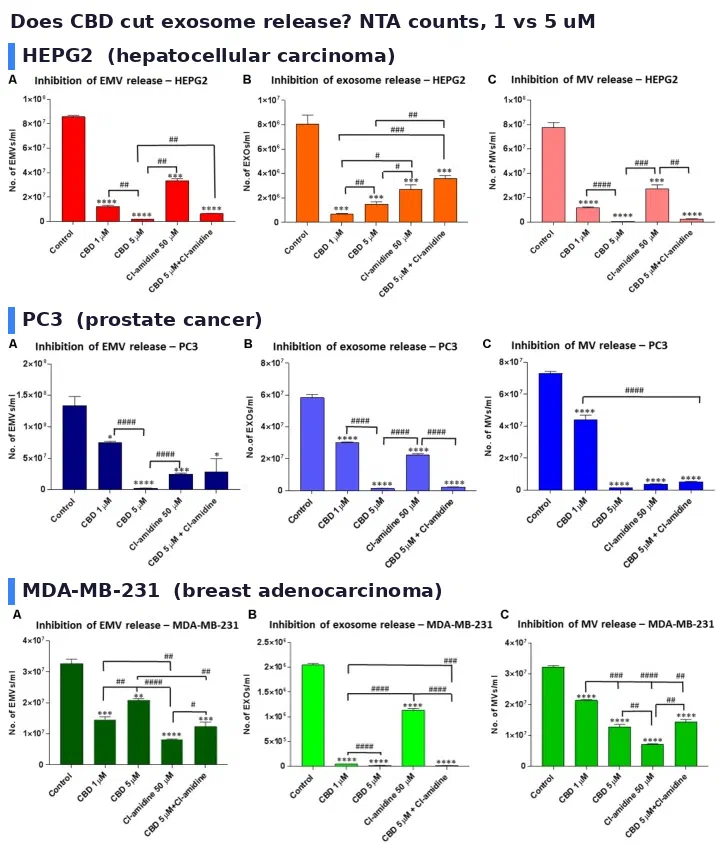
The release finding as published, all three cell lines. Top: HEPG2. Middle: PC3. Bottom: MDA-MB-231. Particle counts by nanoparticle tracking, CBD at 1 and 5 micromolar, one hour. Reproduced from Kosgodage et al. 2018, Front Pharmacol 9:889, PMC6099119, CC-BY.
DeMarino and colleagues, 2022, move the finding to infected cells, and this is the paper that matters most for this site's frame. In HIV-1 infected U1 monocytes and primary macrophages, CBD reduced the number of extracellular vesicles released, and the mechanism tracks two dials at once: reduced viral transcription and autophagy activation AN · MODERATE. The same group's context is why vesicles matter in infection: HIV RNAs such as TAR travel inside EVs and inflame recipient cells. Fewer vesicles, less cargo delivered. The observational hook in the same paper, cannabis use in people living with HIV associated with lower viral load, lower CD16+ monocytes and higher CD4 counts, is exactly that, observational, and it stays in its lane here.
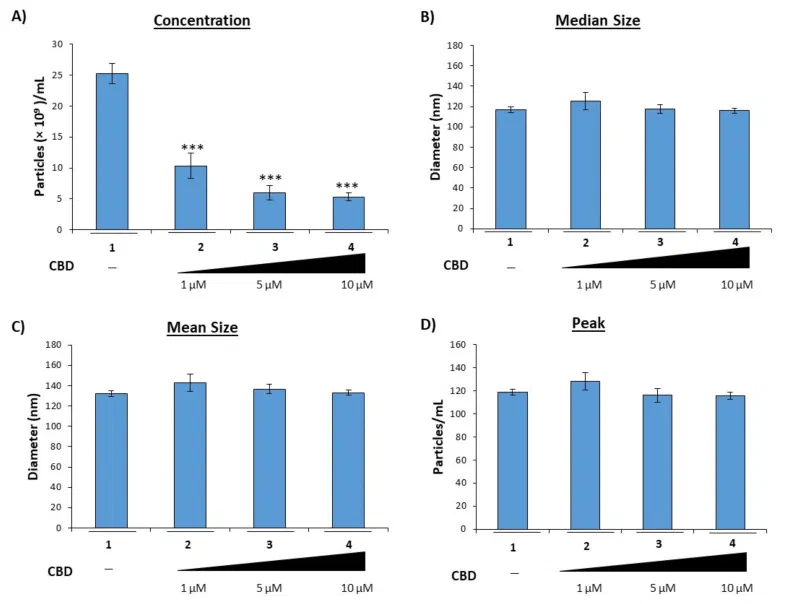
The infected-cell version of the same experiment. HIV-1 infected U1 monocytes, CBD titrated at 1, 5 and 10 micromolar daily for five days, vesicle counts down. Reproduced from DeMarino et al. 2022, Cells 11(4):723, PMC8869966, CC-BY.
Under both sits the autophagy arm, and this is where the mechanism gets mapped residue by residue. Vrechi and colleagues, 2021, showed in human neuroblastoma SH-SY5Y and murine astrocyte lines that CBD-induced autophagy runs through CB1, CB2 and TRPV1, since receptor antagonists block it, through ERK1/2 activation and AKT suppression, and depends on the autophagy initiator ULK1 while being independent of mTORC1. That last combination is a non-canonical pathway, which matters for anyone arriving from the site's mTOR clearance piece: CBD does not route through the mTOR lever that article documents, it runs a parallel one AN · HIGH.
Wang and colleagues, 2022, take the arm to a whole organism, with the honest caveat that the organism is a worm. CBD extended C. elegans lifespan, promoted autophagic flux in nerve-ring neurons, and the extension vanished under RNAi knockdown of the autophagy genes bec-1, vps-34 and sqst-1, and under sir-2.1, the worm SIRT1 homolog. The same paper shows autophagic flux induction in mammalian hippocampal and SH-SY5Y neurons AN · MODERATE. And the group behind Vrechi 2021 published the follow-up in 2025: in tau-overexpressing SH-SY5Y cells, CBD at 100 nanomolar and 10 micromolar lowered total tau and phosphorylated AT8 tau through autophagy, with the autophagy blocker chloroquine reversing the effect AN · MODERATE. An autophagy inducer with a mapped mechanism, in the same mechanistic family as the site's SIRT1 material, is worth a reader's attention on its own terms, even before the vesicle story.
The entry arm, adjacent and distinct#
Two cannabinoid papers usually get folded into this conversation that are doing something different, and the difference matters. Van Breemen and colleagues, 2022, used affinity selection mass spectrometry to find hemp cannabinoids that bind spike, and landed on the acids: cannabigerolic acid, CBGA, and cannabidiolic acid, CBDA. Both blocked infection of epithelial cells by pseudovirus and by live SARS-CoV-2, equally against alpha and beta variants, with micromolar affinities AN · HIGH for the in vitro result. This is an entry-blockade arm, not a release arm. It says something about the virus getting in. It says nothing about vesicles getting out.
The second paper is the honesty test for the whole section. Anil and colleagues, 2021, tested a cannabis extract fraction high in CBD against COVID-relevant inflammation, and got a split result by cell type. In alveolar epithelial A549 cells, the fraction dose-dependently reduced IL-6, IL-8, the chemokines CCL2 and CCL7, and ACE2 expression. In macrophages, the same fraction increased IL-6 and IL-8 and phagocytosis, and a purified phytocannabinoid formulation flipped the macrophage result the other way AN · MODERATE. Same extract, opposite direction, different cell. The authors themselves attach the caution about proposing cannabis as a COVID treatment, and the finding deserves to travel with the citation. Any claim that cannabinoids are simply anti-inflammatory in this disease context dies on this paper.
The spike side of the ledger, and the untested junction#
For the vesicle story to connect to this site's cluster, spike has to be on the shipping side of the transaction. Two papers put it there. Mishra and Banerjea, 2021, showed that cells transfected with spike release exosomes with reprogrammed cargo, loaded with miR-148a and miR-590, which recipient human microglia internalize; the microRNAs suppress USP33 and downstream IRF9 and flip the microglial cytokine profile toward TNF-alpha and NF-kB activation AN · MODERATE, a transfection model, stated as such. Frank and colleagues, 2022, showed the S1 subunit alone acts as a PAMP-like signal: injected intracisternally in rats it drove sickness behavior, and in vitro it activated microglia and TLR2 and TLR4 signaling directly AN · HIGH for the receptor work.
So both halves of the transaction exist in the literature, each measured in its own system. Spike-bearing exosomes circulate in vaccinated humans by day 14 (Bansal, in the relay article's register). Stress and infected cells ship pro-inflammatory cargo in vesicles, and CBD turns vesicle release down in culture. The junction is the missing measurement, and it deserves its own sentence: no published study has tested whether cannabinoids modulate the release, cargo, or count of vaccine-derived or LNP-derived extracellular vesicles, in a cell model, in an animal, or in a person. The lever exists in one literature and the transport layer exists in another, and the experiment that puts them in the same room has not been run.
Here is the whole picture as one diagram, with the untested junction drawn as what it is, a dashed line:
USP33 and IRF9 down,
TNF-alpha up"] A --> E["Spike-bearing exosomes
in plasma by day 14"] F["CBD at 1 to 5 micromolar"] --> G["Exosome release down
in three cancer lines"] F --> H["EV release down from
HIV-1 infected myeloid cells"] F --> I["Autophagy up via ERK1/2,
ULK1, SIRT1-dependent"] I --> J["Tau cleared in
tau-overexpressing neurons"] K["CBGA and CBDA"] --> L["Spike binding blocked,
entry blocked in vitro"] E -. "cannabinoid effect untested here" .-> F classDef ship fill:#e3ecf7,stroke:#5b7ea6,color:#1a1a2e classDef lever fill:#e7f0e3,stroke:#6a8f5a,color:#1a1a2e classDef entry fill:#f3ece0,stroke:#a08a5c,color:#1a1a2e class A,B,C,D,E ship class F,G,H,I,J lever class K,L entry
Blue: the shipping side, what stressed and transfected cells release. Green: the release and autophagy levers. Tan: the separate entry arm. A dashed line is not a pathway. It is the shape of a gap.
What would settle it#
The first experiment is unglamorous: take the DeMarino design and swap the infection for LNP transfection. Cells exposed to LNP-mRNA, vesicle counts by nanoparticle tracking, with and without CBD, and then the same question asked of the vesicle cargo. The second is the observational bridge: if any cohort of CBD users has serial vesicle measurements around vaccination, the hypothesis gets a real test without anyone dosing anybody. The third is the one that would end the argument either way, vesicle fractions from vaccinated plasma with and without cannabinoid exposure, assayed for spike and for vaccine ionizable lipid.
What would refute the interest: CBD failing to reduce vesicle release in primary human cells at concentrations achievable orally, or release inhibition that fails to change cargo transfer to recipient cells. Either result would collapse the junction without needing the human trial first.
What a real product is, from the genomics side#
Everything above uses micromolar purified compound on cells. What people actually buy is where McKernan's cannabis material earns its place in this article, because the gap between the two is where the harm lives.
Most CBD on the market comes from Type III cannabis plants carrying an active CBDAS gene, which sets the flower's chemistry at roughly a 20:1 ratio of CBDA to THCA. As McKernan puts it in the Huberman follow-up post, most gummies are something like 20 milligrams of CBD with 1 milligram of THC riding along, and that accompanying THC is not nothing when the products are evaluated. Full-spectrum oils vary further, and parents in the epilepsy literature have reported longer seizure-reduction duration with them, which is consistent with entourage effects and impossible to bottle as a standard dose.
The interaction ceiling is the grapefruit rule: any drug carrying a grapefruit warning should be assumed to clear more slowly alongside high-dose CBD, because CBD inhibits the same CYP enzymes, CYP3A4 and CYP2C19 among them. McKernan's post names the concrete cases: clobazam, where the slowed-metabolism signal showed up in epilepsy trials, and warfarin and apixaban, both common in exactly the older populations using CBD for sleep and pain. The site's spikeopathy clearance piece already carries the pharmacokinetics, around 6 percent oral bioavailability, multiplied by high-fat meals or piperine, and the CYP3A4 polypharmacy warning. This article adds the practitioner heuristic, not a dose.
And then the contamination findings, each from his own lab's measurements. Commercial flowers remediated by irradiation or ozone after a dirty grow can pass microbial tests while leaving endotoxin behind, undetected by the tests that exist. The largest cannabis microbiome program to date, Zamir Punja's, traced Aspergillus, Fusarium and Penicillium contamination in cocofibre growing medium through to flowering plants, seeds included, which undercuts the assumption that flower contamination is only an air-spread problem. His FOIA work with Yasha Kahn documented lab shopping, growers firing honest potency labs and hiring accommodating ones, replicated independently from Massachusetts regulator data. The hemp loophole rounds it out: 0.3 percent delta-9 THC compliance permits 24 percent THCA flower that converts to THC when burned, sold online with limited age checks. The site's supplement-writing rule, certificate of analysis or it does not exist, applies to this category with more force than almost any other.
One case deserves its own paragraph because of what it says about surveillance rather than chemistry. In 2025 a medical cannabis patient in Pennsylvania died of Cryptococcus neoformans, and the fungal genome from the dispensary product matched the patient's isolate at a handful of SNPs against tens of thousands separating it from wild strains. McKernan's post draws the surveillance conclusion this site has made about vaccine harm reporting, from the other direction: "There is no VAERs for cannabis." Federal registries do not track cannabis fatalities, patients historically hid use to avoid CPS and organ-list consequences, so the familiar claim that no one has ever died from cannabis rests partly on no one keeping the ledger. The same under-tracking critique this site applies to one harm system applies to the other. Consistency is the whole job.
What this article is not claiming#
- No claim that CBD clears spike, reduces vaccine-derived vesicles, or changes post-vaccine outcomes. The junction is untested and the takeaways say so.
- No dosing claim. The culture experiments use micromolar purified compound; oral bioavailability is around 6 percent and product content is unreliable, which is a bigger barrier than any mechanism.
- Infection evidence and vaccination evidence are kept separate throughout. DeMarino is HIV. Bansal is vaccination. Anil is neither, an inflammatory mimic, and it carries a direction reversal between cell types.
- The worm and cell-line work is not human evidence. Kosgodage's three lines are immortal cancer lines, Wang's organism is a nematode, and the register marks every line accordingly.
- The practitioner section is about product reality and interactions, not a recommendation. Anyone on warfarin, apixaban, clobazam or any grapefruit-flagged drug has a prescriber question to ask first.
What would confirm it#
- A replication of release inhibition in primary human cells, including monocyte-derived macrophages, at concentrations measured in plasma after oral dosing.
- The LNP swap experiment: vesicle counts and cargo from LNP-exposed cells with and without cannabinoid treatment.
- Any cohort evidence tying cannabinoid use to measurable differences in circulating vesicle counts or vesicle cargo after vaccination.
What would refute it#
- CBD failing to inhibit vesicle release in primary cells at achievable concentrations, which would confine the finding to immortal lines.
- Release inhibition that leaves cargo transfer to recipient cells unchanged, which would make the mechanism irrelevant to the relay layer even if the count drops.
- A well-powered observational cohort showing no difference in post-vaccination vesicle profiles between cannabinoid users and non-users.
Citation register (calibrated)#
Release and autophagy arm
- Kosgodage US, Mould R, Henley AB, et al. Cannabidiol (CBD) Is a Novel Inhibitor for Exosome and Microvesicle (EMV) Release in Cancer. Front Pharmacol. 2018;9:889. PMID 30150937. DOI 10.3389/fphar.2018.00889. PMC6099119. [AN, three cancer cell lines]
- DeMarino C, Cowen M, Khatkar P, et al. Cannabinoids Reduce Extracellular Vesicle Release from HIV-1 Infected Myeloid Cells and Inhibit Viral Transcription. Cells. 2022;11(4):723. PMID 35203372. DOI 10.3390/cells11040723. PMC8869966. [AN, infected myeloid cells; observational associations noted in text]
- Vrechi TAM, Leão AHFF, Morais IBM, et al. Cannabidiol induces autophagy via ERK1/2 activation in neural cells. Sci Rep. 2021;11:5434. PMID 33686185. DOI 10.1038/s41598-021-84879-2. PMC7940388. [AN, SH-SY5Y and astrocyte lines]
- Wang Z, Zheng P, Chen X, et al. Cannabidiol induces autophagy and improves neuronal health associated with SIRT1 mediated longevity. Geroscience. 2022;44(3):1505-1524. PMID 35445360. DOI 10.1007/s11357-022-00559-7. PMC9213613. [AN, C. elegans plus mammalian neurons]
- Vrechi TAM, Guarache GC, Oliveira RB, et al. Cannabidiol-Induced Autophagy Ameliorates Tau Protein Clearance. Neurotox Res. 2025;43(1):8. PMID 39900844. DOI 10.1007/s12640-025-00729-3. PMC11790692. [AN, tau-overexpressing SH-SY5Y]
- Pereira GJDS, Leão AHFF, Erustes AG, et al. Pharmacological Modulators of Autophagy as a Potential Strategy for the Treatment of COVID-19. Int J Mol Sci. 2021;22(8):4067. PMID 33920748. DOI 10.3390/ijms22084067. PMC8071111. [review, positions CBD in the autophagy-modulator set]
Entry arm
- van Breemen RB, Muchiri RN, Bates TA, et al. Cannabinoids Block Cellular Entry of SARS-CoV-2 and the Emerging Variants. J Nat Prod. 2022;85(1):176-184. PMID 35007072. DOI 10.1021/acs.jnatprod.1c00946. PMC8768006. [AN, pseudovirus plus live virus]
- Anil SM, Shalev N, Vinayaka AC, et al. Cannabis compounds exhibit anti-inflammatory activity in vitro in COVID-19-related inflammation in lung epithelial cells and pro-inflammatory activity in macrophages. Sci Rep. 2021;11:1462. PMID 33446817. DOI 10.1038/s41598-021-81049-2. PMC7809280. [AN, direction reversal by cell type]
Spike shipping side
- Mishra R, Banerjea AC. SARS-CoV-2 Spike Targets USP33-IRF9 Axis via Exosomal miR-148a to Activate Human Microglia. Front Immunol. 2021;12:656700. PMID 33936086. DOI 10.3389/fimmu.2021.656700. PMC8079643. [AN, transfection model]
- Frank MG, Nguyen KH, Ball JB, et al. SARS-CoV-2 spike S1 subunit induces neuroinflammatory, microglial and behavioral sickness responses: Evidence of PAMP-like properties. Brain Behav Immun. 2022;100:267-277. PMID 34915155. DOI 10.1016/j.bbi.2021.12.007. PMC8667429. [AN, rat ICM plus receptor work]
- Bansal S, et al. Cutting Edge: Circulating exosomes with COVID spike protein are induced by BNT162b2 mRNA vaccination. J Immunol. 2021;207(10):2405-2410. PMID 34654691. DOI 10.4049/jimmunol.2100637. [PP, small cohort; full treatment in the relay article]
McKernan's posts, practitioner material, secondary not primary
- Huberman speaks with Matt Hill on Cannabinoids, Nepetalactone Newsletter, 2024: link. Source for the CBDA:THCA ratio, the grapefruit rule, clobazam and anticoagulant cases, biphasic dosing.
- High levels of Endotoxin on commercial cannabis flowers, 2023: link. Source for remediation leaving endotoxin.
- Big Cannabis behaving like Big Tobacco, 2024: link. Source for lab shopping, the FOIA replication, his conflict statement, the 2011 genome.
- Cocofibre can be the source of fungal contamination in Cannabis, 2025: link. Source for the Punja microbiome program and the cocofibre transmission route.
- Cryptococcus neoformans brings a fatality to the medical Cannabis industry, 2025: link. Source for the Pennsylvania case and the surveillance asymmetry.
Open to corrections#
Every number here traces to the register above, and the one claim people will want to make, that CBD cleans up the vesicle layer, is exactly the claim the evidence does not support yet. The culture findings are real and replicated in direction across systems. The junction is unmeasured. If something here is wrong, tell me and it gets corrected with the same prominence as the original claim. General policy on the Methodology page.
]]>