Table of Contents
Key Takeaways
- E. coli K-12 host-genome DNA is present in four of five Comirnaty runs put through full host-genome remapping, at roughly 96 percent genome breadth and 56-95x mean depth, with junction sequences assigned to the DH10B production host. Plasmid-targeted qPCR assays do not detect it.
- Regional coverage is not uniform. All nine Comirnaty lots sit at spike depth ratios of 0.43-0.64. The six Spikevax lots split into spike-enriched (139x, 78x, 59x, 20x) and near-balanced (1.0, 0.8) regimes.
- Fragment lengths track the coverage pattern. Spike-region fragments are 6-26 nucleotides longer than KanR fragments in the 12 backbone-continuous lots, and 17-21 nucleotides shorter in the three lots losing coverage at the cassette boundary (exact binomial p = 0.035, exploratory).
- The SV40 promoter-enhancer-origin region is present at sequencing depths in the millions in all nine Comirnaty lots. In Spikevax the same region varies by lot, at 549x, 56x, 42x and 35x versus each run's minimum, with one lot at 2.1x, below the preregistered threefold threshold.
- The TGA has published finished-product residual DNA measurements for 28 batches, all below 10 ng/dose (Comirnaty 0.05-5.91 ng/dose, Spikevax 0.04-0.89). EMA records document compliance assessments for 236 Comirnaty batches whose underlying measurements are not public. Eight published qPCR assays with 63-233 bp targets are not directly comparable.
- What this does not claim: no mass-per-dose conversion, no genomic integration, no clinical harm, no promoter activity. The line between what the data show and what they leave open is the point of the paper.
Source document. Emmett T, "Residual DNA in Comirnaty and Spikevax: regulatory disclosure, measurement comparability and independent reanalysis", preprint, version 2, published 30 October 2026: Zenodo record 23815537. The sequencing data are the public deposit PRJNA1303864 from Achs et al., npj Vaccines 2025, DOI 10.1038/s41541-025-01304-9. The vial sequencing and the plasmid references OR134577.1 and OR134578.1 are Kevin McKernan's, and the method critique the work builds on is McKernan, Speicher and Rose, Oncotarget 2026. Every number below is in the preprint or in the deposit reanalysis already published on this site.
TL;DR (1-minute read)
The independent reanalysis of residual DNA in Comirnaty and Spikevax is published as a versioned preprint. Two evidence tracks, one record. The sequence track: E. coli K-12 host-genome DNA in four of five Comirnaty runs put through full host-genome remapping, invisible to plasmid-targeted qPCR assays; spike depth ratios of 0.43-0.64 in all nine Comirnaty lots against Spikevax lots that split into two regimes; a fragment-length separation of 12 lots versus 3 at exact binomial p = 0.035, labelled exploratory because two earlier hypotheses were rejected first; and an SV40 promoter-enhancer-origin region at depths in the millions in every Comirnaty lot. The regulatory track: 554 documents indexed, the TGA's 28 published finished-product measurements all below the 10 ng/dose benchmark, EMA compliance assessments for 236 Comirnaty batches whose underlying numbers are not public, and a Health Canada issue analysis, obtained under an Information Commissioner order, recording that the SV40 promoter was in the plasmids for all lots released in Canada and had not previously been disclosed by Pfizer.
What the preprint does not claim is stated with the same precision: no DNA mass per dose, no genomic integration, no clinical harm, no promoter activity. Every sequence finding is traceable to hashed computational artefacts in the supplement.
Why this article exists#
The residual DNA question has been covered on this site in two layers. The BNT162b2 plasmid map article documented what is in the Pfizer plasmid and what the EMA conceded about it in writing. The Achs deposit article took the sequencing data behind the December 2025 npj Vaccines paper and re-mapped it read by read.
The preprint is the capstone of that arc, and it adds two things the site did not yet carry.
First, the sequence analysis is finished and formalised. All fifteen runs were independently remapped from raw data, with eleven subjected to whole-plasmid remapping and five to full host-genome remapping. The SV40-region analysis carried a preregistered threefold threshold; the fragment-length distinction was identified only after two earlier hypotheses had been rejected, and it carries that exploratory label. The Moderna reference OR134578.1 is annotated in full for the first time on this site.
Second, and new: the regulatory half. Five hundred and fifty-four documents, 542 from the EMA, seven from the TGA and five from Health Canada, indexed and read against the sequence findings. That record has never been assembled in one place on this site, and parts of it, the TGA's published finished-product numbers and the Health Canada disclosure finding among them, have not been presented here at all.
What was analysed#
PRJNA1303864 - Achs deposit"] --> B["All 15 remapped
coverage depth + fragment length"] A --> C["11 runs
whole-plasmid remap"] A --> D["5 runs
full host-genome remap"] D --> F["E. coli K-12 DNA
4 of 5 Comirnaty runs"] C --> E1["Comirnaty spike ratios
0.43-0.64, all 9 lots"] C --> E2["Spikevax two regimes
139x 78x 59x 20x vs 1.0 and 0.8"] C --> H["SV40 region
millions of reads, 9 Comirnaty lots"] B --> G["Fragment lengths
12 vs 3 lots, p = 0.035"] R["554 regulatory documents
542 EMA + 7 TGA + 5 Health Canada"] --> T["TGA 28 batches published
all below 10 ng per dose"] R --> U["EMA 236 batches
measurements not public"] R --> V["Health Canada
SV40 present, not disclosed"] G --> W["8 qPCR assays 63-233 bp
not directly comparable"]
The sequencing data are the fifteen Illumina runs of the Achs et al. deposit, generated at the Science Park of Comenius University in Bratislava: nine Comirnaty lots spanning the original, JN.1 and KP.2 lineages, and six Spikevax lots spanning the original, bivalent BA.1 and bivalent BA.4/5. All fifteen were remapped from raw reads for coverage depth and fragment length. Eleven runs were subjected to whole-plasmid remapping. Five went through full host-genome remapping. The broader investigation considered 29 lots across the studies examined.
The references are the ones McKernan's vial sequencing produced: OR134577.1 for Comirnaty, OR134578.1 for Spikevax.
Four findings came out of the sequence work. Each is stated here with its exact numbers and its exact limits.
Finding 1: the host genome is there, and the release assay cannot see it#
E. coli K-12 genomic DNA was detected in four of the five Comirnaty runs subjected to full host-genome remapping. Approximately 96 percent of the K-12 reference genome was covered, at mean depths of 56-95x. The junction sequences identified in those reads were assigned to the DH10B production host.
The site's deposit article documented the same signal at read level: 1.4-2.4 percent of all reads in the four high lots, flat coverage across the entire 4.64 Mb genome in 100 kb bins, a 3,100x spread between brands that a shared-reagent contaminant cannot produce. The preprint adds the strain assignment: the junction sequences point to DH10B, the documented production host, not to a generic laboratory strain.
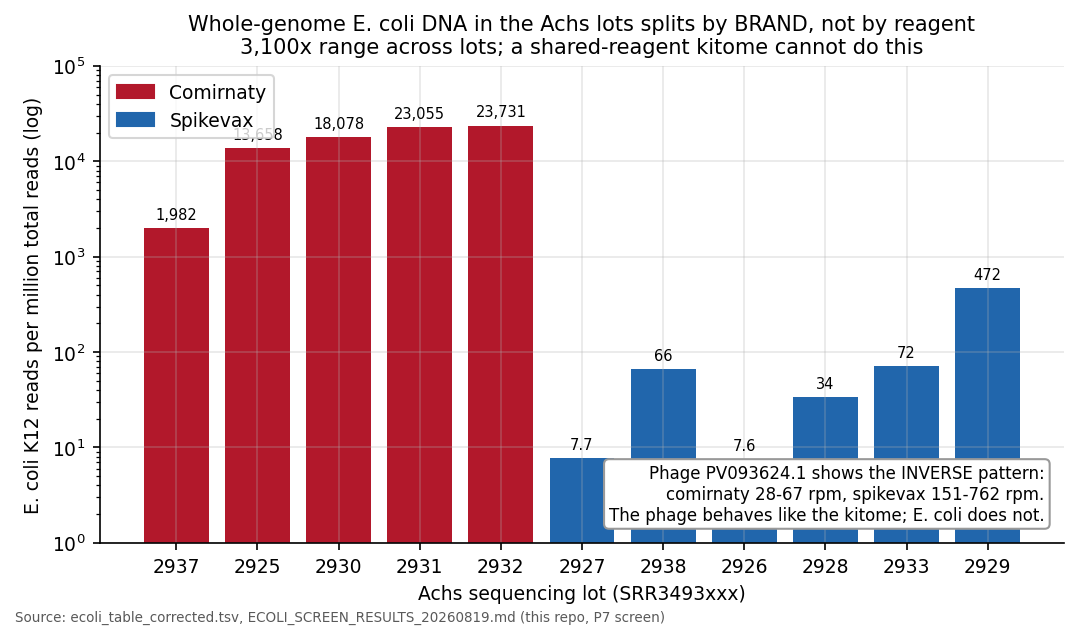
The consequence is arithmetic, not interpretation. Plasmid-specific qPCR assays targeting selected vector sequences do not detect this material. An assay that amplifies vector windows is structurally blind to the host genome. Measurements built on such assays say nothing about host-genome DNA, in either direction.
Finding 2: regional coverage is not uniform, in either brand#
Substantial differences in regional plasmid coverage remained evident across all lots.
All nine Comirnaty lots showed spike depth ratios between 0.43 and 0.64. Not one Comirnaty lot in the deposit is balanced: the spike region of the plasmid is systematically under-represented relative to the backbone.
The six Spikevax lots separated into two regimes. Four lots were markedly spike-enriched, at 139x, 78x, 59x and 20x. Two were approximately balanced, at 1.0 and 0.8. Two regimes, same product, same deposit.
One measurement caveat belongs in the same breath as these numbers: reference-sequence mismatches affect coverage estimates. One run carried a reported 1.3 percent identity-related underestimation. Mapping against a reference that is not the lot's exact construct systematically undercounts, and the magnitude is knowable, which is why it is reported.
This is the sequencing twin of the qPCR problem the Oncotarget critique documented in Achs et al.: where you place your measurement window on a non-uniform plasmid changes what you measure. In qPCR the window is a primer pair. In sequencing it is a reference. The correction is the same in both cases: measure the whole molecule, or say clearly that you did not.
Finding 3: fragment lengths track the coverage pattern, at p = 0.035, exploratory#
In the twelve lots with complete backbone coverage, fragments mapping to the spike region were 6-26 nucleotides longer than fragments mapping to KanR. In the three lots showing coverage loss at the cassette boundary, spike-region fragments were instead 17-21 nucleotides shorter. The 12-versus-3 separation has an exact binomial p value of 0.035.
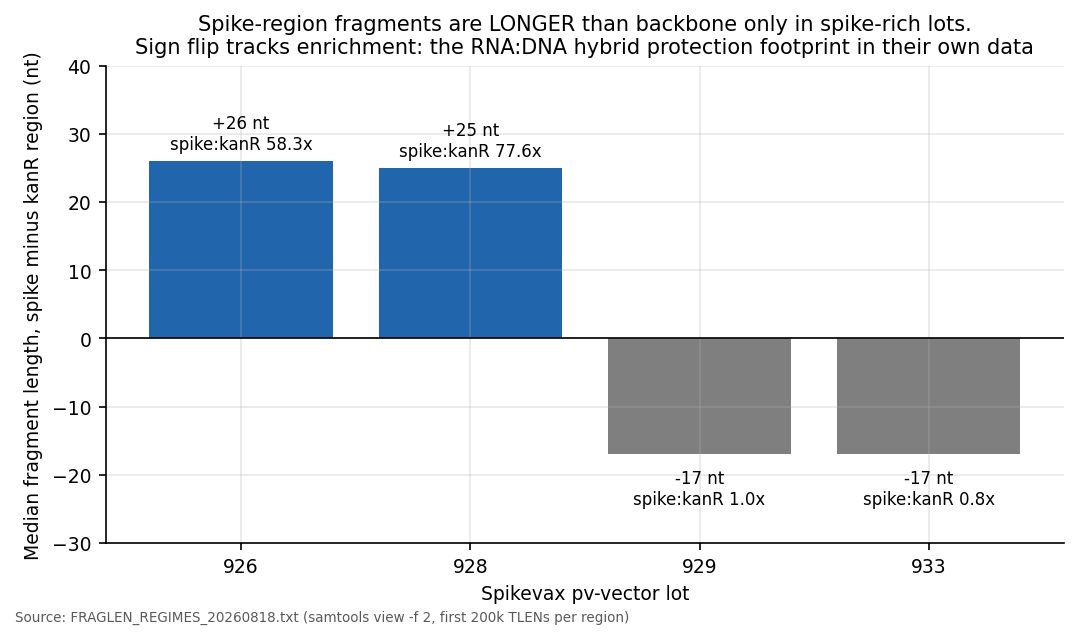
The preprint calls this result exploratory, and the reason matters more than the p value: the distinction was identified after two earlier hypotheses had been rejected. The finding that survived carries the epistemic discount of having been chosen after two others failed. It is reported with that discount attached, not laundered into a confirmatory finding.
The mechanistic reading, if the pattern holds, is the RNA hybrid protection mechanism that McKernan, Rixey and Rose proposed and that the preprint set out to examine: RNA:DNA hybrids formed over spike-coding sequence during manufacturing protect that DNA from DNase digestion, leaving protected regions longer than unprotected backbone. The preprint examines the mechanism. It does not, and does not claim to, settle it.
Finding 4: the SV40 region, at depth, in every Comirnaty lot#
The SV40 promoter-enhancer-origin region was represented at sequencing depths in the millions in all nine Comirnaty lots. Not intermittently. All nine.
Spikevax showed substantial lot-to-lot variation in the same region, with regional coverage reaching 549x, 56x, 42x and 35x the minimum coverage within the respective runs. One lot did not meet the preregistered threefold threshold, reaching only 2.1x. The threshold was preregistered, and the lot that failed it is reported as failing it.
Long-read observations from Pfizer vial material, McKernan's ONT work, supported the presence of circular plasmid structures containing the SV40-derived region. A total of 1,082 reads spanned the circular junction, including one read covering 7,807 of the 7,810 reference positions. A single read spanning essentially the entire plasmid is close to the strongest single-molecule evidence circular geometry can produce.
The limit is stated with the finding: these observations do not establish that every detected plasmid molecule was complete. Some were. How many, the Illumina data cannot say.
What the region is, and what the EMA conceded about it, is documented in the plasmid map article: the SV40 enhancer, promoter and origin at OR134577.1 positions 1096-1453, the designed mammalian promoter for the downstream KanR cassette, on a backbone whose integration property has been documented since 1981.
The Moderna reference, annotated: no SV40, and a cloning intermediate#
The preprint independently annotates OR134578.1, the Moderna plasmid reference, 6,777 base pairs, using the same approach as the Pfizer annotation.
No SV40-derived sequences were identified. Zero, matching what the plasmid map article reported at the footprint level: the two manufacturers made different backbone choices, and only one of them carries SV40.
What OR134578.1 does carry is a 719-nucleotide segment associated with a cloning intermediate. Inside it sits an internal 584-bp duplication of the spike S2 coding region, followed by a synthetic multiple cloning site containing KpnI, NheI and XhoI restriction sites. The spike coding sequence begins immediately downstream of the XhoI site.
That architecture is a record of how the construct was assembled: a duplicated segment and a restriction-site cassette marking an assembly junction. Four publicly available Spikevax libraries provided coverage across the complete reference, so the annotation is not an artefact of one library.
The regulatory record: 554 documents#
The regulatory investigation indexed 554 documents: 542 from the EMA, seven from the TGA and five from Health Canada.
| Regulator | Documents indexed | What the public record holds |
|---|---|---|
| TGA (Australia) | 7 | Finished-product residual DNA measurements for 28 batches: 15 Comirnaty (0.05-5.91 ng/dose) and 13 Spikevax (0.04-0.89 ng/dose), all below 10 ng/dose |
| EMA (EU) | 542 | Compliance assessments covering 236 Comirnaty batches; the underlying batch-level measurements are not publicly available. No publicly accessible Comirnaty drug-product specification module, while the corresponding Spikevax modules were published |
| Health Canada | 5 | An issue analysis, obtained following an Information Commissioner order, reporting that the SV40 promoter sequence was present in plasmids used for all lots released in Canada and had not previously been disclosed by Pfizer |
Three things in that record deserve plain statement.
The TGA published numbers. Twenty-eight batches of finished-product measurements, all below the 10 ng/dose benchmark. This is said plainly because it is true: no measurement in the TGA set exceeds the benchmark. The Comirnaty range runs to 5.91 ng/dose against the 10 ng benchmark, and the Spikevax range tops out at 0.89. What the preprint does with those numbers is not dispute them but contextualise them: they were produced by specific assays, with specific target lengths and calibrators, and they are not directly comparable to other laboratories' numbers without method conversion. That is the comparability finding, below.
The EMA assessed 236 batches without publishing a number. EMA records document compliance assessments covering 236 Comirnaty batches. The underlying batch-level measurements are not publicly available. A compliance conclusion without a published measurement cannot be independently checked. That is not an allegation that the assessments were wrong. It is a statement about what verification is possible from outside, and it is the difference between the two regulators' records in this index: the TGA published its numbers, and the EMA published its conclusions.
The specification asymmetry. The reviewed materials contained no publicly accessible Comirnaty drug-product specification module. The corresponding Spikevax modules were published. The product with the larger published measurement gap is the product whose specification is not public.
What Health Canada's issue analysis says#
A Health Canada issue analysis, obtained following an Information Commissioner order, reported that the SV40 promoter sequence was present in plasmids used for all lots released in Canada and had not previously been disclosed by Pfizer.
Two components, both worth separating. Presence: the promoter was in the plasmids for every lot released in Canada, which is the Canadian regulator's own document agreeing with what the sequence record showed. Disclosure: it had not previously been disclosed, which is the same concession the EMA made in the BWP position paper released under ASK-289849, documented on the plasmid map article. Two regulators, two documents, one finding.
What the regulatory record does not contain#
Published nonclinical biodistribution studies reported distribution of the delivery formulation to the liver, spleen, bone marrow, lymph nodes, adrenal glands and gonadal tissue, together with reported blood-brain barrier passage corresponding to 2-4 percent of plasma levels.
Those studies measured the formulation. None of them specifically measured the biodistribution or persistence of residual DNA.
The preprint's own caveat on this point is exact, and it is reproduced here in its terms: the absence of such publicly available measurements does not establish that these questions were never assessed, or that clinical harm occurred. It limits independent verification. That is the whole of the claim. What the biodistribution studies did measure, and how thin that package was, is covered in the LNP biodistribution article.
Why the published numbers do not compare: eight assays, 63-233 bp#
Comparisons between published residual DNA measurements are complicated by methodological differences. Eight qPCR assays with target lengths ranging from 63 to 233 bp were identified across the studies examined.
Six factors, each capable on its own of moving a reported value: target selection, calibrator design, extraction efficiency, fragment retention, assay interference, and manufacturing sample stage. The last one is the quietest and the largest: a measurement on drug substance, before lipid encapsulation, and a measurement on finished drug product, after it, are measurements of different material. The TGA's published set is finished product. The compliance benchmark the EMA assesses against is drug substance. These are not numbers that can be placed on one axis without saying so.
This is the same structural point the Oncotarget critique made about a single paper, now measured across the whole published landscape: when assays differ in target, calibrator and stage, cross-laboratory disagreement is not a scandal. It is the expected output of the methods. The scandal would be pretending the numbers are interchangeable.
What this analysis does not claim#
The preprint is limited to sequence characteristics, analytical methodology and available regulatory records. The boundary is drawn explicitly, and this article draws it in the same place.
- Sequence abundance was not converted into DNA mass per dose. The conversion requires an anchor, and every available anchor is a contested method. Converting anyway produces false precision.
- The findings do not establish genomic integration. No confirmed cases of genomic integration in vaccinated individuals are identified by this analysis.
- The findings do not establish clinical harm. Nothing in the sequence data or the regulatory index is a harm claim.
- No promoter activity is claimed or demonstrated. Cryptic mammalian promoter activity has been described for members of the ColE1 origin family. The examined plasmid lacks a TATA-containing consensus within its origin region, and the preprint makes no promoter-activity claim, experimental or otherwise.
- Not every plasmid molecule was complete. The long-read circular evidence establishes that some circular molecules existed. It does not establish that all detected DNA was intact plasmid.
Counter-Evidence & Limitations
- Every published finished-product measurement is below the benchmark. The TGA's 28 batches, the only finished-product measurements in the reviewed record, all sit under 10 ng/dose, Comirnaty topping out at 5.91. If the claim were 'published measurements exceed limits', the record refutes it. The preprint's claim is about comparability and verifiability, not excess.
- One Spikevax lot failed the SV40-region threshold. The preregistered threefold test was not met by one lot at 2.1x. The enrichment finding is reported as lot-variable, not universal, in the brand without a designed SV40 element.
- Two earlier hypotheses were rejected before the fragment-length finding. The p = 0.035 result is exploratory by the preprint's own labelling. A reader treating it as confirmatory is reading past the paper's stated limit.
- The regulatory position is that levels are within limits. The EMA's compliance assessments cover 236 Comirnaty batches. The preprint disputes neither the assessments' existence nor their arithmetic; it documents that the public cannot check them.
- Reference mismatch cuts against the reanalysis too. The reported 1.3 percent identity-related underestimation in one run applies to coverage estimates, including the ones the findings rest on. The magnitude is small and reported; it is not zero.
- The E. coli signal is one assay family deep on these lots. The host-genome finding rests on short-read mapping against K-12 references, with junction evidence for DH10B. McKernan's long-read vial data points the same direction on different material, but no orthogonal wet-lab confirmation on the Achs lots has been published.
How to check any of this#
The preprint is versioned, and its traceability statement is quoted from the record: "All underlying public sequencing accessions are identified, and numerical findings from the sequence analyses are traceable to hashed computational artefacts in the supplementary information, allowing independent reproduction and verification."
In practice:
- The preprint, version 2, with the supplementary information: Zenodo record 23815537.
- The raw sequencing data: PRJNA1303864. Public. The read-level reanalysis on this site used the same open tools, minimap2 and samtools.
- The read-level analysis behind findings 1-3, with per-run identifiers and the lot table: the Achs deposit article.
- The plasmid references OR134577.1 and OR134578.1 are public GenBank deposits.
A number in this article that cannot be traced to the preprint, the deposit, or a cited regulatory document is an error, and it gets corrected with the same prominence as the original claim.
Where this leaves the question#
The sequence record now shows, reproducibly, from publicly deposited data: host-genome DNA in Comirnaty runs that plasmid-targeted qPCR cannot detect, non-uniform plasmid coverage in both brands, an SV40 promoter-enhancer-origin region at depth in every Comirnaty lot, circular plasmid structures in vial material, and a Moderna construct with no SV40 sequence but a documented cloning intermediate.
The regulatory record shows: one regulator that published finished-product numbers, all below benchmark; one regulator that assessed 236 batches without publishing the measurements; one regulator whose own issue analysis, obtained by order, records that the SV40 promoter was present and undisclosed; and no published biodistribution or persistence measurement for residual DNA anywhere in the reviewed record.
The open questions are now sharply drawn, and they are the same ones the critical research gaps article tracks: what the residual DNA population actually is in each lot, molecule by molecule; what a directly comparable measurement regime would produce; and what the biodistribution of that DNA, as distinct from the formulation, actually is. None of those is answerable from the public record today. All of them are now precisely defined, which is what a reanalysis was for.
Sources#
- Emmett T. Residual DNA in Comirnaty and Spikevax: regulatory disclosure, measurement comparability and independent reanalysis. Preprint, version 2, 30 October 2026. Zenodo: record 23815537
- Achs MJ, Sedlackova N, Predajna L, Budis H, et al. "Systematic analysis of COVID-19 mRNA vaccines using four orthogonal approaches demonstrates no excessive DNA impurities." npj Vaccines. 2025;10:259. DOI 10.1038/s41541-025-01304-9. Sequencing deposit: PRJNA1303864
- McKernan K, Speicher DJ, Rose J. "Systematic methodological flaws in DNA contamination assessment of mRNA vaccines: a critical analysis of Achs et al. (2025)." Oncotarget. 2026;17:368-376. Full text
- McKernan K et al. Sequencing of bivalent Moderna and Pfizer mRNA vaccines reveals nanogram to microgram quantities of residual DNA. GenBank deposits OR134577.1, OR134578.1 (June 2023). Cited in full in the deposit article's citation register
- McKernan K, Rixey J, Rose J. RNA:DNA hybrids in mRNA vaccine manufacturing. Zenodo 17832183
- Health Canada issue analysis on SV40 promoter presence, obtained following an Information Commissioner order. Documented in the preprint's regulatory index: Zenodo record 23815537
Site companions in this cluster:
- The Host Genome They Said Was Not There: the read-level deposit reanalysis behind findings 1-3
- The BNT162b2 Plasmid Map: the Pfizer plasmid annotation and the EMA's written concessions
- The Lipid Nanoparticle Is Not Packaging: what the biodistribution studies measured and did not
- Critical Research Gaps: the open-questions agenda this preprint feeds
Comments and corrections from readers with primary evidence are welcome. If I have something wrong, tell me and I will correct it, and the correction gets the same prominence as the original claim. Policy on the Methodology page.