Table of Contents
TL;DR (1-minute read)
- Twelve weeks after publication, the lead author told the private Slack channel that a claim the paper makes about BSL-2 passage work "isn't true", and, in the same day's messages, retired two of the paper's principal arguments against laboratory origin. As of 1 September 2026, the Nature Medicine article record displays no correction, addendum, retraction, or Expression of Concern.
- A co-author's description of what the paper was: "It is also important to remember it started as a report to the group that requested our investigation." (Rambaut, 13 January 2022.)
- The fifth author joined the paper at his own request. The disclosure questions that raises are set out in Section VI.
- The retraction request below is what I intend to file: retraction after investigation and, short of that, a documented investigation with an Editorial Expression of Concern while it runs, and correction of the confirmed defects. It has not been sent; the grounds are open to examination and co-signature until it is.
I. What this is, and where it stands#
I have prepared a formal retraction request to the Editor-in-Chief of Nature Medicine, copied to Nature's ethics committee and to the Committee on Publication Ethics (COPE), against:
Andersen, K.G., Rambaut, A., Lipkin, W.I., Holmes, E.C., & Garry, R.F. "The proximal origin of SARS-CoV-2." Nature Medicine 26, 450-452 (2020). DOI: 10.1038/s41591-020-0820-9.
The request is drafted under the COPE Retraction Guidelines v3
(August 2025) on six grounds. The full evidentiary version is
RETRACTION_CALL_PUBLIC_RELEASE_20260811.txt, finalised 11 August
2026, with a short cover version to accompany it to the journal. It
supersedes a 24 July 2026 draft, superseded because the Baric
transcribed interview (10 April 2026) became available in between. It
has not been sent. It goes out as drafted unless a ground is
corrected or withdrawn first, and the grounds are open to examination
and co-signature until then.
One framing point before the grounds. The paper is a highly cited Correspondence central to the SARS-CoV-2 origins debate. The documentary record released by the U.S. Senate in July 2026 shows its authors privately contradicting its central claims within weeks of publication. The retraction request is about that gap. It is not another entry in the argument about where the virus came from.
This request does not depend on Section IV. If every forensic analysis were discarded, Grounds 1, 2 and 6 remain reviewable on documents alone: the Senate-released Slack record, the House Oversight report, and the paper's own published text. The documentary half of Ground 3 is the same kind of material, a conclusion set against the paper's own body text; it needs no data beyond the paper's four corners. The pillars are independent support, not load-bearing structure.
II. The documentary grounds (1, 2 and 6)#
Four of the six grounds are documentary. They rest on primary documents whose authenticity the authors have not disputed, and they do not depend on any forensic analysis of the virus.
Ground 1: publication of an empirical claim the lead author later stated was not true#
The paper states that bat SARS-CoV-like coronavirus passage research "has been ongoing for many years in biosafety level 2 laboratories across the world." Twelve weeks after publication, on 11 June 2020, lead author Kristian Andersen told the authors' private Slack workspace:
"We describe this in the paper and say that this work is performed 'all of the world' [sic], but that isn't true - it has exclusively been going on at WIV. The EgoHealth [sic] grant was also specifically funded for this type of work (and described the kind of experiments to be done in tissue culture)."
When co-author Eddie Holmes pushed back that the Baric lab also did such work, Andersen corrected him:
No, that work is exclusively at WIV AFAIK. Baric's lab is doing (did) gain of function research where they created reverse genetics systems to study the viruses. All of this is done in BSL-3, so much (much!) less risk of exposure. The work in Shi's lab is different - here they are taking bat CoVs and culturing them under BSL-2 in cell lines from different animals - to e.g., understand which ones can infect human cells and what type of mutations that occur in T/C may make them permissive. They probably have more than 10 papers where they describe that type of work on all kinds of SARS-like CoVs.
First message SLACK_000285, the reply SLACK_000286, 11 June 2020. The paper's own wording is "across the world"; Andersen misquoted his own sentence in the same breath as telling the channel it "isn't true". The lead author knew the published sentence was false when he wrote this, said so privately, and no public correction has followed in the six years since. Whether the geographic scope was already known to be false when the sentence was typeset is not a finding this request makes; it is the question the June 2020 messages put to the journal's own investigation.
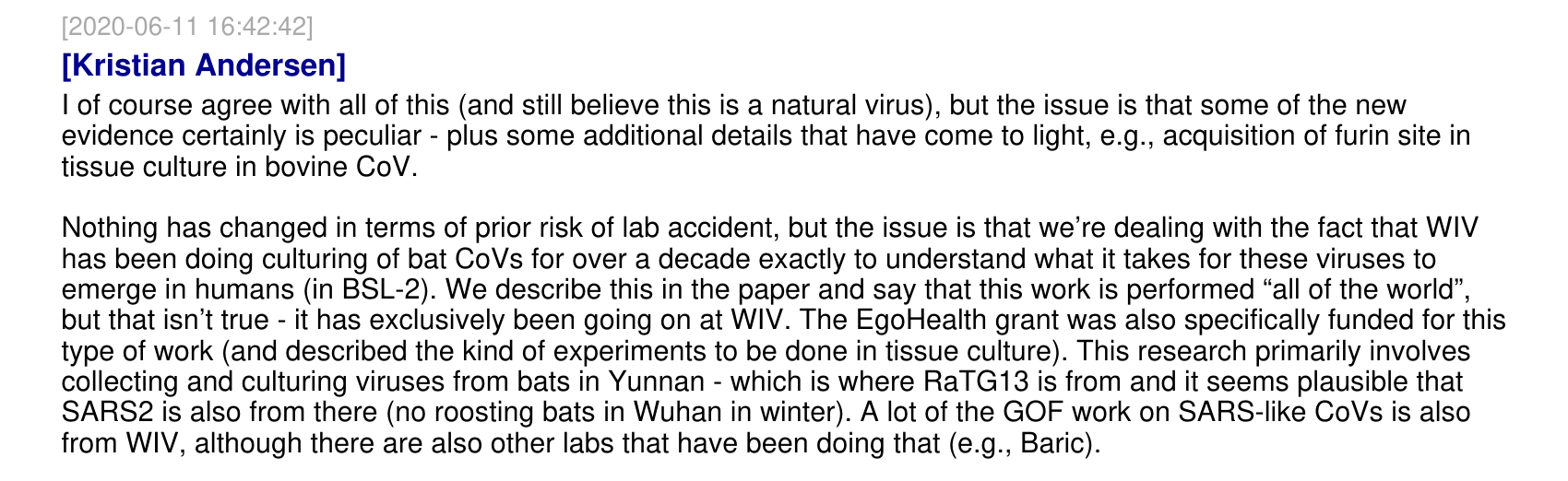
Exhibit 1. The message quoted above, as released. Senate HSGAC Slack release, Bates SLACK_000285 (release PDF p. 71). Unaltered crop.
The geographic-scope sentence is not the paper's only absence claim. On the cell-culture route to a laboratory origin, the paper stacks two more, in consecutive sentences:
"a hypothetical generation of SARS-CoV-2 by cell culture or animal passage would have required prior isolation of a progenitor virus with very high genetic similarity, which has not been described. Subsequent generation of a polybasic cleavage site would have then required repeated passage in cell culture or animals with ACE2 receptors similar to those of humans, but such work has also not previously been described."
The EcoHealth grant sentence sits inside the same 11 June 2020 message as the geographic-scope confession, one sentence after it: the grant "was also specifically funded for this type of work (and described the kind of experiments to be done in tissue culture)". Both published absence claims were in print, uncorrected, on the day the lead author privately described a grant specifically funded for the category of work at issue. The request does not claim the grant text falsifies the second sentence outright; the grant's experimental descriptions and the sentence's passage-with-human-like-ACE2 threshold are for the journal to set side by side. The request records the dates: published absence claim, same-day private account of funded work in the same category.
Ground 2: private abandonment of two of the principal arguments#
against a laboratory scenario
The paper argued against laboratory origin on two grounds: that "manipulation is hard" and would require substantial laboratory time, and that the O-linked-glycan / mucin-domain profile pointed away from cell culture. In the same 11 June 2020 thread, Andersen told the workspace:
"In our paper we argue against (a) manipulation and (b) tissue culture. Our main arguments were that manipulation is hard, but the German's came out and created a reverse genetics system of SARS2 in less than two weeks, so clearly it's not that hard. Our arguments against tissue culture mostly came down to the O-linked glycans and a 'mucin-like' domain. But by now it seems clear that these don't actually form a mucin-like domain, but rather those glycans modulate the function of the furin site."
Holmes closed the cell-culture mechanism in the same thread, quoting Andersen's own numbered item back at him:
To me, "Loss of furin site in tissue culture meaning it's active" strongly argues AGAINST culturing as being the cause of the cleavage site insertion.
(SLACK_000287, 11 June 2020.)
Later experimental literature weakened the passage argument: serial Vero passage degrades or deletes the furin cleavage site; it does not create one (Lau 2020; Johnson 2021; Funnell 2021; Pohl 2021; Laporte 2021). The only natural-origin mechanism the paper proposed for the FCS was abandoned by its own authors on 11 June 2020, twelve weeks in, and nothing was said publicly.
Andersen also moved his private probability estimate in the same exchange: "given no data, I find both scenarios to be equally probable". Later the same evening the authors swapped private odds on lab origin of 70/30, 80/20, and 90/10. None of this was disclosed.
Ground 6: commissioning and competing-interests disclosure#
Ground 6 has two legs: the coordination and disclosure record (6a), and the authors' own descriptions of the paper's genesis (6b).
Ground 6a: coordination with the conveners of the work#
The paper's Competing Interests statement discloses a single interest, Robert Garry's co-founder role at Zalgen Labs, and names no relationship with Fauci, Farrar or Vallance. On 6 June 2021, co-author Andrew Rambaut proposed in the same workspace:
"Perhaps we should try to get the point by point evidence document together ASAP and we can then give it to all the people involved that we know will appreciate having it (Fauci, Farrar, Vallance etc.)?"
Anthony Fauci was Director of NIAID, answerable to the US executive. Patrick Vallance was UK Government Chief Scientific Adviser. Jeremy Farrar directed the Wellcome Trust, a charitable research funder (he became WHO Chief Scientist in 2023). None of the three held any office at a journal. All three convened the work, received it, and the follow-up document was to go to them. The clean competing-interests relationship is Farrar's, as director of a charitable research funder; Fauci and Vallance are documented here as conveners and recipients, and no funding-control claim is made about them. The February 2020 commissioning record, that plan, and a Competing Interests statement that disclosed none of it raise a disclosure question under the journal's own policy. That question is for the journal to answer. It is not answered by calling the science correct. (SLACK_001140, 2021-06-06.)
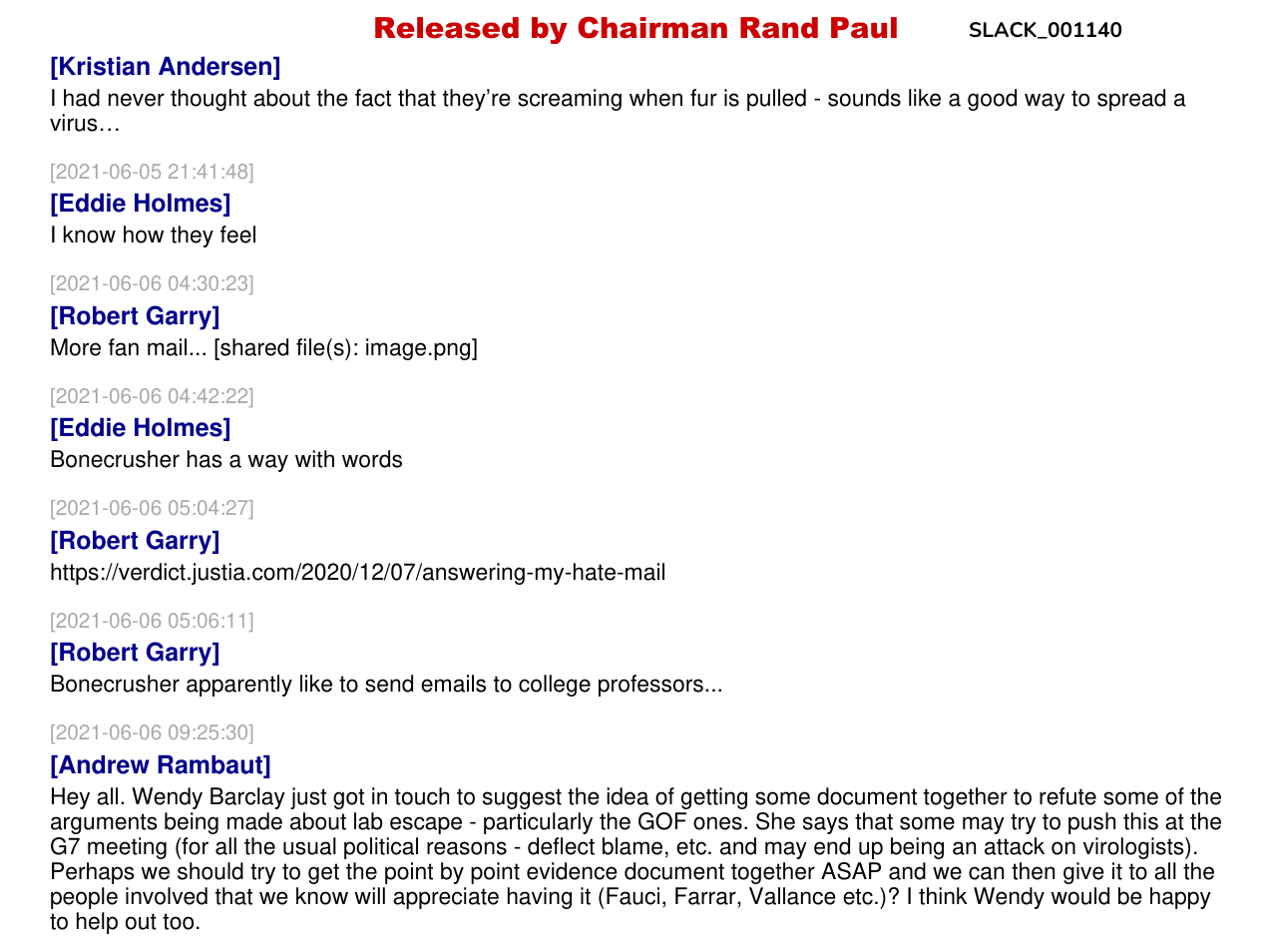
Exhibit 2. Rambaut's message quoted above, with the release stamp. Senate HSGAC Slack release, Bates SLACK_001140 (release PDF p. 926). Unaltered crop.
Ground 6b: commissioning in the authors' own words#
Two authors' own descriptions, a year apart, converge. Andersen, June 2021: Fauci and Farrar "launched a scientific investigation" (SLACK_001156). Rambaut, January 2022, on what the paper originally was: "It is also important to remember it started as a report to the group that requested our investigation." Garry's reply to Nicholas Wade, same thread: "All of the emails regarding the teleconference show the establishment of the hypotheses we later outlined in the Proximal Origins paper and then the assessment of these based on the available evidence." Andersen had advised giving Wade no details ("I strongly suggest not giving him any details"); Garry trimmed a longer draft accordingly and confirmed the send in the same thread ("sent that to wade btw"). (Rambaut 13 January 2022, SLACK_001266; Garry same thread, SLACK_001267, repeated verbatim at SLACK_001268.) Per its own authors, the paper began as a deliverable to the group that requested it. The drafting record, the email chains and the Google Doc history Andersen says "show the whole process well", sits with the House subcommittee, and the Senate Slack export begins 30 April 2020, after publication.
The record documents commissioning. It also documents Farrar's involvement in drafting: House Final Report-6 finds that Farrar led the drafting process and made at least one uncredited direct edit to the paper (pp. 28-29, micro-edit email at fn 102). Ghost-writing of the published text by Fauci, Collins, or Vallance is not documented, and I do not claim it. Farrar's role is a disclosure and authorship-credit question under the journal's competing-interests and contributor rules. That question is for the journal to answer. It is not answered by calling the science correct.
ESTABLISHED · HIGH for the documentary grounds as quoted; the Slack release is a 1,123-page Senate record (SLACK_000216 through SLACK_001337, released 21 July 2026) whose authenticity has not been disputed by the authors.
III. The remaining grounds, in brief#
Ground 3 is methodological failure. The paper's conclusion that the FCS shows no evidence of manipulation is a qualitative assertion. It performs no codon-usage analysis, no codon-pair-bias analysis, no ancestral-state reconstruction, no Type IIS fingerprint analysis, no RSCU deviation test. It does cite the SARS-CoV-1 FCS-insertion literature: Follis, York & Nunberg (Virology 2006) is reference 14, cited on the printed page 450 for the finding that inserting a furin site at the S1/S2 junction enhances cell-cell fusion without affecting viral entry. The eight-pillar package below is carried under this ground.
The conclusion also does not agree with the paper's own body text, an exhibit that needs no data beyond the paper's four corners. The body states:
"Polybasic cleavage sites have not been observed in related 'lineage B' betacoronaviruses, although other human betacoronaviruses, including HKU1 (lineage A), have those sites and predicted O-linked glycans."
The same body passage predicts that SARS-CoV-2-like viruses with partial or full polybasic cleavage sites "will be discovered in other species": absent from the relevant lineage, expected only as a future find. The paper's conclusion then states:
"since we observed all notable SARS-CoV-2 features, including the optimized RBD and polybasic cleavage site, in related coronaviruses in nature, we do not believe that any type of laboratory-based scenario is plausible."
A feature the body placed outside the observed record of lineage B becomes, in the conclusion, a feature the authors say they "observed... in related coronaviruses in nature". The two sentences reconcile only if "related coronaviruses" is stretched to include the lineage A human common-cold coronaviruses the body itself set apart. The request does not adjudicate which sentence matches the data; it records that the operative conclusion sentence and the paper's own factual statement about the same feature are in tension, in a Correspondence whose conclusion was quoted worldwide as the definitive word.
Ground 4 is a subsequent change in assessment by a senior co-author. Senior co-author W. Ian Lipkin said his view had changed after learning that WIV coronavirus work was conducted at BSL-2 ("My view has changed", May 2021, New York Magazine, quoted by Garry in SLACK_001039). He distinguished that concern from direct evidence of a laboratory release. He has not published a correction to the paper, and as of 1 September 2026 the article record displays no correction, addendum, retraction, or Expression of Concern.
Ground 5 is authorship integrity. The Slack record establishes that Lipkin was added as an author at his own request (Andersen: "WHO SUGGESTED ADDING THAT TURD AS AN AUTHOR??? WHO, HUH?!"; Holmes: "true to fashion, Lipkin suggested himself as an author. I was merely the foolish turd facilitator." SLACK_000434, 16 October 2020). The contemporaneous rationale for adding him was framed in terms of gravitas and the weight of his name (below), not a substantial intellectual contribution.
The authors' contemporaneous reason for accepting is now on the record too. The House Oversight report reproduces Holmes's email of 12 February 2020 to Andersen, Garry and Rambaut, two days after Lipkin first received a draft:
"Think we should add him as an author. Safety in numbers. In his own mind he brings a lot of gravitas ... plus because he is involved in the GOF I think it add weights [sic]. Happy to be over-ruled though."
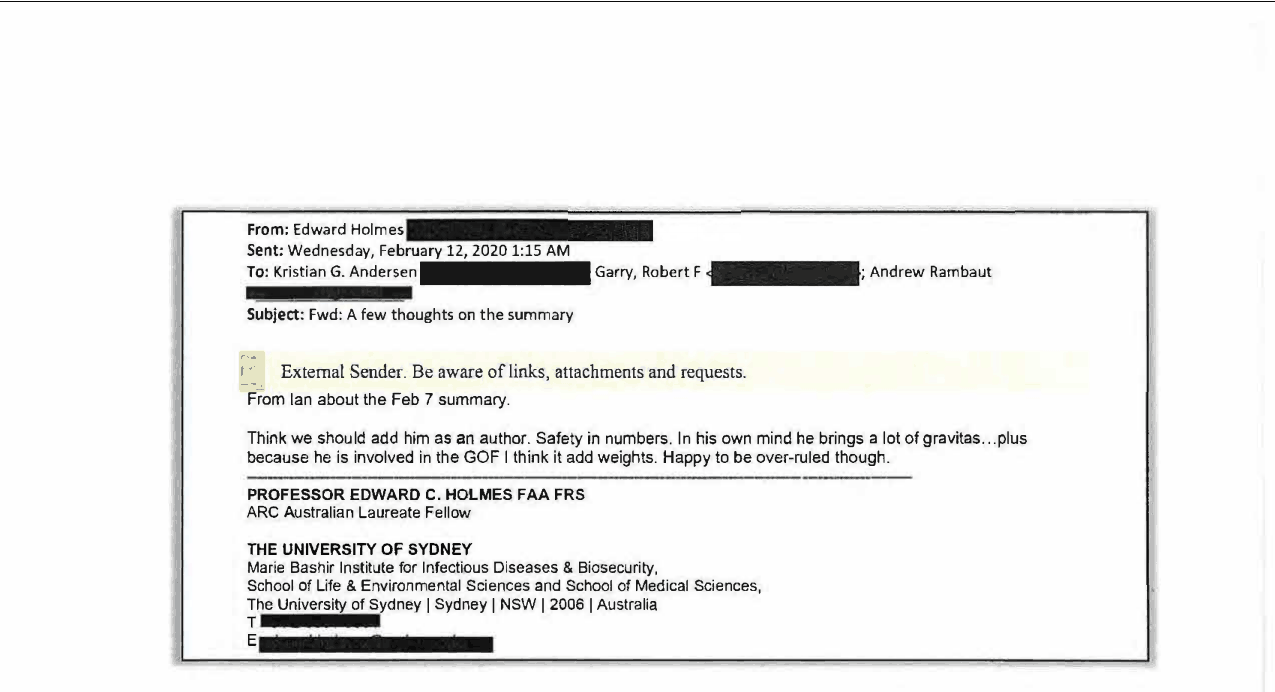
Exhibit 3. The Holmes email quoted above. House Oversight Committee, Final Report-6 (PDF p. 32; fn 112). Unaltered crop.
(Final Report-6, footnote 112.) Neither stated reason is a scientific contribution; one is explicitly tactical. Garry and Andersen each concurred, in testimony quoted in the same report, in terms that concede the point: Garry, "I'm not sure that the GOF really adds much weight" (fn 113); Andersen, "adding Ian as an author, yes, that helps add to the weight of the paper and the authors" (fn 114). The documented rationale does not identify a qualifying substantial intellectual contribution, and the journal should examine the complete contribution record against the applicable ICMJE authorship criteria.
A materiality ledger, because the correction-versus-retraction call turns on which part of the published record each ground touches. COPE v3's operative test is whether editors "no longer have confidence in the results and conclusions reported in the paper":
- Ground 1 touches published empirical sentences. The sentences are individually correctable; what is not correctable is the private record that the lead author called the first one false on the day the paper still stood behind it, with no public correction in the six years since.
- Ground 2 touches two of the paper's principal arguments against a laboratory scenario. Those arguments carry the conclusion sentence; this ground attaches to the conclusion itself.
- Ground 3 touches the conclusion sentence directly: the operative finding in tension with the paper's own body text on the same feature.
- Ground 4 touches no printed sentence. It bears on whether the journal can still have confidence in the paper's conclusions given that a senior co-author's stated view changed once the BSL-2 facts reached him, with no correction from him.
- Ground 5 touches the byline, not the data (ICMJE substantial-contribution territory). Severable as text.
- Ground 6 touches the disclosure record: what the journal was told at submission about the drafting role of a funder-side participant. COPE v3 lists "undisclosed conflicts of interest that could bias interpretation" among the reasons retraction might be necessary.
Grounds 1 through 3 attach to the results and conclusions. Grounds 4 through 6 attach to the conditions under which those conclusions were produced, commissioned, signed and disclosed. None of the six is a typo in a table; the journal cannot cure the set by printing new sentences over the old ones, because the defect the grounds document is the gap between the published record and the authors' own contemporaneous accounts, and a correction changes the former while leaving the latter standing.
The grounds mapped onto the journal's own decision rules#
Nature Medicine's operative correction-and-retraction policy is the Nature Portfolio policy "Corrections, Retractions and Matters Arising" (held snapshot, 27 March 2026). Its retraction rule: "An article may be retracted when the integrity of the published work is substantially undermined owing to errors in the conduct, analysis and/or reporting of the study. Violation of publication or research ethics may also result in a study's retraction." Its interim instruments: an Editorial Expression of Concern, "a statement from the editors alerting readers to serious concerns affecting the integrity of the published paper", which "may be an interim measure or may be final"; and an Editor's Note, "a notification alerting readers if the journal has initiated an inquiry in response to concerns raised about a published article". Publishing either "is recommended by the Committee on Publication Ethics (COPE) as a means of keeping readers updated while a potentially lengthy research integrity investigation is underway". The same policy commits the journal to "thoroughly investigate concerns that are directly raised with us by authors and readers", with authors "always given an opportunity to respond". COPE retraction guidance v3 (2025) supplies the operative test: "Editors can decide to retract a publication if they no longer have confidence in the results and conclusions reported in the paper", and lists "unethical research practices, compromised peer review, or undisclosed conflicts of interest that could bias interpretation of the work" among the reasons retraction might be necessary.
Each ground, mapped onto those rules:
| Ground | What it puts in question | Rule engaged | Minimum adequate response if retraction is withheld |
|---|---|---|---|
| 1 | A published empirical sentence the lead author privately called false twelve weeks in; no correction in six years | Retraction rule (integrity undermined "owing to errors in... reporting"); COPE: "any form of misrepresentation" | Correction of the sentence, plus investigation of the Slack record |
| 2 | The authors' private abandonment of both principal arguments against a laboratory scenario, never disclosed | COPE no-confidence test ("no longer have confidence in the results and conclusions") | Documented investigation, with an EEoC while it runs |
| 3 | No quantitative test of the conclusion anywhere in the paper; the conclusion in tension with the paper's own body text | Retraction rule ("errors in the conduct, analysis and/or reporting of the study") | Correction or EEoC on the conclusion sentence |
| 4 | A senior co-author's public change in assessment, uncorrected since May 2021 | COPE no-confidence test (bears on confidence; touches no printed sentence) | Author statement, disclosed to readers |
| 5 | A byline added at its holder's own request; the recorded rationales are gravitas and safety in numbers, not contribution | "Violation of publication or research ethics" clause; ICMJE criteria 1 and 2 | Contributor-record review under the journal's authorship policy |
| 6a / 6b | Undisclosed coordination with the officials who convened and received the work; commissioning in the authors' own words | COPE: "undisclosed conflicts of interest that could bias interpretation of the work" | Adjudication under the competing-interests policy, published |
COPE v3: editor no longer has confidence in the results and conclusions. ICMJE (Corrections and Version Control): errors serious enough to invalidate results and conclusions may require retraction. Neither instrument carves out Correspondence. PubMed indexes this article as PublicationType Letter (PMID 32284615).
The request asks for retraction because the grounds are not independent defects of wording; read together they go to confidence in the results and conclusions. The rules above also define the fallback, and the request carries one explicitly (Section V).
IV. The forensic package (eight pillars)#
The request also carries eight reproducible analyses, committed to the supracode-tool repository with scripts and line-cited verdict documents. They are independent of the documentary grounds: Grounds 1, 2 and 6 stand even if every pillar fell.
- Multi-host codon-usage null bracket: CGG-CGG at the FCS is anomalous under bat and viral codon pools and matches human codon usage.
- Codon pair bias: Wuhan-Hu-1 clusters with natural viruses, and no held codon-optimized construct uses adjacent CGG-CGG at the FCS. The optimizers use CGG freely at the single-codon level, including at the first FCS arginine, and both companies broke the pair at the second (Pfizer CGG-AGA, Moderna CGG-AGG). This is consistent with Andersen's private assessment of 21 September 2021: "Correct. Key here too is that if you were to 'optimize' the FCS sequence (as is commonly done for these types of experiments) you would not end up with the FCS sequence we see, including the CGG codons. But again, it doesn't really tell us much." (Andersen, 21 September 2021, SLACK_001214.) His hedge is answered by the data on both sides of it: the multi-host codon-usage null puts CGG-CGG at the FCS outside natural viral and bat codon pools, and the pair-bias record shows no published optimized construct ever produced the pair Andersen said optimization would not produce.
- Ancestral-state reconstruction at S1/S2: PRRA in 1 of 6 genomes; large-scale validation at 0 of 195 natural sarbecoviruses carrying any minimal furin motif, against a 99.35% positive-control detection rate in SARS-CoV-2 sequences.
- DEFUSE key-sites comparison: FCS insertion, ACE2-binding selection, RaTG13-like backbone.
- Bruttel / Washburne / VanDongen Type IIS fingerprint, re-run as a codon-aware silent-introduction metric: 60% silent motif introduction vs RaTG13, against a natural envelope of 0-50% across 15 natural genome pairs (12 at 0%; the natural maximum, BANAL-52 vs RaTG13, at 50%). The margin over the natural envelope is one site in five, so this pillar is carried as corroborating, not standalone. The published rebuttal of the original fingerprint claim, Wu 2023 (Environmental Research 224:115481), addresses the site-count and fragment-size criteria; the silent-introduction rate this pillar measures is not addressed there.
- Locus-specific cloning-scar scan: zero Type IIS clusters at the FCS locus. This one is silent on de novo synthesis and is carried with that caveat.
- Codon-optimisation impossibility test: the rest of the genome is not optimised; the FCS anomaly is locus-specific.
- Pre-pandemic intent: DEFUSE 2018; Follis 2006; Baric transcribed interview, "That part would be done by me" (p. 92) and "That is definitely gain-of-function" (p. 99).
The Baric transcribed congressional interview matters most because it directly addresses who was assigned the proposed work. It establishes that the DEFUSE proposal included inserting a furin cleavage site into a sarbecovirus backbone, that the step was assigned to the investigator himself, and that he considered it technically feasible. The paper dismissed as implausible a scenario a DEFUSE co-investigator stated, in a congressional transcribed interview, he was to perform.
A date line worth keeping straight: only Follis 2006 was knowable by the authors at publication, and they knew it: the paper cites it as reference 14. A furin-site insertion at the S1/S2 junction of a SARS-CoV-1 spike had been published fourteen years earlier, and the paper cites that work for its cell-cell fusion result. DEFUSE was unknown outside its own proposers until the 2021 leak, and the Baric interview is from 2026. Those two bear against the paper's maintained conclusion, not against the authors' 2020 diligence.
MECHANISTIC · MODERATE for the pillars as independent support; they are site analyses, not peer-reviewed publications, and are flagged accordingly in the request.
V. Honest odds#
I put a full retraction by Nature Medicine within 18-24 months in the low single digits. Retracting a highly cited Correspondence central to the SARS-CoV-2 origins debate would be unprecedented for the journal. An Editorial Expression of Concern is the more probable institutional response, and I put that at 20-30% over the same window, moved up by the policy mapping in Section III and the explicit interim ask. The realistic best case is that the request forces formal research-integrity review at one or more of the authors' home institutions (Scripps, Edinburgh, Columbia, Sydney and Tulane were named for referral), draws a public response from Andersen or Holmes on the documented contradictions, and gets cited in subsequent coverage.
The request has value even if the journal never acts. It puts on the record, in one citeable document, what the Slack and Baric releases established about the distance between the published conclusion and the authors' private assessments.
The ask, in the form that goes to the journal:
I request retraction after investigation under Nature Medicine's post-publication policy and COPE retraction guidance (v3). If the journal finds the record short of immediate retraction, I request: (1) a documented investigation of Grounds 1, 2, 5, and 6; (2) an Editorial Expression of Concern while that investigation runs; (3) correction of any confirmed factual and disclosure defects, including the still-live "across the world" sentence.
HYPOTHESIS + INV · MODERATE for the prospects; the documentary case itself stands at HIGH confidence on the quoted exchanges.
VI. The intelligence community's proximity to the paper#
The Fauci / ECA referral note#
A three-page document package stamped "Released by Chairman Rand Paul", entered into the record of the 29 July 2026 HSGAC hearing "Testimony of Anthony Fauci" and circulated with a 29 August 2026 file date, includes a CIA memorandum recording a 4 June meeting between CIA's WCPMC component and Dr. Anthony Fauci. The memo does not print the year; 4 June fell on a Thursday in 2020 and a Friday in 2021, so the year is ambiguous on its face. Transcribed from a scan, with the usual OCR caveats on exact wording, the memo records Dr. Fauci encouraging and directing CIA's ECA component to contact virologists including Dr. Robert Garry (Tulane), Dr. Marion Koopmans (Erasmus MC), and Dr. Kristian Andersen (Scripps), noting Andersen's recent publication with Dr. Andrew Rambaut adjudicating features of the virus as consistent with a natural origin.
Whichever year the meeting falls in, Proximal Origins was already published (17 March 2020). The note is evidence of the paper's afterlife in government channels, the NIAID Director pointing the CIA toward its authors as the adjudicators of origin, not of its genesis. It is consistent with the coordination picture of Ground 6 and does not by itself establish commissioning.
Lipkin's intelligence practice, and Demaneuf's hypothesis#
The fifth author's role has drawn renewed attention. Gilles Demaneuf (DRASTIC), in X threads of 31 July and 4 August 2026, argues Lipkin was placed on the paper as an intelligence-community observer, there to shape the narrative and preserve a channel into China. His primary source is the House Select Subcommittee's transcribed interview of Lipkin (6 April 2023, public; an unsworn staff interview conducted with counsel present).
In Lipkin's own words, the transcript establishes:
- A decades-long practice of reporting overseas outbreak information to US agencies, the CIA included: "I was able to go into Saudi Arabia and get information that I fed back then to the CDC and NIH -- and the CIA as well -- about what was happening in Saudi Arabia. So I've done this many times." (p. 35)
- Chinese contacts treated as protected sources, around a 31 December 2019 voicemail from George Gao, then director of the China CDC: "My ability to operate and actually protect you, honestly, and work around the world is no different than a journalist who has to protect sources", and "I am your best link to China. You don't want to lose me there." (pp. 32-33, following an off-the-record discussion)
- Near-quarterly meetings with FBI New York at which agents asked what he had "found out that would be of value" (p. 110), and his own earlier writing that he had been "questioned by the FBI, the CIA, the DOD, House committees" (p. 110).
- Entry into the author group on 10 February 2020, the day Edward Holmes first sent him a draft, immediately after Lipkin telephoned Holmes "very worried about the furin cleavage site", reporting that "high ups are as well, inc. intel" (Holmes email, 10 February 2020, reproduced in the House Select Subcommittee's Final Report-6 and cited there at footnote 108). The same report records that Holmes later said of him, "I think Ian thinks it's from a lab." Lipkin confirmed in the interview that 10 February was his first involvement; he was not on the 1 February 2020 call.
The transcript does not contain a tasking document, a reporting chain, or any admission that an agency placed him on the author list. Asked directly whether he maintains "any permanent relationship with any component of the intelligence community", he answered "I do not" (p. 111). He stands by the paper's core conclusion while leaving open an inadvertent research-related incident.
Demaneuf's "mole" reading is an inference from language, timing and career pattern, and it is not needed. The verified facts carry the disclosure problem by themselves: a self-inserted fifth author (Ground 5) with a self-described practice of feeding outbreak intelligence to the CIA, who joined the group the same day he flagged that the intelligence community was worried about the furin cleavage site, on a paper whose Competing Interests statement does not disclose any of it. The stronger claim stays a hypothesis the record does not settle, and it is carried here only as one.
The convergence with the Fauci / ECA note above is real but partial: the CIA memo shows the Agency being directed toward Andersen, Rambaut, Garry and Koopmans; it does not mention Lipkin.
VII. Status#
- 11 August 2026: public-release and cover versions finalised. Supersedes the 24 July 2026 draft.
- Not yet submitted to Nature Medicine. It will be filed as drafted unless a ground is corrected or withdrawn first.
- Co-signers are open. Independent scientists wishing to add their names before filing are invited to make contact.
- This article will be updated on filing, and on any response from Nature Medicine, COPE, the authors, or their institutions.
Prior requests, because the journal has been asked before. An open letter of 26 July 2023, led by Bryce E. Nickels and published at Biosafety Now with 50+ signers, asked Nature Medicine to publish an Expression of Concern and begin a process of withdrawal or retraction. A second letter, to Chief Editor Dr Joao Monteiro on 14 May 2024, signed Nickels, Kahn, Harrison, Newman and Ebright, asked the same on the ground of Jeremy Farrar's undisclosed role in the paper's prompting, organizing and editing as a competing-interests breach. The 11 June 2024 status update posted with that letter records: "Dr. Montiero has yet to acknowledge receipt of this request." [sic] As of 1 September 2026 the article record carries no correction, no Expression of Concern, no retraction and no editor's note. This request is at least the third the journal has received on the paper, and the first whose documentary base, the July 2026 Senate releases of the Slack record and the Baric transcribed interview, postdates both.
The underlying evidence presentation, the Slack record and the Baric transcribed interview in full context, stays in Pinsolle's Framework: Spike, mRNA, and the Lab-Origin Question, where the retraction call was originally carried as a subsection.
Sources#
- Andersen, K.G., Rambaut, A., Lipkin, W.I., Holmes, E.C., & Garry, R.F. (2020). "The proximal origin of SARS-CoV-2." Nature Medicine 26, 450-452. DOI: 10.1038/s41591-020-0820-9. https://www.nature.com/articles/s41591-020-0820-9
- Proximal Origins Slack workspace, 1,123 pages, Bates SLACK_000216 through SLACK_001337. Released 21 July 2026 by Chairman Rand Paul, U.S. Senate Committee on Homeland Security and Governmental Affairs (the release stamp names the Chairman only). https://www.paul.senate.gov/wp-content/uploads/2026/07/slack-drop-pm.pdf Archive (byte-identical to held copy): http://web.archive.org/web/20260825134746id_/https://www.paul.senate.gov/wp-content/uploads/2026/07/slack-drop-pm.pdf
- Transcribed Interview of Dr. Ralph Baric, 10 April 2026, same
Committee (pp. 65, 81, 91-92, 99 cited in the request). Page cites
are to the stamped transcript page in the page header ("Released by
Chairman Rand Paul"), not PDF viewer pagination; viewer page = stamp
- 2 (pp. 92 and 99 sit on viewer pages 94 and 101). https://www.paul.senate.gov/wp-content/uploads/2026/07/2026.07.23_UPDATED-FINAL-FINAL_BARIC-TI_Redacted.pdf Archive (byte-identical to held copy): http://web.archive.org/web/20260823003628id_/https://www.paul.senate.gov/wp-content/uploads/2026/07/2026.07.23_UPDATED-FINAL-FINAL_BARIC-TI_Redacted.pdf
- Transcribed interview of Dr. W. Ian Lipkin, 6 April 2023, House Select Subcommittee on the Coronavirus Pandemic (unsworn staff interview, public): https://oversight.house.gov/wp-content/uploads/2023/07/2023.04.06-Lipkin-Transcript.pdf Archive (byte-identical to held copy): http://web.archive.org/web/20260203035600id_/https://oversight.house.gov/wp-content/uploads/2023/07/2023.04.06-Lipkin-Transcript.pdf
- Gilles Demaneuf's Lipkin threads, 31 July and 4 August 2026: https://typefully.com/gdemaneuf/more-on-lipkins-intel-roles-VxrDPWD and https://typefully.com/gdemaneuf/who-got-played-dSWjjr1
- Edward Holmes email, 10 February 2020 (Lipkin call re the furin cleavage site and "high ups... inc. intel"), reproduced in House Oversight Committee, Final Report-6, footnote 108: https://oversight.house.gov/wp-content/uploads/2023/07/Final-Report-6.pdf Archive (byte-identical to held copy): http://web.archive.org/web/20260707133919id_/https://oversight.house.gov/wp-content/uploads/2023/07/Final-Report-6.pdf
- COPE Council. COPE Guidelines: Retraction Guidelines. August 2025. https://doi.org/10.24318/cope.2019.1.4 (version 3, published 4 September 2025; supersedes v2, 2019).
- Nature Portfolio, "Corrections, Retractions and Matters Arising" (the operative correction-and-retraction policy for Nature Medicine; quoted in Section III): https://www.nature.com/nature-portfolio/editorial-policies/correction-and-retraction-policy Archive (held snapshot, 27 March 2026): http://web.archive.org/web/20260327184530id_/https://www.nature.com/nature-portfolio/editorial-policies/correction-and-retraction-policy
- Nature Medicine article record for Andersen et al. (2020), the basis for the "no correction, no Expression of Concern" statements above (held snapshot, 1 September 2026): https://www.nature.com/articles/s41591-020-0820-9 Archive (held snapshot): http://web.archive.org/web/20260901231049id_/https://www.nature.com/articles/s41591-020-0820-9
- Follis, K.E., York, J., & Nunberg, J.H. (2006). "Furin cleavage of the SARS coronavirus spike glycoprotein enhances cell-cell fusion but does not affect virion entry." Virology 350(2), 358-369. DOI: 10.1016/j.virol.2006.02.003. PMID 16519916. PMC7111780.
- Wu, F. (2023). "Updated analysis to reject the laboratory-engineering hypothesis of SARS-CoV-2." Environmental Research 224, 115481. PMID 36804316. PMC9937728.
- Vero-passage FCS-loss literature: Lau et al. (2020) Emerg Microbes Infect 9:837-842, https://www.tandfonline.com/doi/full/10.1080/22221751.2020.1756700; Johnson et al. (2021) Nature 591:293-299, https://www.nature.com/articles/s41586-021-03237-4; Funnell et al. (2021) npj Vaccines 6:83, DOI: 10.1038/s41541-021-00346-z; Pohl et al. (2021) PLOS Biology 19:e3001006, DOI: 10.1371/journal.pbio.3001006; Laporte et al. (2021) PLOS Pathogens 17:e1009500, https://journals.plos.org/plospathogens/article?id=10.1371/journal.ppat.1009500.
- HSGAC document release package, 3 pages (record pp. 111-113), stamped release of Chairman Rand Paul entered into the record of the 29 July 2026 hearing "Testimony of Anthony Fauci"; file dated 29 August 2026. CIA memorandum on the 4 June WCPMC-Fauci meeting (Section VI above). https://www.paul.senate.gov/wp-content/uploads/2026/08/2026.08.29_Final-Hearing-Document-Release-Package.pdf Archive (byte-identical to held copy): http://web.archive.org/web/20260830004241id_/https://www.paul.senate.gov/wp-content/uploads/2026/08/2026.08.29_Final-Hearing-Document-Release-Package.pdf
- Open letter to Nature Medicine re Andersen et al. (2020), 26 July 2023, led by Bryce E. Nickels, published at Biosafety Now (50+ signers): https://biosafetynow.org/open-letter-to-nature-medicine/
- Letter to Dr Joao Monteiro, Chief Editor, Nature Medicine, 14 May 2024, signed by Nickels, Kahn, Harrison, Newman and Ebright (Farrar competing-interests ground); the 11 June 2024 status update quoted in Section VII accompanies it: https://biosafetynow.substack.com/p/covid-origins-proximal-origins-retraction-daf
- Full request text and eight-pillar forensic package:
retraction_call_20260811/in the supracode forensic repository, available on request for independent verification.
Related posts#
- Pinsolle's Framework: Spike, mRNA, and the Lab-Origin Question - the parent article; the Slack and Baric evidence in full context.
- The Case for Halting mRNA Experiments - the manufacturing and contamination companion.
- ACHS Sequencing Deposit and the Host Genome - independent re-mapping of the SRA deposit, building on McKernan's deposit work.
- Methodology - how this article's evidence tags work.