Table of Contents
Key Takeaways
- The 18.5-day median comes from Wuhan hospital inpatients, not nursing-home residents. Scottish care-home data show 11 days where COVID was the underlying cause and 22 days for COVID-associated deaths; a French nursing-home cohort shows 12 days.
- The interval differences make time-to-death a research question, not proof of secondary infection.
- ICU adjudication tied many ventilated deaths to unresolved bacterial pneumonia; that is ICU evidence, not care-home evidence.
- The Scottish Government formally answered that it does not hold DNR, midazolam, or cause-of-death data for care-home residents and that it is not possible to determine whether treatment protocols caused more deaths than lives saved.
- Netherlands counted only tested residents; US prescribing rose 150 percent for azithromycin in April 2020 then fell below baseline. What each country can answer differs, and the article maps it.
- Guidance, discharge policies, and financial incentives shaped care; the datasets that would test the treatment-timing hypothesis were never collected.
TL;DR#
- The 18.5-day onset-to-death median is from Wuhan hospital inpatients, not nursing-home residents. (DOI:10.1016/S0140-6736(20)30566-3 / PMID:32171076)
- Care-home intervals differ: 11 days where COVID was the underlying cause in Scottish linked data, 22 days for COVID-associated deaths, 12 days in a French nursing-home cohort. (Scotland, PMC10859243; France, PMC8233961)
- ICU adjudication tied many ventilated deaths to unresolved bacterial pneumonia, not virus alone; ICU data, not care-home data. (PMID:37104035)
- The Scottish Government formally does not hold DNR, midazolam, or cause-of-death data for care-home deaths, and states it is "not possible to determine whether treatment protocols caused more unnecessary deaths than lives saved." (gov.scot FOI 202300373450)
- Guidance, discharge policies, and financial incentives shaped care; transparency gaps persist. (FOI/AG/CMS below)
In 2020, nursing-home care in Ireland, New York, and Ontario came under crisis rules that met extreme frailty at scale. Empiric antibiotics for post-viral pneumonia grew harder to start, and other protocols filled the space.
The 18-Day Question#
The 18.5-day figure is real and widely quoted: median time from symptom onset to death in the early Lancet cohort. (DOI:10.1016/S0140-6736(20)30566-3 / PMID:32171076) What it is not, is a nursing-home number. That cohort was hospital inpatients in Wuhan.
Care-home-specific intervals, where they exist, come out different:
- Scotland (all 1,092 care homes, linked national data, March 2020 to October 2021): median time from positive test to death was 11 days where COVID-19 was the underlying cause, and 22 days for COVID-associated mortality. (PMC10859243)
- France (15 nursing homes, greater Marseille, 480 residents with COVID): median onset-to-death was 12.0 days (IQR 8.0-24.3); 123 residents were hospitalized, 96 died. (PMC8233961)
The measured intervals, side by side:
| Cohort | Setting | Median interval | Definition |
|---|---|---|---|
| Wuhan, Lancet 2020 | hospital inpatients | 18.5 days | symptom onset to death |
| Scotland, all 1,092 care homes | care homes, linked national data | 11 days | positive test to death, COVID as underlying cause |
| Scotland, same cohort | care homes | 22 days | positive test to death, COVID-associated |
| France, 15 homes (Marseille) | care homes | 12.0 days (IQR 8.0-24.3) | symptom onset to death |
symptom onset or positive test"] --> B["Days 7 to 10
typical viral peak"] B --> C["Day 11
Scotland, all 1,092 care homes
COVID as underlying cause"] B --> D["Day 12
France, 15-home cohort
symptom onset to death"] B --> E["Day 18.5
Wuhan hospital inpatients
symptom onset to death"] B --> F["Day 22
Scotland, same cohort
COVID-associated deaths"]
Every measured median sits past the viral peak, and no two cohorts agree on the number. The definitions differ too: the Scottish interval starts at the positive test, the hospital and French intervals at symptom onset. That is the question, drawn.
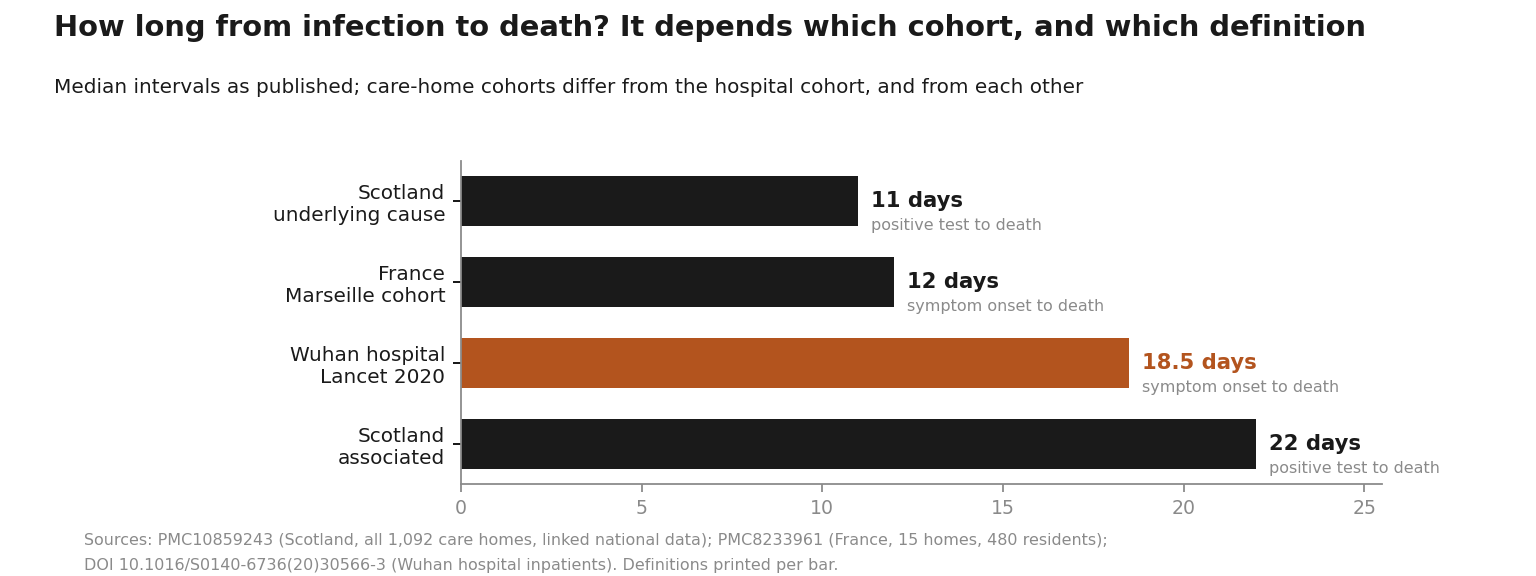 Figure 1: the four measured intervals side by side, definitions printed per bar. The orange bar is the hospital cohort the 18-day figure actually comes from. Sources as printed on the figure; generated from the verified record, script in the site repository.
The Scottish cohort adds two findings that frame everything below: 96.6 percent of Period-1 COVID deaths occurred in care homes with a known outbreak (98.8 and 95.1 percent in the later periods), and COVID mortality per 1,000 beds ran 45.8, then 29.3, then 3.5 across the three periods. (PMC10859243; Age and Ageing version)
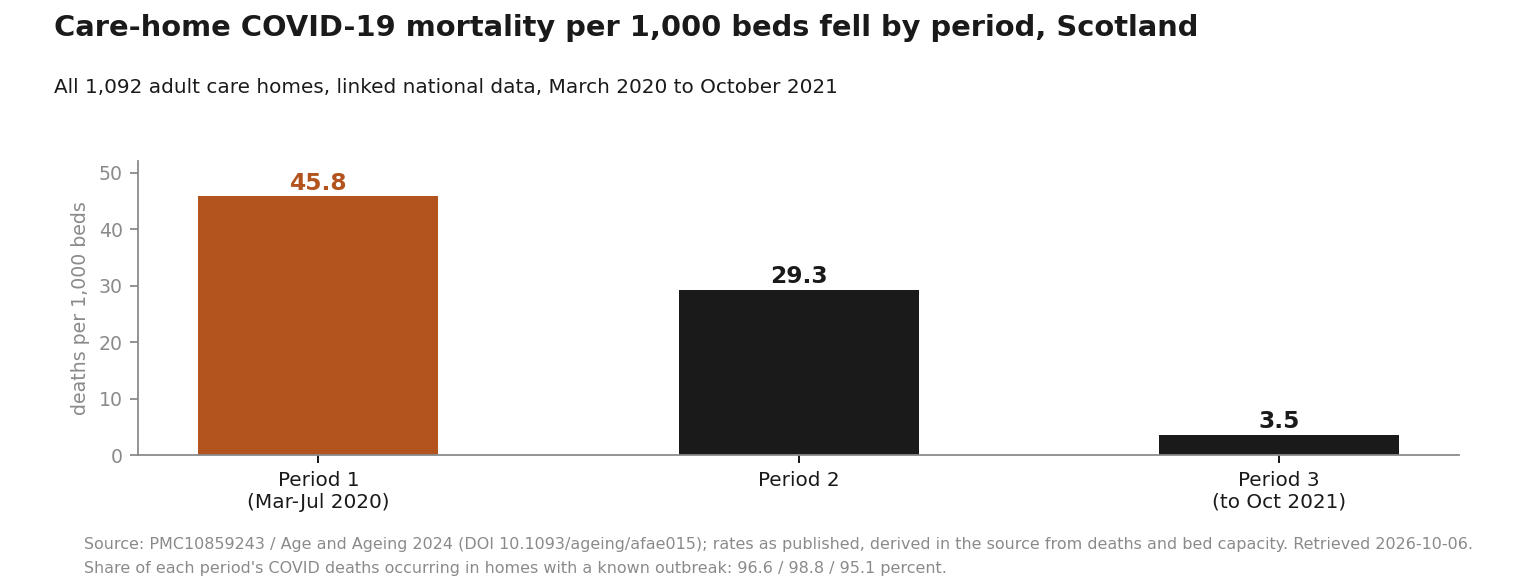 Figure 2: the per-bed trajectory across the three periods, with the outbreak-concentration shares in the footer. Source: PMC10859243 / Age and Ageing 2024.
So the interval is not a constant and not a verdict. It is a question: why did time-to-death differ between hospital and care-home populations, and what happened clinically during that window? Peak viral replication runs roughly 7 to 10 days, so deaths at day 11, 12, or 18 all sit past the viral peak, in the window where secondary bacterial pneumonia is one candidate explanation among several (testing delay, symptom-recognition delay, frailty, transfer policy, cause-of-death classification, non-COVID excess mortality). The bacterial hypothesis is testable against exactly one thing: treatment records. Which brings this article to its central finding, below.
Standard practice in high-risk elders: watch closely for bacterial pneumonia and treat early when clinically suspected. In many facilities, rigid interpretations of "antibiotic stewardship" delayed that step. Oversight flagged sustained problems in older-persons services through 2020–2021. (HIQA overview, Dec 2022)
Receipts:
- Lancet Wuhan hospital cohort: onset-to-death median 18.5 days. (DOI:10.1016/S0140-6736(20)30566-3 / PMID:32171076)
- Scottish linked care-home cohort, PMC10859243
- French nursing-home cohort, PMC8233961
- HIQA monitoring report 2020–2021
Limits: intervals vary by setting, ascertainment, and treatment. A late death is consistent with a secondary complication, including bacterial pneumonia, but timing alone cannot establish the cause.
A Preventable Death#
Picture an 85-year-old in a Dublin nursing home in March 2020. This is an illustrative composite built around the documented cases cited below, not one resident's chart. Before COVID, if her cough lingered and oxygen dropped, a GP would start antibiotics to prevent bacterial pneumonia.
With a positive COVID test, everything changed. Labeled "viral case," isolated from family, she entered the critical 8-18 day window. The protocol demanded proof of bacterial infection before antibiotics but sputum cultures take 48-72 hours. She deteriorated alone, dying on day eighteen from "COVID-19 pneumonia."
This wasn't isolated. Systemic treatment denial in Irish homes was described in documented reports. Families in New York sued over similar policies. The common thread: missed treatment windows for secondary infection.
Receipts:
- Interview documenting treatment denial
- Louise Roseingrave investigation
- Limit: Individual cases ≠ system-wide proof; they direct where to look.
What the profession's own record says#
At a Medical Council Fitness to Practise hearing in September 2025, the former President of the Irish Medical Council was asked about the March 24, 2020 HSE instruction that stopped pharmacies dispensing a treatment to the community, including nursing-home residents. Her answers, under oath: the restriction applied "to everybody." "Everyone was deprived except in hospital patients." And when asked how that squared with claims that nobody was denied treatment: "That was the policy of the time" - adding she was not saying it was correct. (Gript, Roseingrave)
The same hearing record contains the counterweight. The GP who asked the question, Dr Marcus de Brun, had resigned from the Medical Council in April 2020 over nursing-home policy, and the treatment-denial question reached the hearing only because he forced it there; he faced ten allegations of professional misconduct over social media posts. The system documented its own conduct, when compelled.
Receipts:
- Gript: de Brun hearing, day one (Doyle: "Everyone was deprived except in hospital patients"; "That was the policy of the time")
- Roseingrave: former IMC president admits "everybody"
- Limit: testimony describes Irish dispensing policy; it is not a verdict on any individual prescriber's intent.
The prescription record: two movements#
The US prescribing data measured the same pattern from the other side, in two movements. First, April 2020: across 1,944 nursing homes, hydroxychloroquine prescribing rose 563 percent, azithromycin 150 percent, and ceftriaxone 43 percent above 2019 - doctors reaching for the available tools while the deaths mounted. (PMC7989581) Then the channel closed: guidance, regulatory warnings, and dispensing controls, and by May total antibiotic prescribing ran below 2019 levels through October. The surge shows the profession working; the decline shows the off-script channel being shut.
In Ireland the closure was not a bedside decision at all. The HSE instructed pharmacies directly, which means the denial sat upstream of the consultation: a GP could have wanted to prescribe and been unable to dispense. That is what makes the former IMC president's phrasing precise rather than rhetorical - the deprivation was of "everybody" except hospital inpatients, by instruction.
What no dataset shows, in either country, is the pairing that would settle it: which resident, which day of illness, which drug considered and refused, what outcome. The Scottish FOI records that those data were never collected.
Receipts:
- US prescribing trends, 1,944 homes: HCQ +563% (95% CI 5.87, 7.48), azithromycin +150%, ceftriaxone +43% in April 2020; total antibiotics -5% (May) to -4% (October) vs 2019
- HSE dispensing restriction testimony
- Limit: aggregate prescribing is not treatment timing; the April surge and the below-baseline decline can coexist with both rescue and denial at the individual level - the record that would distinguish them does not exist.
How Bacteria Finish the Job#
ICU adjudication work tied a large share of COVID deaths on ventilators to unresolved bacterial pneumonia. (PMID:37104035)
This echoes influenza history: viruses damage airways; bacteria exploit the breach. (PMID:18710327)
Say it → receipts → limits:
- Unresolved VAP linked to mortality in COVID ICU cohort. (PMID:37104035)
- 1918 pattern: bacterial pneumonia drove most deaths. (Morens et al. 2008, PMID:18710327)
- Limit: ICU data ≠ care-home data; elders in LTC often weren't cultured or imaged, and autopsies were rare.
Why Big Trials Missed the Nursing-Home Question#
Azithromycin/doxycycline late in broad populations showed no benefit. (RECOVERY azithro DOI:10.1016/S0140-6736(21)00149-5; PRINCIPLE azithro PMID:33676597; PRINCIPLE doxy PMID:34329624)
That doesn't falsify timing-in-frailty. The excluded group needs early, targeted empiric coverage when clinical suspicion is high. We're talking about very old, high-risk residents.
Receipts:
- RECOVERY azithromycin null. (DOI:10.1016/S0140-6736(21)00149-5)
- PRINCIPLE azithromycin null. (PMID:33676597)
- PRINCIPLE doxycycline null. (PMID:34329624)
- Early antibiotic cohort showing benefit. (PMID:38504586)
- Limit: RCTs under-sampled nursing-home residents starting before day-10.
Policies That Tilted the Board#
Ireland
- HIQA reported persistent risks in older-persons services 2020–2021.
- Frontline accounts described transfer and access problems; professional hearings acknowledged systemic treatment denial.
- Excess mortality analysis
New York
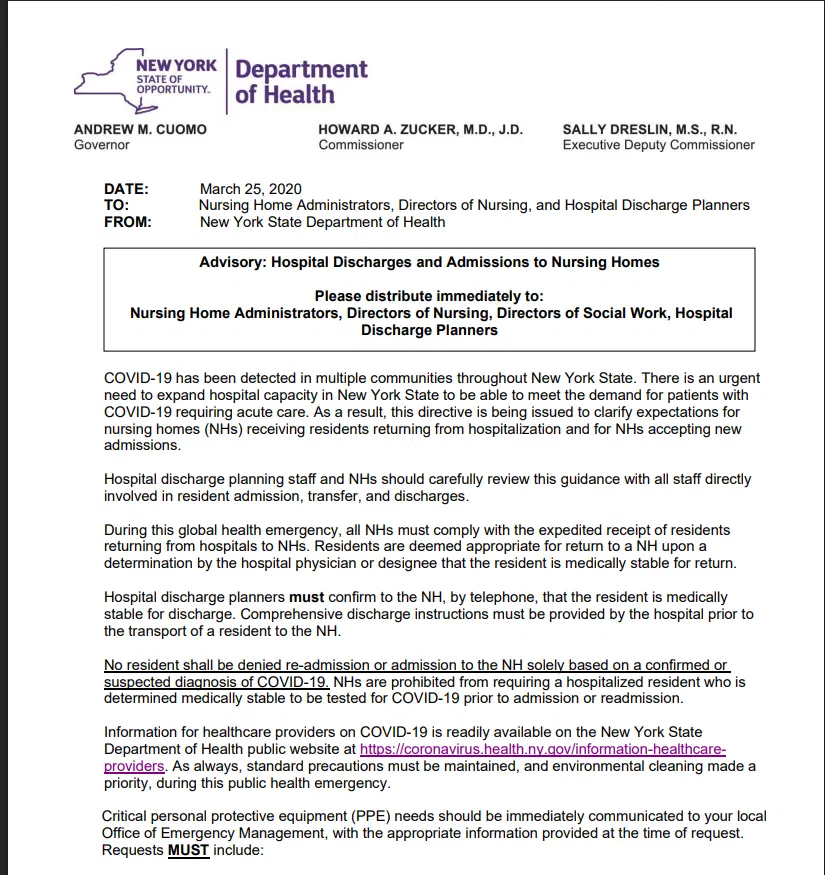
Mar 25, 2020 DOH Advisory, mirror PDF: https://skillednursingnews.com/wp-content/uploads/sites/4/2020/03/DOH_COVID19__NHAdmissionsReadmissions__032520_1585166684475_0.pdf (Contains the exact line: “No resident shall be denied re-admission or admission … solely based on a confirmed or suspected diagnosis of COVID-19.”)
Official confirmation, later DOH directive that supplements the Mar 25 advisory (DAL 20-14, May 11, 2020): https://www.health.ny.gov/professionals/hospital_administrator/letters/2020/docs/dal_20-14_covid_required_testing.pdf
Secondary cite noting the original URL is now unavailable (NYS Bar Association, Nov 2020): https://nysba.org/wp-content/uploads/2021/01/health-Law-Resolutions-and-report-with-cover-approved-November-2020.pdf
NY AG Report (Jan 2021): nursing-home deaths were undercounted; admission guidance "may have put residents at increased risk."
Receipts:
- DOH Advisory 3/25/2020
- NY Attorney General report
- Limit: Advisory impact size varies by facility staffing and IPC.
Ontario
- Long-Term Care COVID-19 Commission documented catastrophic failures in cohorting, staffing, and IPC.
- Provincial guidance set high bar for empiric antibiotics unless bacterial infection strongly suspected. (Ontario Science Table guidance; archived copy)
Receipts:
- LTC Commission Final Report
- Ontario Science Table Clinical Guidelines, archived copy
- Limit: Province-wide prescribing logs tied to outcomes not public.
Protocol-Driven Deaths: #ScottGate#
2025 Senate testimony described 100+ deaths under protocols restricting empiric antibiotics while deploying remdesivir and excluding repurposed drugs.
Receipts:
- Senate testimony
- Senate testimony clip
- Remdesivir nephrotoxicity (PMID:32445440)
- Midazolam surges
- HSE Ireland publications
- MAGICapp protocols
- Limit: Testimony is allegation; requires audit verification.
Financial Context#
Ireland Private operators paid "hard work" bonuses during peak stress periods.
Receipts:
- Irish Times investigation
- Aisling O'Loughlin investigation
- Limit: Correlation ≠ causation.
US Payment Structures Medicare NCTAP add-on payments for COVID inpatients, including remdesivir periods.
Receipts:
- CMS NCTAP explainer
- Limit: Payment exists; effect on clinical choices needs econometrics.
The Human Cost#
Residents died without family present. Irish carer Niamh Brophy: "44 residents under my care died." (RTÉ, 22 Sep 2021)
Receipts:
- RTÉ interview
- Varadkar tweet
- Arkmedic analysis
- Limit: Individual testimony ≠ system-wide proof.
Essential Audits#
- Antibiotic Timing vs. Outcomes (Days 8–18): Pull de-identified care-home charts; align symptom onset, CRP/PCT, first antibiotic dose, and 30-day mortality.
- Transfer & Discharge Effects: Link hospital→nursing-home transfers to facility outbreaks post-advisories.
- Transparent Stewardship Dashboards: Facility-level starts, durations, C. diff, resistance.
- Dual Denominators: Report deaths by place of residence and place of death.
- Nursing-Home-Specific Trial: Early, targeted empiric therapy vs watchful waiting with biomarker triggers.
Counterpoints & Unknowns#
- Low co-infection on admission: Many studies found low bacterial co-infection initially. (PRINCIPLE/RECOVERY nulls)
- AKI and remdesivir: Causation contested; confounding by severity likely.
- Data gaps large: Few autopsies; sparse LTC prescribing timestamps.
The Data That Should Exist But Doesn't#
The strongest finding of this investigation is a negative one. The deaths are counted. The policies are published. The layer that would connect them, individual treatment decisions tied to individual outcomes, was in most jurisdictions never collected.
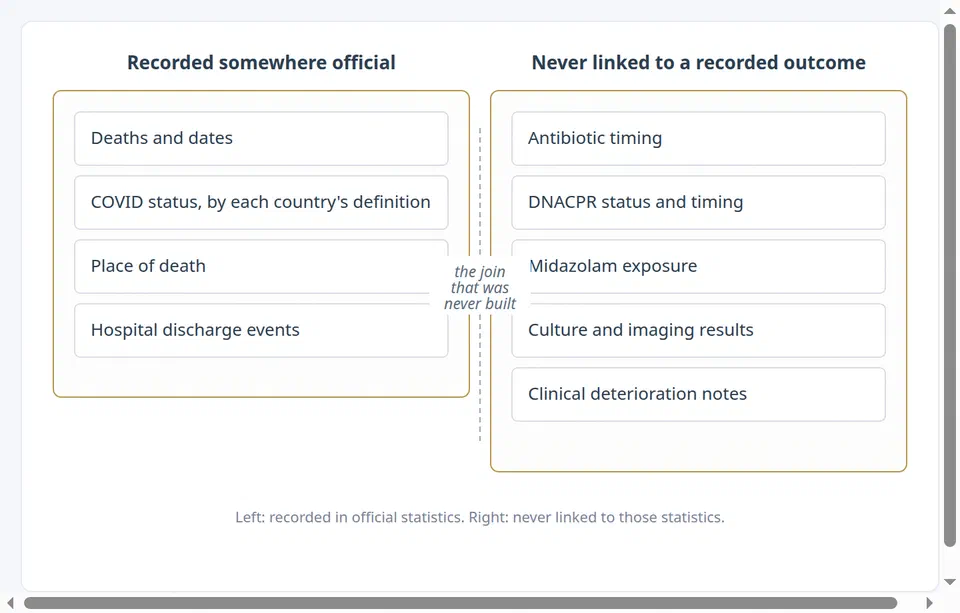
The left column exists in every jurisdiction below. The right column is what the FOI answers, the audit findings, and the prescribing aggregates all fail to supply: nothing that names a resident, a day of illness, a decision, and an outcome in the same row.
Scotland said so in writing. A 2023 FOI asked the Scottish Government for the causes of death behind the 2,724 care-home deaths of April 2020, how many residents had DNR orders, how many were treated with midazolam within 14 days of death, and whether the NICE NG163 end-of-life protocols caused more deaths than lives saved. The answer, for every one of those questions, was that the government does not hold the data: DNR status is not recorded at death registration, midazolam toxicology exists only where a death is referred to the Procurator Fiscal, and, verbatim, "It is therefore not possible to determine whether treatment protocols caused more unnecessary deaths than lives saved." (gov.scot FOI 202300373450)
The Netherlands counted only the tested. RIVM stated its nursing-home death figures "only involve nursing home residents who have been tested for COVID-19" and that "since not all patients are tested, the actual number of nursing home residents with COVID-19 who have died is higher" than the published figure, with Nivel and Verenso engaged to estimate the untested cases. (RIVM) Cross-country death comparisons inherit that ascertainment problem.
US prescribing contradicts the simple version of the withholding story. In 1,944 US nursing homes, azithromycin prescribing rose 150 percent and ceftriaxone 43 percent in April 2020 relative to 2019, and total antibiotic prescribing then ran below 2019 levels from May through October. (PMC7989581) Antibiotics were not simply withheld; they surged early and fell later. What no dataset shows is the pairing that matters: which resident, which day of illness, which drug, which indication, what outcome.
Wales shows the definition problem in numbers. Between 1 March and 10 July 2020, Care Inspectorate Wales recorded 3,382 deaths from all causes in adult care homes, of which 734 were notified as suspected or confirmed COVID: 340 confirmed, 394 suspected. Place of death for the COVID-notified: 500 in the care home (68 percent), 209 in hospital (28 percent), 13 other, 9 own home, 2 ambulance, 1 hospice. (GOV.WALES) The release itself carries the warning: cause of death is "reported by the care home provider," is "not based on laboratory confirmed tests, and [is] therefore not directly comparable with Public Health Wales (PHW) data," and the two series "cannot be added together."
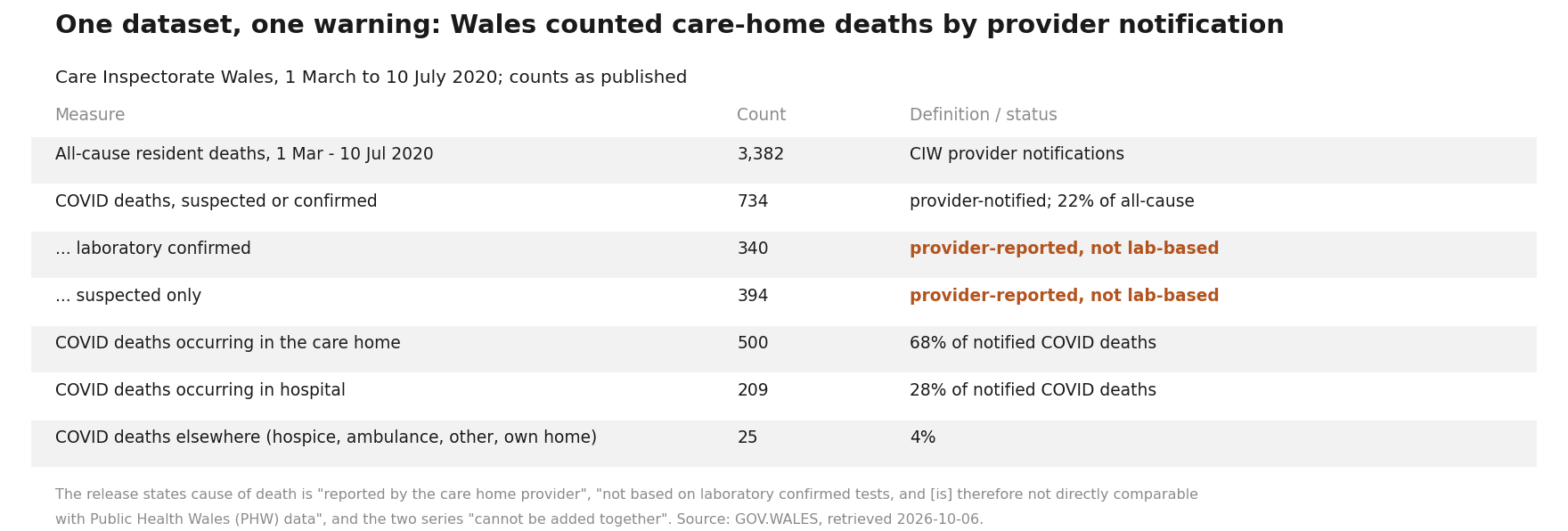 Figure 4: the CIW notification counts as published, with the confirmed/suspected split and the release's own non-comparability warning. Source: GOV.WALES, retrieved 6 October 2026.
The same death, five definitions, five different totals: provider notification (Wales) vs laboratory confirmation (PHW) vs death certificate mentioning COVID vs underlying cause COVID (Scotland's 11 days) vs COVID-associated (Scotland's 22 days). Every cross-country comparison in this article inherits whichever definition each country chose.
England's excess is measured to the death. April 2020: 28,013 care-home deaths against a five-year average of 9,500, an excess of 18,513, +194.9 percent. (ONS FOI) Across 2020, 155,376 care-home resident deaths in England (+18.5 percent vs 2019), 8,236 in Wales (+20.3 percent), with 86.6 percent of England's resident deaths occurring inside the care home. (ONS)
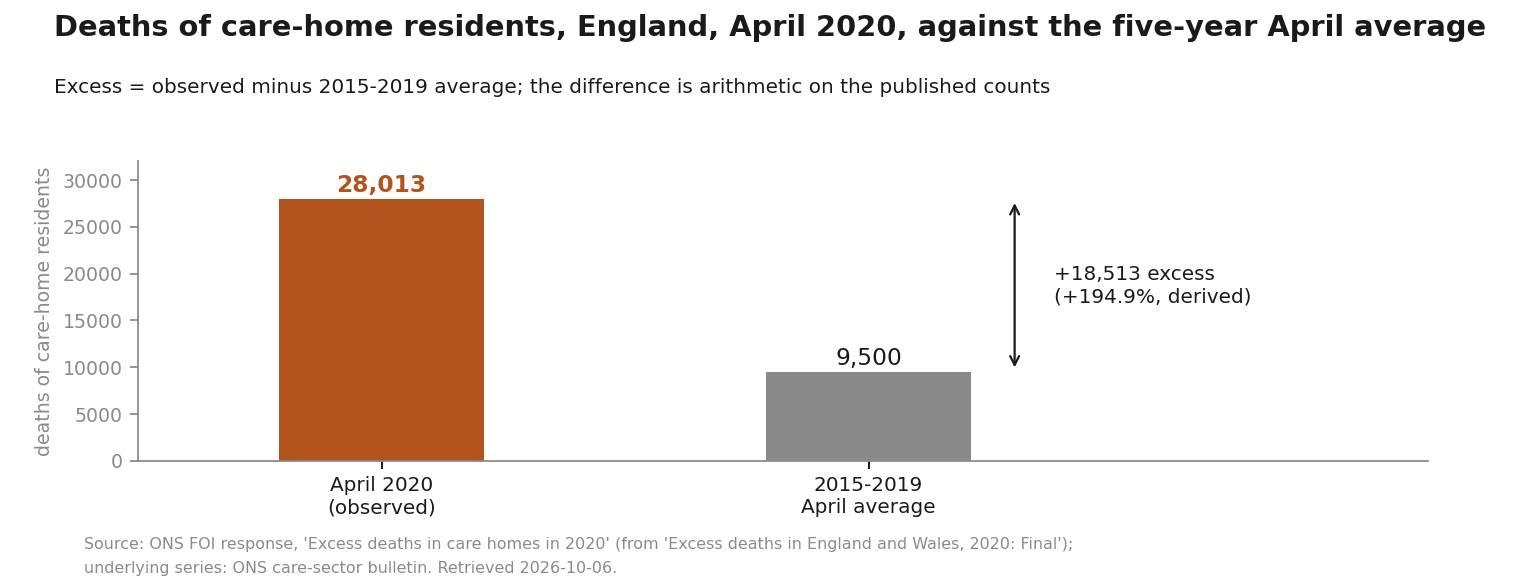 Figure 3: the April 2020 excess against the five-year average, from the ONS FOI response. The excess arithmetic is derived on the figure. And the discharge pathway is documented at audit level: around 25,000 people were discharged from hospitals into care homes between 17 March and 15 April 2020 (vs around 35,000 in the same period of 2019), "not all patients were tested for COVID-19 before discharge," and "on 15 April, the policy was changed to test all those being discharged into care homes." (NAO)
England, March 2020"] -->|"discharged, COVID test not required"| B["Care home bed"] B --> C["Outbreak, staffing, isolation,
and treatment decisions follow"] D["Around 25,000 discharges
17 March to 15 April 2020
(NAO audit)"] -.-> A E["15 April 2020:
policy changed to test
all hospital discharges into care homes"] -.-> B
Canada: the transfer collapse. Long-term-care residents were 3 percent of Canadian COVID cases and 43 percent of COVID deaths (March 2020 to August 2021). Hospital transfers from LTC fell 25 percent overall against the pre-pandemic period, and by condition: pneumonia -52 percent, COPD -58 percent, heart failure -41 percent, sepsis -31 percent, delirium -23 percent. (CIHI) Fewer hospital transfers means fewer cultures, fewer imaging studies, and fewer escalations: the exact inputs the treatment-timing question needs. CIHI's own reading cuts the other way and belongs in the evidence-against column: infection-control practices "protected people from infections that trigger hospitalizations" for COPD and pneumonia, so some of that decline may be prevented illness, not denied care.
DNACPR: documented problems, not a documented universal. The CQC review heard that "most providers we spoke with were unaware of DNACPR decisions being applied to groups of people" while also hearing "evidence from people, their families and carers that blanket decisions had existed," alongside "poor record keeping and lack of audits" and inconsistent review of decisions once in place. (CQC, Protect, respect, connect) Blanket DNACPR occurred and was not universal; both halves are in the official record.
| Question | What the CQC review supports |
|---|---|
| Blanket DNACPR decisions existed | Yes, evidence heard from residents, families, and carers |
| Applied universally as policy | No, most providers were unaware of group-level decisions |
| Documentation and audit | Poor record keeping and lack of audits identified |
What each country can and cannot answer#
| Region | All-cause deaths | COVID deaths (definition) | Interval data | Discharge policy data | DNACPR audit | Treatment-to-outcome linkage |
|---|---|---|---|---|---|---|
| Scotland | linked national cohort | underlying-cause and associated, both | 11/22 day medians | guidance published | not held (FOI) | does not exist |
| England | ONS resident series | certificate-based | not published as medians | NAO audit: 25,000 discharges, testing from 15 Apr | CQC review exists | does not exist |
| Wales | CIW provider notifications | provider-notified, unconfirmed | not published as medians | not assessed here | CQC review exists | does not exist |
| France | research cohorts | cohort-defined | 12 day median (one cohort) | not assessed here | not assessed here | cohort only |
| Netherlands | tested residents only | laboratory-confirmed | not assessed here | not assessed here | not assessed here | ascertainment gap |
| Canada | CIHI series | certificate-based, share-verified | not assessed here | not assessed here | not assessed here | transfer aggregates only |
| US | state-level | state-defined | not assessed here | state advisories documented | state-level | prescribing aggregates only |
| Ireland | HPSC/HIQA oversight series, mortality census exists | census-based | not held as care-home intervals | guidance published | HIQA flagged care-planning problems | FOI-dependent |
| Ontario | Commission documented | Commission documented | not assessed here | Commission documented | Commission documented | Commission documented |
Every "not assessed here" and every "does not exist" is a research task, not a conclusion. The audits section below names them.
Receipts:
- gov.scot FOI 202300373450 (section 17(1) notices; NG163 sentence quoted verbatim)
- RIVM statement
- US prescribing trends, PMC7989581
- CQC DNACPR review
- ONS care-sector deaths 2020: England 155,376 resident deaths in 2020, 18.5 percent above 2019; Wales 8,236, 20.3 percent above
- Limit: the matrix records data availability, not findings. Where a cell says "not assessed here," this page has not reviewed that jurisdiction's record, not that the record is absent.
What Would Falsify This Article#
- The bacterial-treatment hypothesis weakens substantially if care-home records show that most residents who deteriorated in the later illness phase received timely antibiotics when bacterial infection was clinically suspected, with no association between delayed treatment and mortality.
- The protocol-failure hypothesis weakens if facility-level mortality differences are fully explained by outbreak size, resident frailty, age, staffing, and infection burden after adjustment.
- The interval hypothesis (that time-to-death distinguishes causes) weakens if cause-of-death ascertainment across the Scottish, French, and hospital cohorts turns out to drive the 11, 12, and 18.5-day differences.
Evidence (each bullet ends with citation)#
- Onset→death ~18.5 days in early hospital cohort. (DOI:10.1016/S0140-6736(20)30566-3 / PMID:32171076)
- Scottish care homes: 11 days (COVID underlying cause) and 22 days (COVID-associated), all 1,092 homes, linked data. (PMC10859243)
- French care homes: 12.0 days median onset→death, 480 residents. (PMC8233961)
- Former IMC president, under oath at a Fitness to Practise hearing: the dispensing restriction applied "to everybody"; "Everyone was deprived except in hospital patients." (Gript)
- Scottish Government: DNR, midazolam, and cause-of-death data not held; NG163 harm cannot be determined. (FOI 202300373450)
- US 1,944 homes: hydroxychloroquine +563 percent, azithromycin +150 percent, ceftriaxone +43 percent in April 2020, then total antibiotics below 2019 May-October. (PMC7989581)
- ONS: England care-home resident deaths 155,376 in 2020 (+18.5 percent vs 2019); Wales 8,236 (+20.3 percent). (ONS)
- ICU adjudication: unresolved bacterial pneumonia contributed to deaths. (PMID:37104035)
- Historical anchor: 1918 deaths largely from bacterial pneumonia. (Morens et al. 2008, PMID:18710327)
- RECOVERY azithromycin: no benefit. (DOI:10.1016/S0140-6736(21)00149-5)
- PRINCIPLE azithromycin: no benefit. (PMID:33676597)
- PRINCIPLE doxycycline: no benefit. (PMID:34329624)
- Early antibiotic cohort benefit. (PMID:38504586)
- NY Mar 25 2020 advisory (admissions). (archived PDF
- NY AG (Jan 2021): undercounting; admission guidance risk. (AG PDF)
- Ontario LTC Commission final report. (Commission PDF)
- CMS NCTAP established Nov 2020. (CMS pages)
- ACTT-1: remdesivir shortened recovery. (PMID:32445440)
- RTÉ: "44 residents under my care died." (RTÉ page)
- Irish CSO data: medical deaths up 77% ages 15-24. (CSO 2022)
- Coroners report 30% rise in sudden deaths. (Coroners returns)
- Patrick E. Walsh analysis: (Substack)
Plain-English Explainer (for families & carers)#
What this section is: A simple summary in everyday language. What it isn’t: Medical advice. Talk to a clinician about personal care.
The one-minute version#
- Hospital patients in the earliest big cohort died a median 18.5 days after symptoms; care-home residents in Scotland and France died at 11, 22, and 12 days. The interval varies by population.
- Deaths this late sit in the window where secondary bacterial pneumonia, a lung infection that follows a virus, is one candidate cause. Timing alone cannot prove it.
- In 2020, rules and fear of "overusing antibiotics" made early treatment harder for frail elders in many facilities; US data also show an early azithromycin surge, so the full picture is unrecorded.
Why “18 days” matters#
- Virus phase: usually 7–10 days.
- Extra week later: danger zone for bacteria to move in.
- A death at day 11, 12, or 18 sits after the viral peak, where a secondary complication including bacterial pneumonia is one candidate cause among several. Timing alone cannot establish the cause. (Intervals: hospital cohort 18.5 days, Scottish care homes 11 and 22, French care homes 12. DOI:10.1016/S0140-6736(20)30566-3; PMC10859243; PMC8233961)
What “secondary bacterial pneumonia” means#
- A virus weakens the lungs.
- Bacteria take advantage.
- In the frail, this can turn deadly fast without timely antibiotics. (ICU reviews show many deaths tied to unresolved bacterial pneumonia. PMID:37104035)
What changed in 2020#
- Labels: “It’s viral no antibiotics unless proven.”
- Proof problem: Cultures can take 2–3 days; many homes lacked quick testing.
- Transfers: Some areas pushed care back to homes; hospitals discharged earlier.
- Result: The early window for stopping bacterial pneumonia was often missed.
For families: how to read a loved one’s file (practical)#
Take notes. Ask for copies where you have the right.
- Symptom timeline: First day of cough/fever → date of death. Is it ~18 days?
- Oxygen numbers: Any SpO₂ dips (e.g., ≤92%)? When?
- Biomarkers: C-reactive protein (CRP) or procalcitonin (PCT) checked? Rising values can signal bacteria.
- Imaging: Any chest X-ray report saying “consolidation,” “infiltrate,” or “possible bacterial pneumonia”?
- Antibiotics:
- When was the first dose ordered?
- Which drug and how long?
- Was treatment stopped while the resident still had fever/low O₂?
- Sedatives & end-of-life meds: Midazolam/morphine start dates vs. oxygen decline.
- Transfers: Was hospital transfer requested or refused? By whom? On what date?
Five plain questions to ask the facility
- “On what date did symptoms start, and when was the first antibiotic considered or given?”
- “What were the CRP/PCT results and chest X-ray findings?”
- “Who decided to withhold or stop antibiotics and why?”
- “What was the plan if the resident worsened after day 7?”
- “Were family consultations documented before comfort-only care began?”
Myth vs Fact#
Myth: “Antibiotics don’t treat COVID, so they’re pointless.” Fact: They don’t treat the virus, but they can treat the bacterial pneumonia that often follows in frail elders.
Myth: “If big trials found no benefit, it never helps.” Fact: The major trials tested late use in broad groups. Frail nursing-home residents early in the risk window were under-studied.
Myth: “If cultures were negative, there was no bacteria.” Fact: Cultures can be late, hard to collect, or false-negative in the elderly. Clinicians often treat on clinical signs in high-risk cases.
What we still don’t know (and must audit)#
- Did early antibiotics (days 8–18) reduce deaths in care homes when clinical signs suggested bacteria?
- How often did sedatives start before a full pneumonia work-up?
- Did discharge/admission rules raise risk inside specific homes?
- Are there facility-level logs tying antibiotic timing → outcomes?
(Why this matters: ICU research (Gao et al. 2023, PMID: 37104035) links many deaths to bacterial pneumonia; the 1918 pandemic (Morens et al. 2008, PMID: 18710327) showed the same pattern.)
Plain glossary#
- Secondary bacterial pneumonia: A bacterial lung infection that happens after a virus.
- CRP / PCT: Blood tests that can hint at bacterial infection.
- Empiric antibiotics: Starting treatment before culture proof when risk is high.
- Comfort care: Medicines to ease distress near the end of life. Needs clear consent and timing.
For the record (short sources)#
- 18-day timing: Zhou et al., Lancet 2020. DOI:10.1016/S0140-6736(20)30566-3
- Bacterial pneumonia drives mortality in severe cases: ICU adjudication, 2023. PMID:37104035
- Historical analogue: 1918 deaths mostly bacterial (Morens et al. 2008, PMID:18710327).
- Policy context: NY AG nursing-home report (Jan 2021): https://ag.ny.gov/sites/default/files/2021-nursinghomesreport.pdf
- Ontario LTC Commission report (Apr 30, 2021): https://files.ontario.ca/mltc-ltcc-final-report-en-2021-04-30.pdf
Takeaway: If a resident worsened after day 7, and no timely antibiotic was even considered despite signs of bacteria, that is a checkable gap. Families deserve clear answers in writing.
Links (primary)#
- Lancet onset→death median, hospital cohort
- Scottish linked care-home cohort
- French nursing-home cohort
- Scottish Government FOI: care-home data not held
- CQC DNACPR review
- RIVM nursing-home undercount statement
- US nursing-home prescribing trends
- ONS care-sector deaths 2020
- ONS FOI: April 2020 care-home excess deaths
- NAO: hospital discharge into care homes
- CIHI: COVID-19 impact on long-term care
- GOV.WALES: care-home death notifications, Mar-Jul 2020
- Scottish cohort, Age and Ageing
- ICU adjudication
- 1918 influenza bacterial pneumonia
- RECOVERY azithromycin
- PRINCIPLE azithromycin
- PRINCIPLE doxycycline
- Early antibiotic cohort
- NY DOH advisory 3/25/2020
- NY AG nursing-home report
- Ontario LTC Commission
- HIQA overview 2020–2021
- CMS NCTAP
- Remdesivir nephrotoxicity
- RTÉ interview
- Irish CSO data
- Coroners returns
- Patrick E. Walsh analysis
- Interview documenting treatment denial
- Louise Roseingrave investigation
- Irish Times investigation
- Aisling O'Loughlin investigation
- Midazolam surges analysis
- HSE Ireland publications
- MAGICapp protocols
- Arkmedic analysis
Bottom line: If early, targeted antibiotics during days 8–18 fail to move outcomes in frail residents, stewardship is vindicated. If they do, we missed something straightforward and preventable. The audit is overdue.