Table of Contents
Key Takeaways
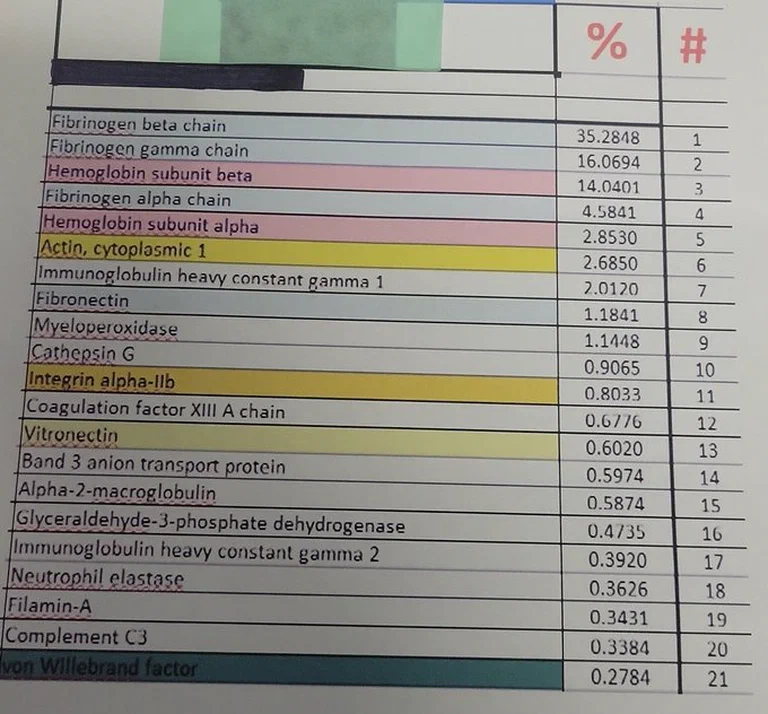
- A single investigator proteomic analysis of reported 'calamari clots' describes fibrinogen dominance (35.28 percent), haemolysis markers, and neutrophil proteins. No independent replication exists.
- Proposed mechanism, untested in humans: LNP-driven inflammation engages PAD4-mediated citrullination and NETosis, pathways established in endotoxin and sepsis models.
- Confidence is MODERATE for the cell biology, LOW for the composition claims, LOW for prevalence and causation; the anticoagulant-failure explanation is mechanistic reasoning, not a clinical finding.
Correction, 4 October 2026. The opening framing claimed these clots are "discovered by pathologists worldwide"; the actual sources are embalmer and mortuary reports circulated through substack investigators, with no peer-reviewed pathological series. The proteomic figures come from a single investigator analysis without independent replication and are scoped as such throughout. Two speculative extension sections ("Turbo-Cancer Connection" and "V-AIDS") were removed as uncited; a labelled-hypothesis paragraph replaces them. The supplement pulse-cycling and mini-senolytic schedules were removed; no trial supports them in this context. The lay analogy is now labelled as an analogy.
Executive Summary#
Since 2021, embalmer and mortuary reports, circulated through a chain of substack investigators, have described unusual rubbery, fibrous masses ("calamari clots") claimed to resist standard anticoagulants. One investigator-team proteomic analysis of such a mass reports fibrinogen beta chain at 35.28 percent of recovered protein, alongside haemolysis markers and neutrophil proteins. No peer-reviewed pathological series of these structures exists; this site's amyloid fibrin review grades the mortuary-report literature as unverified, and every figure below carries that limitation.
The mechanism layer is separate and better evidenced, though not in this context: lipid nanoparticles are inflammatory in animal and cellular models (Ndeupen et al., PMID 34841223); PAD4-driven citrullination and NETosis are established pathways (Wang 2009; Lewis, PMID 25622091); and endotoxin activates PAD4 in published animal work (PMID 32889238). The bridge from those mechanisms to the mortuary clots, specifically LNP-triggered PAD4 activation in vaccine recipients, is a hypothesis with no direct human measurement.
Neither the prevalence of these structures, nor any causal relationship to vaccination, nor their response to any therapy has been established. The related and separately documented phenomenon of amyloid fibrin microclots in Long COVID is covered in the amyloid fibrin review; the two literatures are distinct and are not merged here.
TL;DR#
Unusual rubbery clots have been reported by embalmers and mortuary staff since 2021 and circulated by substack investigators. A single investigator proteomic analysis reports fibrinogen dominance (35.28 percent), haemolysis markers, and neutrophil proteins. No peer-reviewed pathological series exists.
Proposed mechanism, labelled hypothesis: LNPs are inflammatory in animal and cellular models; PAD4-driven citrullination and NETosis are established pathways in endotoxin and sepsis biology. The bridge from one to the other in vaccine recipients is unmeasured in humans.
Key evidence: the proteomic report (single, unreplicated) and the mechanistic literature (peer-reviewed, but not tested in this context).
Evidence Level: [CM] Investigator reports, [AN] Mechanistic studies, CONFIDENCE: MODERATE for the cell biology, LOW for the composition claims, LOW for prevalence/causation in humans
Why the anticoagulant argument stays mechanistic: if the composition claims hold, conventional anticoagulants would be expected to underperform against non-fibrin aggregates; that is reasoning, not a clinical finding.
What Are "Calamari Clots"?#
Evidence Level: [CM] Investigator and embalmer reports, CONFIDENCE: LOW-MODERATE (no peer-reviewed series)
Since 2021, embalmers and mortuary staff have reported removing rubbery, fibrous white masses that resist breakdown. The reports circulated through substack investigators (the analysis chain credited in the acknowledgments); no peer-reviewed pathological series of these structures has been published, and this site's amyloid fibrin review grades the mortuary-report literature as unverified.
As described in the reports:
- Rubber-like texture that does not dissolve
- A reported protein composition dominated by fibrinogen beta chain (35.28 percent in the single available analysis)
- Reported non-response to heparin, warfarin, and other anticoagulants
- Occurrence post-mortem and in surgical settings, per the same reports
Evidence Limitations: Most reports from individual investigators; large-scale epidemiological data lacking; prevalence estimates unclear; pre-2020 baseline data insufficient.
On the reports' own description these are not classic thrombi. What they actually are, immunopathological aggregate, handling artefact, or previously unrecognised variant, is unresolved.
The Layman's Analogy: A City in Chaos#
Analogy, labelled as such: the following illustrates the proposed mechanism. It is not evidence.
Think of your body as a well-run city. When a pipe bursts (you get cut), repair crews (platelets) arrive with flexible rubber seals (fibrin) to patch the leak. Once fixed, cleanup crews dissolve the seal. Normal, healthy.
Now imagine what happens with LNPs:
A disruptive delivery truck (the lipid nanoparticle) enters the city, setting off every alarm. The immune system panics. An engineer named PAD4 goes haywire, hardening the rubber seals into brittle plastic. Security guards (neutrophils) throw incredibly sticky webs (NETs) everywhere.
The next "repair" becomes a chaotic clog of hardened plastic, sticky webs, and debris. Standard cleanup crews (blood thinners) have no tools for this mess.
That's the calamari clot in a nutshell.
The single proteomic report#
Evidence Level: [CM] Single investigator report, CONFIDENCE: LOW (requires replication)
One published analysis reports the protein profile of such a mass. Its figures follow, as reported.
Fibrinogen dominance with abnormal ratios:
- Fibrinogen β-chain: 35.28% (reported as markedly overrepresented)
- Fibrinogen γ-chain: 16.07%
- Fibrinogen α-chain: 4.58% (unusually low)
This skewed ratio, if confirmed, would be more consistent with an acute-phase or inflammatory origin than with routine coagulation. It is unconfirmed.
Other reported components:
- Hemoglobin subunits (14.04%, 2.85%), significant hemolysis, damaged red blood cells
- Cytoskeletal proteins: Actin (2.68%), Filamin-A (0.34%), cellular breakdown
- Immune activation: IgG1 (2.01%), Complement C3 (0.34%)
- NETosis markers: Cathepsin G, neutrophil elastase, myeloperoxidase
What's missing:
- Factor XIIIa (0.68%), clot stabilizer, underrepresented
- von Willebrand factor (0.28%), low for platelet adhesion
Evidence Limitations: Single proteomic analysis from investigator report; no independent laboratory replication; no comparison to pre-2020 cadaver clots; sample size unclear.
Proposed interpretation: aggregates from cell breakdown, NETosis, and complement activation rather than classic thrombi. Unconfirmed pending independent replication.
The Prime Suspect: Lipid Nanoparticles#
Evidence Level: [AN] Preclinical/In vitro, CONFIDENCE: MODERATE for biological activity, LOW for clinical causation
The molecular evidence points to LNPs as potential triggers through multiple pathways. Critically, LNPs are not passive carriers; they are biologically active structures that initiate immune and cellular stress responses even without mRNA cargo.
LNP Adduct Formation#
Evidence Level: [AN] In vitro/biochemical, CONFIDENCE: MODERATE for mechanism, LOW for in vivo relevance
Citation status: no primary paper for adduct formation is carried in this article's reference list; the paragraph is mechanistic reasoning from the L-DMD framework discussion below and should be read as proposed, not established.
LNPs contain ionizable lipids with electrophilic groups that react with amino acids in proteins, creating covalent LNP-protein adducts. These stable bonds:
- Alter protein conformation and enzymatic activity
- Create neoantigens triggering inappropriate immune responses
- Interfere with normal protein-protein interactions
- Modify cellular signaling through structural damage
Preferred targets: Coagulation proteins, endothelial proteins, immune regulators, structural proteins.
The L-DMD Framework (Seger, Gutschi & Seneff)#
The L-DMD framework, set out in a preprint by Seger, Gutschi and Seneff, proposes that LNPs act as active biointerfaces that disrupt cellular membranes:
- Alter membrane structure, triggering immune responses and ROS
- Interfere with phosphatidylinositol cycle regulating organelle trafficking
- Activate NF-κB, MAPKs, JAK-STAT, mTOR pathways
- Affect PPARγ and cytochrome P450 systems (fat metabolism, detoxification)
- Exosome-mediated spread, LNPs packaged into exosomes for systemic distribution
Biodistribution: animal data#
Animal biodistribution studies report multi-organ LNP accumulation:
- Multi-organ accumulation occurs rapidly post-injection
- Extended persistence in tissues for weeks to months
- Blood-brain barrier penetration in some formulations
- Reproductive organ accumulation
- Bone marrow deposition
Animal biodistribution data show multi-organ distribution; equivalent human cellular expression data were not generated before rollout.
Human Evidence: microRNA Dysregulation#
Evidence Level: [PR] Human pilot study, CONFIDENCE: MODERATE (small sample, single center)
A 2024 pilot study of 111 pregnant women receiving Moderna mRNA-1273 found significant microRNA alterations:
- miR-21-5p↑, regulates TLR/NF-κB inflammatory signaling, fibrotic pathways
- miR-23a-3p↓, normally suppresses NF-κB; reduction suggests lost inflammatory brake
- miR-451a↑, erythroid maturation regulator; suggests hematologic stress
Cytokine changes: IL-6, IL-6R, TNF-α, IL-10, IL-1β peaked 5-6 weeks post-vaccination, markedly higher with 2-3 doses versus single dose.
As reported: These changes occurred independently of antibody levels; the study's interpretation is that LNPs/modRNA themselves drive immune dysregulation.
Limitations: Single study; pregnancy-specific population may not generalize; small sample size; no control for other confounders.
The proposed switch: PAD4 and citrullination#
Evidence Level: [AN] Animal/Endotoxin studies, CONFIDENCE: MODERATE for mechanism, LOW-MODERATE for LNP connection
The enzyme PAD4 (peptidylarginine deiminase 4) is the proposed central mechanism transforming normal coagulation into pathological clot formation.
What PAD4 Does#
Citrullination: Calcium-dependent conversion of arginine to citrulline. This:
- Alters protein charge, structure, and immune recognition
- Creates rigid, amyloid-like fibrin structures resistant to degradation
The Endotoxin Connection#
Evidence Level: [AN] Animal studies, CONFIDENCE: MODERATE for endotoxin-PAD4 link
The endotoxin-PAD4 link is peer-reviewed animal work:
- PAD4 inhibitors protect against LPS-induced lung injury (PMID 32889238)
- C5a/C5aR signaling promotes neutrophil activation and increased PAD4 expression in sepsis (PMID 39831526)
- Citrullination alters antimicrobial peptides, compromising endotoxin defense
Geoffrey Pain's substack commentary compiled this literature and connected it to LNPs; the compilation is investigator work, the underlying papers are peer-reviewed.
The proposed bridge, labelled hypothesis: if bacterial endotoxin robustly activates PAD4, LNP-induced inflammation may trigger similar cascades. No study measures PAD4 activity in vaccine recipients.
Systemic consequences, extrapolated#
PAD4 citrullinates structural proteins beyond histones in inflammatory models. The connective-tissue consequences sometimes attributed to it in commentary (tendon fragility, poor wound healing, bone demineralisation) are extrapolations this article does not claim.
Why Blood Thinners Fail#
| Treatment | What It Does | Why It Fails |
|---|---|---|
| Heparins/Warfarin/DOACs | Target coagulation factors to inhibit thrombin | Doesn't calm PAD4, dissolve NETs, or address corrupted platelet surfaces |
| Antiplatelets | Inhibit platelet aggregation | No effect on immune webs (NETs) or citrullinated fibrin |
| Fibrinolytics (tPA) | Dissolves normal fibrin | Expected to underperform against amyloid-like structures if the composition claim holds |
| DNases | Cut NET DNA scaffolds | Experimental, most targeted approach but still unproven |
Stated as reasoning, not finding: if these structures are immune-mediated aggregates, anticoagulants would be expected to underperform. The clinical claim of treatment resistance rests on case reports.
Counter-Evidence & Limitations#
How this model could be wrong or overstated:
| Claim | Counter-Evidence | Limitation |
|---|---|---|
| "Calamari clots" are new phenomenon | No systematic pre-2020 cadaver studies for comparison | Rubbery clots may have existed previously unrecognized |
| LNP-PAD4 causal link | No direct human studies measuring PAD4 post-vaccination | Extrapolation from endotoxin models |
| Proteomic analysis interpretation | Single investigator report; no independent lab replication | Findings need validation |
| Prevalence estimates | No population-level data on frequency | May be rare occurrence, not mass phenomenon |
| Treatment resistance | Individual case reports only | Some clots may respond to standard therapy |
| Gestational transmission | Single case report | Extremely rare if true |
| CJD link to vaccination | Case series (26) lacks control group | Background CJD rates unclear |
Key Gaps in Evidence:
- Multi-center blinded pathological studies
- Pre-2020 cadaver comparison data
- Population prevalence estimates
- Direct measurement of PAD4 activity post-vaccination
- Controlled treatment trials
- Dose-response relationship to vaccination
- Genetic susceptibility factors
Alternative Explanations:
- Increased detection due to heightened awareness
- Reporting bias (pathologists more likely to note unusual clots post-2020)
- Coincidence with other factors (COVID infection itself, environmental changes)
- Natural variation in clot composition previously unrecognized
Speculative extensions, not established#
Evidence Level: [CM] Hypothesis, CONFIDENCE: LOW, no citations carried here
Two extensions previously carried under their own headers ("Turbo-Cancer Connection" and "V-AIDS") were removed as uncited. What can be said, labelled hypothesis only: PAD4 and NET biology appear in oncology and immunology research independent of vaccines, and chronic inflammation can drive T-cell exhaustion in established contexts. No study connects either pattern to mRNA vaccination outcomes. "V-AIDS" is an activist label, not a diagnosis; this site does not treat it as a clinical entity.
Candidate approaches, and what supports them#
No controlled trial has tested any therapy against these structures, and their prevalence and histological characterisation are themselves unestablished. Hypothesis has a place here, and this is it: what the proposed mechanism suggests, stated at the strength the evidence carries.
Fibrin-directed proteolysis: nattokinase, lumbrokinase. If the composition report holds, the material is fibrin-dominant, and proteolytic agents with fibrin-degrading activity are the direct mechanistic match. Evidence level: in-vitro activity and case reports in related contexts. No trial in this context.
NET-scaffold digestion: DNase. If NET DNA scaffolds contribute, DNase targets them directly. Evidence level: established clinically in cystic fibrosis for a different problem; experimental here.
PAD4 inhibition. The proposed switch itself. Evidence level: research tools in sepsis models (Lewis et al., PMID 25622091); no clinical PAD4 inhibitor is available for this indication.
Where the dosing discussion lives. The compound-by-compound detail, with its evidence levels, is in the amyloid fibrin review and the spike protocol. The pulse-cycling and mini-senolytic schedules from earlier versions of this article were removed in the 4 October 2026 correction: no trial supports those specific schedules against these structures.
Conclusion#
The reports, the cell biology, and the proposed bridge are three separate layers, and only the middle one is established.
Evidence Summary:
| Claim | Evidence Type | Confidence | Notes |
|---|---|---|---|
| Unusual rubbery clots exist | [CM] Investigator reports | MODERATE | Multiple independent reports |
| Altered protein composition | [CM] Proteomic analysis | LOW | Single report, needs replication |
| LNP-induced immune activation | [AN/PR] Human pilot study | MODERATE | Small sample, plausible mechanism |
| PAD4-citrullination mechanism | [AN] Endotoxin studies | MODERATE | Well-established in sepsis models |
| LNP-PAD4 causal link | [CM] Theoretical | LOW | No direct human evidence |
| Prevalence/epidemiology | [CM] Unknown | LOW | No population data |
| Treatment protocols | [CM] Anecdotal | LOW | No controlled trials |
On the hypothesis, these structures would arise from:
- LNP-induced inflammatory signaling triggering systemic immune activation (MODERATE confidence)
- PAD4-mediated protein modification (citrullination) (MODERATE confidence for mechanism, LOW for LNP causation)
- Sustained NET formation from dysregulated immune responses (LOW-MODERATE confidence)
- Endothelial dysfunction from chronic inflammatory damage (LOW-MODERATE confidence)
The path forward is the gaps list above: blinded pathological characterisation first, then prevalence data, direct PAD4 and NET measurement in recipients, and controlled treatment data.
Final Assessment: This model is biologically plausible and supported by mechanistic studies, but human clinical evidence remains limited. Many claims are based on investigator reports that require independent validation. Stronger evidence is needed before drawing definitive conclusions about prevalence, causation, or optimal treatment approaches.
Acknowledgments#
This analysis synthesizes research from Nicolina0815 and Narfgb on Substack, whose work on PAD4, citrullination, and LNP-induced immune dysregulation has been instrumental.
Special acknowledgment to Geoffrey Pain, PhD for establishing the endotoxin-PAD4 mechanistic link.
Major acknowledgment to Falko Seger, L. Maria Gutschi, and Stephanie Seneff for the L-DMD framework on LNP-driven membrane dysfunction.
Key References#
Note 2026-09-26: the Evidence Codes legend below predates the site-wide vocabulary (see /methodology/). Where the two differ, the evidence-snapshot card at the top of this page governs.
Evidence Codes: [PR] Peer-reviewed human trials | [PP] Preprint/observational | [AN] Animal/in vitro | [CM] Commentary
Primary Research:
- Wang Y, et al. Histone Hypercitrullination Mediates NET Formation, DOI: 10.1083/jcb.200806072 [AN] PAD4 mechanism
- Lewis HD, et al. PAD4 inhibition disrupts NET formation, PMID: 25622091 [AN] NETosis pathway
- Ndeupen S, et al. mRNA-LNP platform is highly inflammatory, PMID: 34841223 [AN] LNP bioactivity
- Zuo Y, et al. NETs in COVID-19, DOI: 10.1172/jci.insight.138999 [PR] NET clinical relevance
Endotoxin-PAD4 Research: 5. PAD4 inhibitor protects against LPS-induced lung injury, PMID: 32889238 [AN] Endotoxin-PAD4 link 6. C5a/C5aR promotes neutrophil PAD4 expression in sepsis, PMID: 39831526 [AN] Inflammatory pathway
Human Evidence: 7. microRNA changes post-mRNA vaccination (pilot, pregnancy cohort), PMID: 38932387 [PR] Immune modulation pilot 8. Spike persistence in cerebral arteries 17 months post-vaccination, PMID: 40184822 [CM] Case report 9. DNA contamination in mRNA vials, PMID: 40913499 [PR] Manufacturing quality
LNP Biointerface: 10. Seger F, et al. Lipid Nanoparticles as Active Biointerfaces, DOI: 10.20944/preprints202511.0517.v1 [CM] Theoretical framework
Risk of Bias Assessment#
| Domain | Risk | Note |
|---|---|---|
| Investigator reports | HIGH | Single-source findings without independent replication |
| Mechanistic extrapolation | MODERATE | Endotoxin models may not translate to LNP effects |
| Selection bias | HIGH | Convenience sampling of unusual cases |
| Publication bias | MODERATE | Positive findings more likely reported |
| Confounding | HIGH | Multiple concurrent factors (infection, environment, genetics) |
| Blinding | LOW | No blinded assessments in investigator reports |
| Prevalence estimates | VERY HIGH | No population-level data |
Educational content, not medical advice. Clinical decisions belong with qualified healthcare professionals.