Table of Contents
Key Takeaways
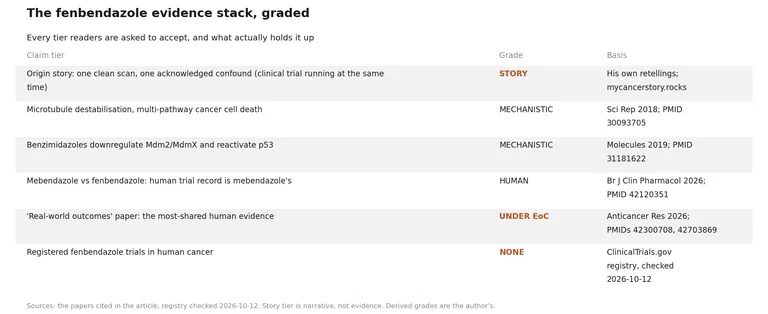
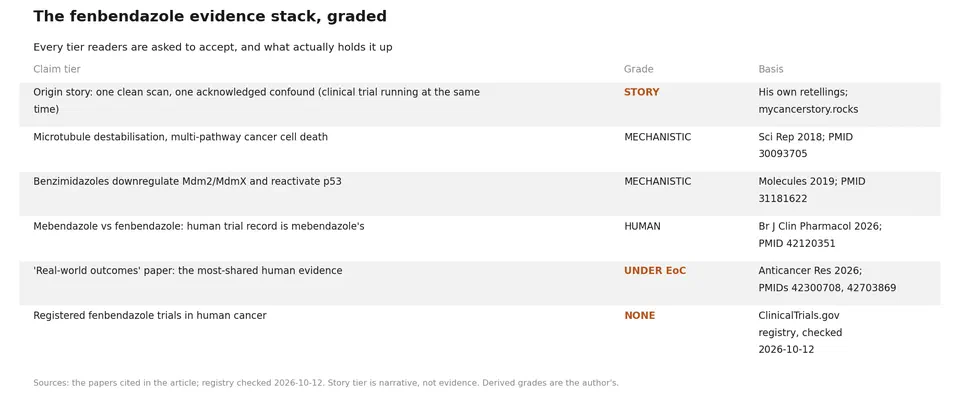
- The fenbendazole story begins with one man's clean scan and his own honest caveat: he was simultaneously enrolled in a clinical trial of an experimental therapy, and he says he will never know which of the two deserved the credit.
- The preclinical mechanisms are real: fenbendazole destabilises microtubules and benzimidazoles activate p53 by downregulating Mdm2 and MdmX in tumour cells.
- Human evidence is thin and unevenly distributed: the systematic review with real human data is in mebendazole for brain tumours, not fenbendazole.
- The most-shared human outcomes paper in this space, the 'real-world' ivermectin and mebendazole cancer study, has been under Expression of Concern since 2026.
- None of this licenses delaying conventional treatment. The question is whether the mechanisms justify properly designed trials, and the answer is yes, several of which are running.
The fenbendazole story has an origin point, and it is worth reading carefully, because everything built on top of it inherits the shape of what happened there.
In 2016 an Oklahoma man named Joe Tippens was diagnosed with small cell lung cancer, widespread and grim. He has told the story many times since, and the version on his own site, in his own words, includes a detail that most of the people who repeat the story leave out: he was enrolled in a clinical trial of an experimental therapy at the same time a veterinarian friend suggested a dog dewormer called Panacur, whose active ingredient is fenbendazole, 222 mg a day. His scans came back clean. He has been clean since. And he has always said, plainly, that he will never know whether the dewormer or the trial drug deserved the credit.
That is the honest version of the origin. This article grades what is actually underneath: the mechanisms, the human data, and the safety picture. The short version: the mechanisms are real and interesting, the human evidence is thin and lives mostly in mebendazole rather than fenbendazole, and the most-shared human outcomes paper in this space is under Expression of Concern.
The mechanisms are real#
Start with what is not in dispute, because it is the strongest part of the whole story.
Fenbendazole belongs to the benzimidazole class, the same family as mebendazole, which is an approved human medicine. The clearest preclinical paper is Duan and colleagues in Scientific Reports (2018, PMID 30093705): fenbendazole acts as a moderate microtubule destabilising agent and kills cancer cells through multiple pathways at once. Microtubules are the cell's scaffolding and its freight network, and taxanes and vinca alkaloids, two of oncology's working drug classes, already hit them. Fenbendazole's disruption is moderate rather than catastrophic, which matters: the paper's title says so deliberately.
The second mechanism is more interesting and less widely reported. A 2019 paper in Molecules (PMID 31181622) showed that benzimidazoles downregulate Mdm2 and MdmX, the two proteins cancers use to suppress p53, and reactivate p53 in tumour cells that overexpress MdmX. p53 is the genome's integrity checkpoint; half of human cancers disable it somehow. A cheap anthelmintic that re-arms it in p53-intact tumours is a genuinely interesting idea, and the mechanism has a plausible route to selectivity, because the effect is strongest in cells that depend on the Mdm2/MdmX shield.
For mebendazole specifically there is more: a 2022 paper in Breast Cancer Research (PMID 36578038) found it reduces distant organ metastases partly by suppressing integrin beta-4 expression and cancer stemness, and a 2023 paper in Cancers (PMID 36831670) found it disrupts hypoxia-inducible factor signalling in breast cancer cells. These are cell-line and animal results. They say the biology is not fantasy. They do not say the clinic works.
The human evidence lives in mebendazole, not fenbendazole#
Here is the detail that changes how you should read almost everything in this space: the benzimidazole with actual human trial data in oncology is mebendazole, the approved human drug, not fenbendazole, the veterinary one.
A 2026 systematic review in the British Journal of Clinical Pharmacology (PMID 42120351) covers mebendazole repurposing in neuro-oncology from first principles: case series, early-phase trials in glioblastoma, safety at continuous dosing, survival signals in combination regimens. The trials are small and mostly early-phase, and nothing is established. But there is a human pharmacology literature, dosing experience, and a trial record. Fenbendazole has none of that. When the two are discussed as interchangeable, which is the norm in popular discussion, the human evidence of one is silently lent to the other. They are not interchangeable: mebendazole is the molecule with the trial record; fenbendazole is the molecule with the story.
The most-shared human paper is under Expression of Concern#
In 2025 the space got what it had been waiting for: a "real-world clinical outcomes" study of ivermectin and mebendazole in cancer patients, published in Anticancer Research, reported as human proof that the protocols work. It spread everywhere, and it is the citation behind most current claims that human outcomes data exists.
Check its current status. The journal has placed the paper under Expression of Concern, with an update notice published in 2026 (PMIDs 42300708 and 42703869). An Expression of Concern is not a retraction, but it is the journal telling readers that serious questions about the paper's reliability have been raised and not resolved. The single most-shared piece of human evidence in the fenbendazole-and-friends space is currently a paper you are supposed to read with that warning attached.
This is worth sitting with. In the evidence system, a paper's weakness is printed on the record and permanently searchable. The system is slower than a headline. It is also the only part of this space that ever corrects itself.
The safety picture is real but misused#
The pro-fenbendazole argument leans on safety, and the safety record is genuinely good, within its actual boundary. Fenbendazole has decades of veterinary use. The joint FAO/WHO expert committee evaluated it for residue safety in food animals in 1999 (WHO Technical Report, cited in the JECFA record, PMID 10416362). Mebendazole has decades of human use as a dewormer, and its continuous high-dose oncology dosing carries known liver-enzyme risks that the neuro-oncology trials monitored.
What the safety record does not support is the inference that runs "safe in dogs, therefore safe at any human dose for any duration, therefore risk-free to combine with everything." Continuous high-dose fenbendazole in humans has no pharmacokinetic study, no drug-interaction matrix, and no monitored cohort. Nobody has collected it. Safety data requires recording what happened to everyone, including the people who stopped, the people whose liver enzymes rose, and the people whose cancer progressed while they were dosing.
What would settle it, and what is actually running#
The question "does fenbendazole work in human cancer" is answerable, and the route is the boring one: registered trials with a control arm, a validated dose, and pre-registered endpoints. Mebendazole is further along that road in brain tumours. For fenbendazole itself, there is no registered trial. The ivermectin-in-oncology trial wave, covered separately, is the closest cousin, and its results will say as much about trial design in repurposed drugs as about ivermectin.
Until then, the honest grading reads like this. Mechanisms: real, multiple, and worth following. Safety: probably tolerable at deworming doses, unknown at continuous self-prescribed oncology doses. Human efficacy: unevidenced for fenbendazole, early-phase for mebendazole, and the loudest human paper in the space is under Expression of Concern. The man at the origin of the story told you himself which part was uncertain. The empire built on his scan dropped that part first.
Sources#
Core preclinical and mechanistic
- Duan Q, Liu Y, Rockwell S. Fenbendazole acts as a moderate microtubule destabilizing agent and causes cancer cell death by modulating multiple cellular pathways. Sci Rep 2018. PMID 30093705 [AN]
- Benzimidazoles downregulate Mdm2 and MdmX and activate p53 in MdmX overexpressing tumor cells. Molecules 2019. PMID 31181622 [AN]
- Mebendazole prevents distant organ metastases in part by decreasing ITGβ4 expression and cancer stemness. Breast Cancer Res 2022. PMID 36578038 [AN]
- Mebendazole treatment disrupts the transcriptional activity of HIF-1 and HIF-2 in breast cancer cells. Cancers 2023. PMID 36831670 [AN]
Human evidence and its status
- From anthelmintic to neuro-oncology: a systematic review of mebendazole repurposing for brain tumour therapy. Br J Clin Pharmacol 2026. PMID 42120351 [SR]
- Expression of Concern: Real-world clinical outcomes of ivermectin and mebendazole administration in cancer patients. Anticancer Res 2026. PMID 42300708 and update PMID 42703869 [PP]
- Oral fenbendazole for cancer therapy in humans and animals: a review. Anticancer Res 2024. PMID 39197912 [PP]
The phenomenon
- Tippens J. The Protocol, his own published regimen and its disclosure notes, continuously updated at mycancerstory.rocks. The clinical-trial confound appears in his own retellings.
- FAO/WHO Joint Expert Committee on Food Additives, fenbendazole residue evaluation. WHO Tech Rep Ser 1999. PMID 10416362 [PP]
Educational content, not medical advice. Work with a clinician for diagnosis and treatment decisions.