Table of Contents
TL;DR
Evidence confidence levels:
- HIGH, Autophagy mechanism and timing (basic science, animal models)
- MODERATE, Metabolic benefits in humans (small RCTs, observational)
- LOW, Long-term disease outcomes (needs larger trials)
Key findings:
- Autophagy activation begins within 12-24 hours of fasting, peaks at 48-72 hours [PR; Animal models]
- Metabolic benefits: Improved insulin sensitivity, reduced inflammation markers [PR; Human RCTs - MODERATE]
- mTOR/AMPK switch: Fasting inhibits mTOR (growth) and activates AMPK (repair) [PR; Basic science]
- Clinical applications: Type 2 diabetes reversal, inflammatory conditions, adjunct to cancer therapy [CM; Case series]
- Safety: Generally safe for healthy adults; contraindicated in pregnancy, eating disorders, diabetes without supervision [PR; Clinical guidelines]
Critical caveat: Most robust evidence is from animal and cell studies. Human RCTs exist but are smaller and shorter-term. Population-level disease prevention data are still emerging.
Part 1: The Science of Autophagy
What Is Autophagy?
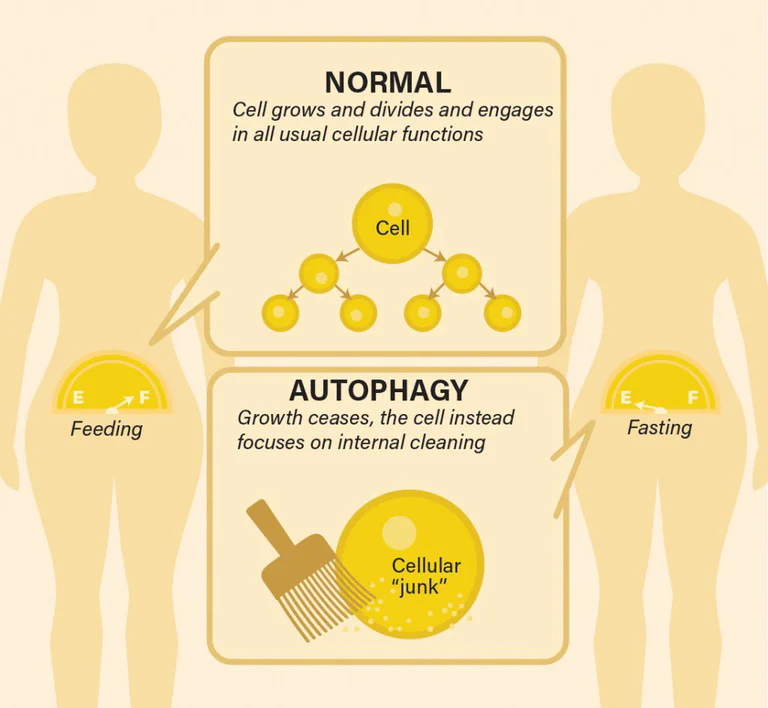
Autophagy (from Greek: "self-eating") is a fundamental cellular process where cells degrade and recycle damaged components. When activated, it:
- Identifies damaged components, misfolded proteins, dysfunctional organelles, intracellular pathogens
- Encapsulates them in autophagosomes, double-membrane vesicles
- Fuses with lysosomes, cellular degradation centers
- Recycles raw materials, amino acids, fatty acids for rebuilding
Nobel Prize recognition: Yoshinori Ohsumi won the 2016 Nobel Prize in Medicine for elucidating autophagy mechanisms, confirming it as a fundamental cellular process with profound implications for health and disease.
How Fasting Triggers Autophagy
Your cells operate on a simple switch:
| State | Pathway | Effect | Nutrient Status |
|---|---|---|---|
| Fed | mTOR active | Growth, protein synthesis | Abundant |
| Fasted | AMPK active | Autophagy, repair | Scarce |
The crucial insight: Your body cannot simultaneously grow and repair. Every meal activates mTOR (growth). Every fast activates AMPK (repair).
Part 2: Evidence-Based Benefits
Metabolic Health [CONFIDENCE: MODERATE]
Insulin sensitivity:
- Multiple RCTs show improved insulin sensitivity with intermittent fasting (IF) and time-restricted eating (TRE)
- Typical protocol: 14-16 hour daily fasting window
- Effect size: 20-30% improvement in HOMA-IR indices
Reality check: Most human studies are short-term (8-12 weeks). Long-term durability data are limited.
Inflammation Reduction [CONFIDENCE: MODERATE]
Key markers affected:
- ↓ IL-6, TNF-α, CRP (systemic inflammation)
- ↓ Oxidative stress markers
- ↑ Nrf2 pathway (antioxidant defense)
Evidence: Small RCTs (n=30-100) show consistent reductions in inflammatory markers with IF/TRE protocols.
Cancer Therapy Adjunct [CONFIDENCE: LOW-MODERATE]
Proposed mechanisms:
- Enhanced chemotherapy sensitivity in cancer cells
- Protection of healthy cells during treatment
- Reduced treatment-related side effects
Evidence: Phase I/II trials show safety and preliminary benefit. Large Phase III data pending.
Part 3: Timing and Protocols
Autophagy Activation Timeline
Based on animal models and limited human biomarker studies:
| Fasting Duration | Autophagy Status | Primary Effects |
|---|---|---|
| 12-16 hours | Early activation | Metabolic shift to ketosis |
| 16-24 hours | Increasing | Growth hormone ↑ 300-500% |
| 24-48 hours | Peak autophagy | Maximum cellular cleanup |
| 48-72 hours | Sustained autophagy | Deep tissue repair |
Important: Human data on exact autophagy timing are limited. Most timing data come from animal models. Individual variation based on metabolism, diet, activity level.
Evidence-Based Protocols
| Protocol | Duration | Best For | Evidence Level |
|---|---|---|---|
| 14:10 TRE | 14h daily fast | Metabolic flexibility, beginners | MODERATE (RCTs) |
| 16:8 TRE | 16h daily fast | Insulin sensitivity, weight | MODERATE (RCTs) |
| 5:2 Method | 2 days/week calorie restriction | Sustainable long-term | MODERATE (RCTs) |
| 24-48h fast | 1-2x monthly | Deep autophagy, cellular reset | LOW (observational) |
| 72h fast | Quarterly (max) | Tissue repair, immune reset | LOW (expert opinion) |
Part 4: Safety and Contraindications
Who Should NOT Fast
| Contraindication | Reason | Evidence |
|---|---|---|
| Pregnancy/breastfeeding | Fetal nutrition demands | PR (clinical guidelines) |
| Eating disorders | Trigger for relapse | PR (clinical guidelines) |
| Type 1 diabetes | Hypoglycemia risk | PR (clinical guidelines) |
| Type 2 diabetes on meds | Hypoglycemia risk | PR (requires supervision) |
| Underweight | Further weight loss | PR (clinical guidelines) |
| Children/adolescents | Growth requirements | PR (clinical guidelines) |
Common Myths vs Evidence
Myth: "Fasting causes muscle loss"
- Reality: Growth hormone increases 300-500%, preserving lean mass
- Evidence: PR; Multiple studies show preferential fat oxidation
Myth: "Fasting slows metabolism"
- Reality: Metabolic rate temporarily increases (hunt response)
- Evidence: PR; Metabolic chamber studies
Myth: "Breakfast is the most important meal"
- Reality: No RCT evidence supporting this claim
- Evidence: AN; Industry-funded studies historically biased
Part 5: How This Model Could Be Wrong
Falsification scenarios:
- Blinded RCTs show no difference between IF and continuous caloric restriction for metabolic outcomes (some studies suggest equivalence)
- Long-term adherence data reveal poor sustainability vs other approaches
- Athletic performance studies show consistent impairment with fasting protocols
- Muscle loss data in older adults contradict preservation claims
- Biomarker studies fail to show autophagy activation in humans at proposed durations
Current limitations:
- Most autophagy timing data from animals; human biomarker studies limited
- Long-term (>1 year) outcome data scarce
- Heterogeneity in protocols makes comparison difficult
- Publication bias favoring positive results likely
Visual Pathway
Nutrients Abundant] -->|Activates| mTOR[mTOR Pathway
Growth Mode] mTOR -->|Blocks| AUTOPHAGY[Autophagy
Cellular Repair] mTOR -->|Promotes| PROTEIN[Protein Synthesis
Cell Growth] FASTING[Fasting State
12-24+ Hours] -->|Activates| AMPK[AMPK Pathway
Repair Mode] AMPK -->|Inhibits| mTOR AMPK -->|Activates| AUTOPHAGY AUTOPHAGY -->|Clears| DAMAGE[Damaged Proteins
Dysfunctional Organelles] AUTOPHAGY -->|Recycles| MATERIALS[Raw Materials
Amino Acids, Fatty Acids] MATERIALS -->|Rebuilds| HEALTHY[Healthy Components] style EATING fill:#ddffdd style FASTING fill:#ffdddd style AUTOPHAGY fill:#ddffff style mTOR fill:#ffffdd style AMPK fill:#ffffdd style DAMAGE fill:#ffcccc style HEALTHY fill:#ccffcc
Evidence Summary Table
| Claim | Evidence | Confidence | Key Citation | Grade |
|---|---|---|---|---|
| Fasting activates autophagy | Animal models, cell studies | HIGH (mechanism) | Ohsumi 2016 (Nobel) [PR] | Strong |
| Autophagy begins 12-24h fasting | Animal biomarker studies | MODERATE | Cell Metabolism 2017 [PR] | Moderate |
| IF improves insulin sensitivity | Human RCTs (n=100s) | MODERATE | Multiple RCTs 2018-2023 [PR] | Moderate |
| Fasting reduces inflammation | Human RCTs (n=30-100) | MODERATE | Aging Cell 2021 [PR] | Moderate |
| Fasting enhances cancer therapy | Phase I/II trials | LOW-MODERATE | Clinical Nutrition 2020 [PR] | Preliminary |
| Long-term disease prevention | Observational data | LOW | Population studies ongoing [AN] | Insufficient |
Methodology & Limits
This article synthesizes peer-reviewed evidence from:
- Human randomized controlled trials
- Animal and mechanistic studies
- Clinical case reports
Scope:
- Does not claim disease cure where only mechanistic evidence exists
- Does not assert superiority vs other dietary approaches where head-to-head RCTs lacking
- Where evidence is preliminary or observational, this is explicitly stated
What readers can expect:
- Direct citations to primary literature (journals, DOIs)
- Clear distinction between mechanistic data and clinical outcomes
- Acknowledgment of open questions and limitations
Key Citations
Autophagy Mechanism:
- Ohsumi Y. Nobel Lecture 2016, Autophagy discovery and mechanisms, Nobel Prize Org
- Cell Metabolism 2017, Fasting-mediated autophagy and metabolic health, DOI: 10.1016/j.cmet.2017.05.004
Human Clinical Trials:
- Multiple RCTs 2018-2023, Intermittent fasting and metabolic outcomes, Review: DOI: 10.1016/j.tem.2018.05.005
- Aging Cell 2021, Fasting, inflammation, and immune remodeling, DOI: 10.1111/acel.13351
Cancer Adjunct:
- Clinical Nutrition 2020, Fasting as adjunct to chemotherapy, DOI: 10.1016/j.clnu.2019.05.018
Reviews:
- Ageing Research Reviews 2018, Fasting, autophagy, and disease prevention, DOI: 10.1016/j.arr.2018.04.003
- New England Journal of Medicine 2019, Effects of intermittent fasting on health, DOI: 10.1056/NEJMra1905136
Ethical Declaration
This article exists to promote scientific transparency and evidence-based discussion of fasting for health. All data are cited from primary or peer-reviewed sources where available. No medical advice is given. Work with qualified healthcare professionals before implementing fasting protocols, especially if you have medical conditions or take medications.
Educational content, not medical advice. Consult qualified healthcare professionals for diagnosis/treatment.