Table of Contents
Key Takeaways
- The EMA's own BWP position paper, released under ASK-289849, confirms in writing that all four SV40 elements are present in the BNT162b2 plasmid starting material and were not highlighted at original authorisation.
- The public sequence OR134577.1 shows a 695 bp SV40 footprint at 100% identity to strain 776; the SV40 promoter is the designed mammalian promoter for the downstream KanR/NeoR cassette, not a vestigial fragment.
- The backbone traces to pCMV-Script (1997) and the pSV2 family (1981), whose founding paper documented chromosomal integration as the basis of the transformation system; Moderna's plasmid contains zero SV40 sequence.
- The 10 ng compliance figure is measured on Drug Substance, before LNP encapsulation; the Drug Product in the syringe is not what is tested. What this article does not claim is itemised in its claim register.
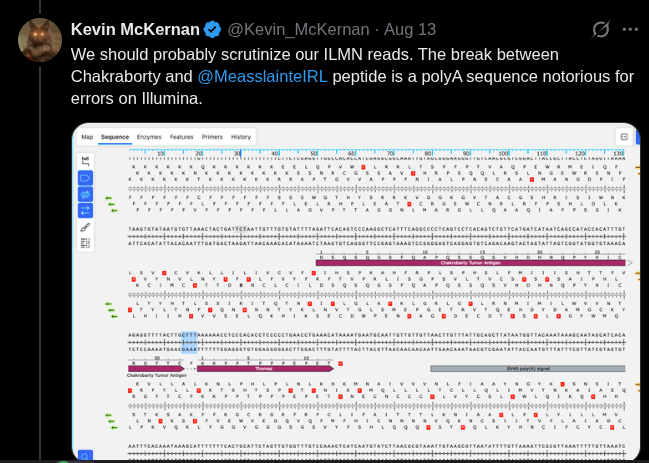
Kevin McKernan, 13 August 2026: "We should probably scrutinize our ILMN reads. The break between Chakraborty and @MeasslainteIRL peptide is a polyA sequence notorious for errors in Illumina."
Source documents. The EMA BWP position on residual DNA in Comirnaty (EMA/CHMP/BWP/61303/2023, adopted 31 October 2023, released to me under ASK-289849 batch 2 via release letter EMA/142071/2026, 19 June 2026). The public GenBank deposit OR134577.1 (McKernan et al., 20 June 2023). Every coordinate and motif call in this article is reproducible from these two sources. The full companion paper is archived on Zenodo: DOI 10.5281/zenodo.21918632.
TL;DR (1-minute read)
Why this article exists
On 19 June 2026, the European Medicines Agency released a document to this author under access-to-documents request ASK-289849. The document is the BWP position on residual DNA in Comirnaty, adopted by the Biologics Working Party at its meeting of 30 to 31 October 2023 (reference EMA/CHMP/BWP/61303/2023).
That document contains three regulatory concessions the EMA committed to in writing. This article uses the EMA's own words as the anchor for a sequence-level annotation of the BNT162b2 plasmid that any reader can verify from the public GenBank record.
The public does not need to take the author's word for what is in the vaccine plasmid. The sequence is public. The EMA's position is now public (released under ASK-289849). The reader can check both.
What the EMA's own document says
Three concessions in the BWP position paper frame everything that follows. The quotes are verbatim from the released document.
Concession 1. The SV40 elements are in the plasmid.
Page 6 (BWP assessment):
"BioNTech/Pfizer has confirmed that SV40 promoter, SV40 Enhancer, SV40 Origin, and SV40 polyA signal elements are present in the DNA plasmid, which is a starting material in the manufacturing process of BNT162b2 / Comirnaty Drug Substance."
This is the EMA on the record. The "no SV40 in Comirnaty" position is closed. All four SV40 elements are present: the promoter, the enhancer, the origin of replication, and the polyadenylation signal.
Concession 2. The manufacturer did not disclose the SV40 content at the time of the original authorisation.
Page 6 (BWP assessment):
"While the full DNA sequence of the plasmid starting material was provided in the initial marketing authorisation application for Comirnaty, the applicant did not specifically highlight the SV40 sequence, as it was considered to be a non-functional part of the plasmid. They have since clarified this information in response to questions raised by EMA."
The full DNA sequence was provided. The SV40 sequence was not highlighted. The EMA considers this a non-disclosure that required subsequent "clarification." The regulatory record now states that the SV40 content was not identified at MAA.
Concession 3. The testing regime does not measure what is in the syringe.
Page 5 (Rationale for testing at Drug Substance level):
"Analysis of finished drug product (DP) samples requires additional sample manipulation, including extraction of residual DNA from the LNP, which may impact the ability to sensitively detect and characterize residual DNA."
Translation: the regulatory compliance number (10 ng DNA per 30 microgram RNA dose) is measured on the Drug Substance, the upstream intermediate before lipid nanoparticle encapsulation. The Drug Product, what is actually in the syringe and injected into people, is not the material being tested. The justification is technical (the LNP makes DNA harder to extract), but the consequence is that the number on the compliance certificate does not measure what the patient receives.
What is in the plasmid
The public GenBank deposit OR134577.1, recovered from bivalent vaccine vials by Kevin McKernan and colleagues in June 2023, is the complete 7,810 base pair sequence of the BNT162b2 production plasmid. Eleven genetic elements are identifiable by motif scan against public reference databases:
| Element | Position | Length | Function |
|---|---|---|---|
| SV40 second cassette (non-coding): splice/poly(A) module | 165 to 501 | 337 bp | Small-t intron fragment, T-ag 3' terminus, three SV40 poly(A) signals |
| SV40 CPD phospho-degron (KKPPTPPPEPET) | 319 to 354 | 36 bp | Inherited from T-ag, no upstream ATG |
| SV40 enhancer / promoter / origin | 1096 to 1453 | 358 bp | Drives mammalian expression of KanR |
| Kanamycin / neomycin resistance | 1487 to 2304 | ~817 bp | Bacterial and mammalian selection |
| BsaI Type IIS assembly scar | 2610 | 6 bp | Golden Gate assembly remnant |
| T7 promoter | 3603 to 3619 | 17 bp | Drives in vitro transcription of spike mRNA |
| Spike CDS (BA.4/5 bivalent insert) | 3673 to 7479 | 3,807 bp | The vaccine mRNA product |
| AarI Type IIS linearisation site | 7583 | 7 bp | Linearisation for in vitro transcription |
| SapI Type IIS assembly scar | 79 | 7 bp | Assembly remnant |
| SV40 polyadenylation signals (3 signals) | within 220 to 501 | ~282 bp | Native SV40 poly(A) cassettes |
| f1 / ColE1 origin | remainder | ~3,000 bp | High-copy bacterial replication origin |
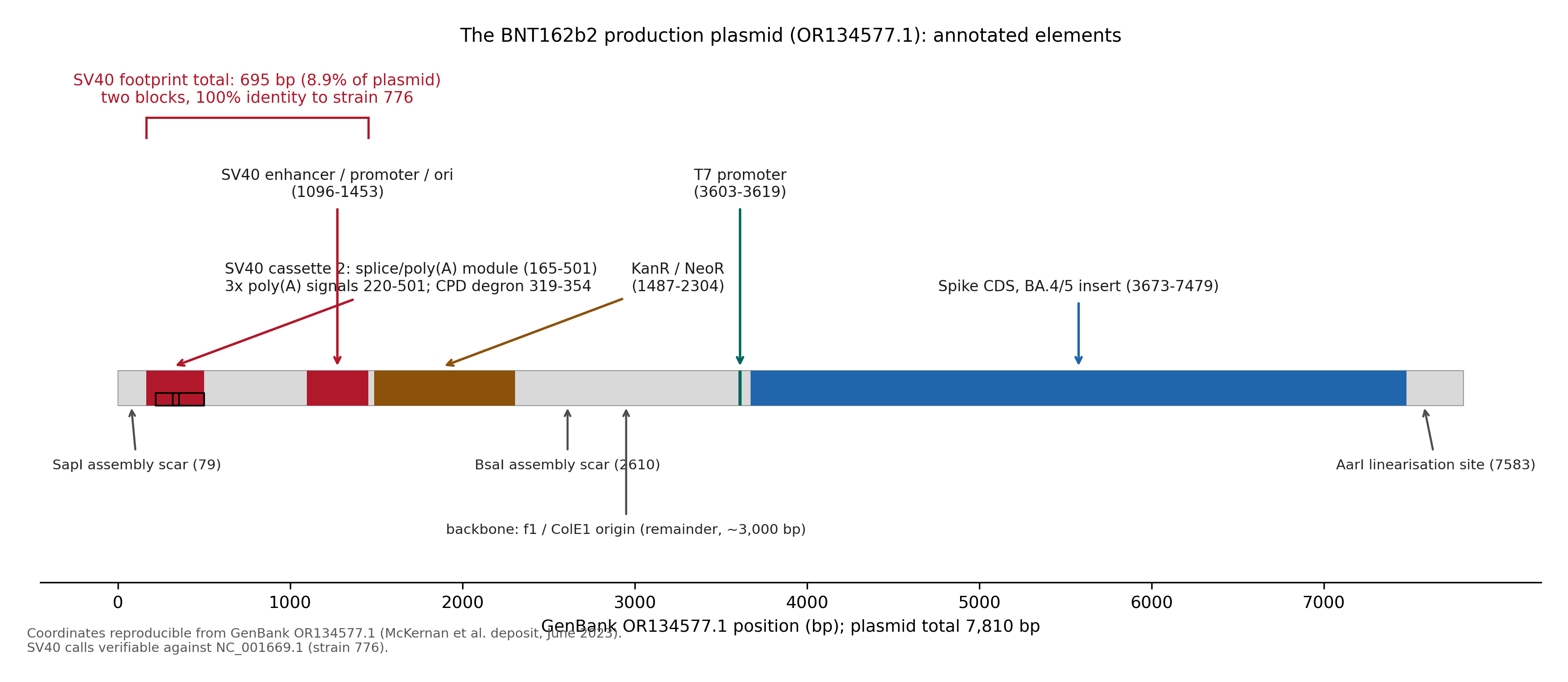
The mRNA vaccine product (the T7 transcript) is spike-only. The SV40, KanR, and backbone elements are in the plasmid DNA template, not in the mRNA. Any exposure route for SV40 and KanR sequences in a vaccinated person is via residual plasmid DNA co-formulated in the lipid nanoparticle, not via the mRNA itself.
This is the sequence-level confirmation of EMA concession 1. The EMA said the four SV40 elements are present. The public sequence shows exactly where they are, how long they are, and what else is around them.
The SV40 footprint in detail
The plasmid contains 695 bp of SV40 sequence (8.9% of the total plasmid) at 100% identity to SV40 strain 776, the ATCC reference. The footprint has two functional blocks.
Block 1 (positions 165 to 501): the second SV40 cassette, a non-coding splice and polyadenylation module. This is not a T-ag gene. It is the plasmid's second SV40 cassette, and it has three parts: a 60 bp fragment of the small-t antigen 19s mRNA intron (positions 165 to 224; SV40 coordinates 4569 to 4628), the 3' terminal 138 nucleotides of the SV40 large T-antigen gene (positions 220 to 357, including the phosphodegron motif at T-ag residues 697 to 708, KKPPTPPPEPET), and all three native SV40 polyadenylation signals. This is the SV40 poly(A) cassette that the EMA confirmed is present.
The T-ag fragment does not translate. There is no start codon upstream of it, no promoter that would transcribe it, no splice donor and acceptor pair that could assemble a T-ag mRNA, and GC content below the CpG island threshold for active promoters. The 138 nt fragment is 6.5% of the T-ag CDS. Translation of T-ag protein from this plasmid is excluded by the sequence evidence.
Block 2 (positions 1096 to 1453): the enhancer, promoter, and origin. The full SV40 regulatory region in functional form. All three T-antigen binding sites. Both 72 bp enhancer repeats (the full enhancer). The early promoter with its 21 bp repeat triplet. The origin of replication intact. This is the SV40 promoter/enhancer and origin that the EMA confirmed are present.
This block drives mammalian expression of the downstream kanamycin/neomycin resistance gene. That is the design intent: G418 selection of transfected mammalian cells.
This is not whole SV40 virus. The plasmid contains less than 7% of the T-antigen gene. None of the Rb-binding, p53-binding, helicase, or ATPase domains. No SV40 miR-S1. No capsid DNA.
The architectural correction: SV40 is KanR's promoter
The BWP position paper describes the SV40 elements as functionally inert. The BWP assessment (page 5) characterises the SV40 sequence as having been "considered to be a non-functional part of the plasmid."
The public sequence shows this characterisation is architecturally wrong.
The SV40 enhancer/promoter block at OR134577.1 positions 1096 to 1453 ends 34 base pairs upstream of the kanamycin/neomycin resistance CDS at position 1487. In pCMV-Script, the commercial vector from which this backbone derives, this is the designed promoter for mammalian expression of the KanR/NeoR gene. The 358 bp SV40 block is not a vestigial fragment. It is the upstream regulatory element for the downstream selection marker.
This is the design intent of the parent vector. Stratagene's pCMV-Script was engineered so that the SV40 early promoter drives NeoR expression in mammalian cell lines for G418 selection during transient or stable transfection workflows. That functional architecture was inherited unchanged into the BNT162b2 production plasmid through the pST vector family (Holtkamp et al. 2006).
The regulatory frame that calls SV40 "non-functional" is looking at the bacterial propagation step only. In E. coli, the SV40 promoter is indeed silent. But the plasmid's purpose is not bacterial propagation. Its purpose is to serve as the DNA template for in vitro transcription of the spike mRNA, and before that, to be manufactured, purified, and quality-controlled in a process where the mammalian selection architecture is part of the vector design. The SV40 promoter is functional in the design context that matters: any mammalian cell that receives this DNA.
The vector genealogy: from 1981 to BNT162b2
The backbone of the BNT162b2 plasmid traces to pCMV-Script, a commercial cloning vector sold by Stratagene in 1997 (GenBank AF028239.1). Three independent sequence tests confirm this.
Test 1. The 3,469 bp backbone block of OR134577.1 matches pCMV-Script as a single continuous block at 99.97% identity. The competing candidate, pcDNA3.1(+), matches only as six disjoint fragments.
Test 2. Every named backbone feature (the SV40 splice/poly(A) cassette, the SV40 enhancer/promoter/ori, the f1 origin, the KanR gene) matches pCMV-Script at 100% over the full feature length. pcDNA3.1(+) matches every feature only partially, with SNPs and truncations.
Test 3. Four diagnostic positions in the kanamycin resistance gene distinguish pCMV-Script from pcDNA3.1(+). OR134577.1 matches pCMV-Script at all four. The probability of pcDNA3.1(+) ancestry is 0.39%.
Primary literature confirmation. Holtkamp et al. 2006 (Blood, PMID 16940422), the founding paper of BioNTech's pST mRNA vector family from the Mainz group of Sahin and Tureci, states that pST1 was built "into the pCMV-Script-Vector (Stratagene, La Jolla, CA)."
The developmental chain:
pSV2-gpt (Mulligan and Berg, PNAS 1981) -> pCMV-Script (Stratagene, 1997) -> pST1 (Holtkamp et al., Blood 2006) -> pST family -> BNT162b2 production plasmid (OR134577.1)
The SV40 content has been in this vector family since 1981. It is not a pandemic-era insertion. It is not a 1997 commercialisation decision. It is the original design of the pSV2 vector family, transmitted through pCMV-Script into BioNTech's pST platform, which has carried it since 2006.
Moderna made a different choice. The Moderna mRNA-1273 plasmid (OR134578.1) contains zero SV40 sequence. Zero base pairs. The same vaccine modality, the same regulatory pathway, the same lipid nanoparticle delivery, and Moderna used an SV40-free backbone. SV40 inclusion was a manufacturer design choice, not a technological necessity.
The 1981 integration property
The two SV40 elements in the BNT162b2 plasmid correspond to the two SV40 functional blocks defined in the founding paper of the pSV2 vector family. Mulligan and Berg, in their 1981 PNAS paper (PMID 7017722), described the SV40 origin/promoter block and the SV40 polyadenylation block at the exact coordinates inherited in OR134577.1.
The same paper documented something else, on pages 2075 to 2076:
"[Transformants] contain one to five copies of the transfecting DNA associated with, and most probably integrated into, cellular DNA sequences."
The pSV2 vector family, from which the BNT162b2 plasmid descends, was characterised in its founding publication as integrating into the host cell chromosome. Integration was not a side effect. It was the basis of the transformation system. The SV40 promoter/enhancer drives marker gene expression from an integrated copy, and stable inheritance of the transformed phenotype requires chromosomal integration.
This property has been documented in the primary literature for 45 years.
The BWP position paper says: "There is no scientific evidence that any of these SV40 fragments can act as insertional mutagens." (page 5). This statement addresses insertion of a functional SV40 virus. It does not address the integration property of the pSV2 vector family documented by Mulligan and Berg. The manufacturer's risk frame is replication. The property documented in the founding paper of the vector family is integration.
What is redacted
The manufacturer's dossier section eCTD 3.2.S.2.3 ("Source, History and Generation of Plasmids") is where the SV40 content, the pCMV-Script ancestry, and the vector genealogy belonged. It identifies the production plasmid as pST4-1525 and contains:
- Figure 3.2.S.2.3-1: the plasmid map
- Figure 3.2.S.2.3-2: the complete pST4-1525 sequence
Both figures are redacted in the public release.
The EMA describes pST4-1525 as 7,824 base pairs. The public GenBank deposit OR134577.1 is 7,810 base pairs. A 14 bp difference. The most likely explanations are assembly boundary trim, propagation drift, or a formulation difference. But the only way to resolve the gap definitively is to compare OR134577.1 against the unredacted pST4-1525 sequence.
That sequence exists. It is in Figure 3.2.S.2.3-2. It is redacted.
What the BWP committed to do, and what has not been done
The BWP position paper (31 October 2023) committed to two actions by 1 December 2023:
"1. Further analytical evaluation of residual DNA on DS level - planned completion: 1 Dec 2023. Analysis and characterization of the size distribution of residual DNA fragments and residual intact circular plasmid. Assessment of the presence of SV40 sequences in residual DNA."
"2. Capability of the residual DNA plasmid replication in bacteria (i.e., transformation capability) - planned completion: 1 Dec 2023."
These were commitments to tests that, as of the document's date, had not been performed. The document is dated October 2023. This article is dated August 2026.
The BWP also said (page 7):
"Confirmatory testing at finished product level by the manufacturer and/or independent testing carried out by OMCL to confirm the levels of residual DNA in commercial batches of Comirnaty could also be considered."
"Could be considered" is the regulator's way of saying "is not currently required." As of the date of this article, finished-product (Drug Product) testing has not been mandated.
The category error: mRNA safety is not residual DNA safety
A pattern has emerged in the regulatory and publishing response to the residual DNA question. Safety arguments constructed for the mRNA product are applied to the residual plasmid DNA as if the two molecular species were interchangeable. They are not.
The mRNA is the intended product. It is transcribed in vitro from the plasmid template, capped, polyadenylated, purified, and encapsulated in lipid nanoparticles. It is designed to be translated in the cytoplasm. It does not enter the nucleus. It does not integrate. The safety profile of a non-integrating, cytoplasmic mRNA is well established.
Residual plasmid DNA is a process contaminant. It is the template itself, carryover from the in vitro transcription reaction. It is a different molecular species with different properties. It is double-stranded DNA, not single-stranded RNA. It contains the full plasmid backbone: the SV40 enhancer/promoter, the KanR/NeoR cassette, the f1 origin, and the bacterial replication origin. It is stable in ways the mRNA is not. It can be transported into the nucleus. It can persist.
The category error was documented in a recent commentary by Polykretis et al. (2026, Oncotarget) on the peer-review response to a residual DNA case report. Two rejection letters illustrate the error. The first stated that "mRNA vaccines only synthesize antigenic proteins in the cytoplasm and do not involve gene integration or replication" and concluded that "COVID-19 mRNA vaccines do not enter the cell nucleus, and thus cannot cause cancer." This is true of the mRNA. It is not an argument about the residual DNA. The second stated that "insertional mutagenesis is a well-known risk for certain viral vector-based gene therapies" but dismissed the concern because "mRNA vaccines are non-integrating by their fundamental design."
The residual DNA is not the mRNA. A safety argument that begins and ends with the properties of the mRNA product does not address the properties of the contaminant. The regulatory question is whether a double-stranded DNA molecule carrying an SV40 enhancer/promoter and a mammalian selection cassette, delivered inside a lipid nanoparticle, presents a different risk profile from the mRNA it accompanies. That question has not been answered by being assumed away.
How to verify this yourself
You do not need to trust this article. You can reproduce every coordinate and every identity claim from the public record.
- Download OR134577.1 from NCBI (the BNT162b2 plasmid).
- Download NC_001669.1 from NCBI (SV40 strain 776 reference).
- Download AF028239.1 from NCBI (pCMV-Script).
- Install Biopython and BLAST (both free, both open-source).
- BLAST OR134577.1 against NC_001669.1: you will recover the 695 bp SV40 footprint at 100% identity.
- BLAST the OR134577.1 backbone against AF028239.1: you will recover the 3,469 bp continuous match to pCMV-Script at 99.97% identity.
- Check the four diagnostic KanR positions (2362, 2662, 2708, 2872 in pCMV-Script coordinates): OR134577.1 matches pCMV-Script at all four.
The EMA BWP position paper is available from the author on request (released under ASK-289849) or directly from the European Medicines Agency under Regulation (EC) No 1049/2001.
What this article does not claim
This article does not claim that SV40 large T-antigen protein is produced from the BNT162b2 plasmid. The sequence evidence excludes T-ag translation (no start codon, no promoter, no splice sites).
This article does not claim that whole SV40 virus is present in the vaccine. Less than 7% of the T-ag gene is in the plasmid. No capsid DNA. No SV40 miR-S1.
This article does not claim a deliberate pandemic-era SV40 insertion. The SV40 content is a 1981 legacy feature of the pSV2 vector family, inherited through pCMV-Script (1997) into the pST family (2006). It is a long-standing platform design choice that survived fourteen years of development.
What this article does claim is that:
- The EMA has confirmed in writing that all four SV40 elements are in the BNT162b2 plasmid starting material.
- The EMA has confirmed in writing that while the full DNA sequence of the plasmid was provided in the initial application, the applicant did not specifically highlight the SV40 sequence, as it was considered to be a non-functional part of the plasmid.
- The public GenBank sequence shows the SV40 footprint is 695 bp at 100% identity to SV40 strain 776, traceable to the pSV2 vector family whose integration property has been documented since 1981.
- The Moderna plasmid contains zero SV40 sequence, making the SV40 inclusion a manufacturer design choice.
- The testing regime measures the Drug Substance (before LNP encapsulation), not the Drug Product (what is in the syringe).
The disclosure question is whether the integration property of this vector family, documented in the primary literature for 45 years, should have been addressed before the product was administered to billions of people.
Citation register
- EMA/CHMP/BWP/61303/2023. BWP position on residual DNA in Comirnaty. Adopted 31 October 2023. Released to me under ASK-289849 batch 2.
- EMA/142071/2026. Release letter, ASK-289849 batch 2. Signed Gaetan Guyodo, Head of Access to Documents Service, 19 June 2026.
- McKernan K et al. Sequencing of bivalent Moderna and Pfizer mRNA vaccines reveals nanogram to microgram quantities of residual DNA. Genes Insights. 2024;7:1-15. DOI: 10.33393/genesi.2024.0294. GenBank deposits OR134577.1, OR134578.1.
- Mulligan RC, Berg P. Selection for animal cells that express the Escherichia coli gene coding for xanthine-guanine phosphoribosyltransferase. Proc Natl Acad Sci USA. 1981;78(4):2072-2076. PMID 7017722.
- Holtkamp S, Kreiter S, Selmi A, et al. Modification of antigen-encoding RNA increases stability, translational efficacy, and T-cell stimulatory capacity of dendritic cells. Blood. 2006;108(13):4009-4017. PMID 16940422.
- Speicher DJ, Rose J, McKernan K. Quantification of residual plasmid DNA and SV40 promoter-enhancer sequences in Pfizer/BioNTech and Moderna modRNA COVID-19 vaccines from Ontario, Canada. Autoimmunity. 2025;58(1):2551517. DOI: 10.1080/08916934.2025.2551517. PMID 40913499.
- Kammerer U, Steger K. BioNTech RNA-based COVID-19 injections contain large amounts of residual DNA including an SV40 promoter/enhancer sequence. Sci Public Health Policy Law. 2024;5:10.
- Polykretis P, Seneff S, Tran K, et al. The censorship of post-COVID-19 injection residual DNA biosafety research: a case report. Oncotarget. 2026.
- SV40 strain 776 reference: NC_001669.1 (NCBI RefSeq).
- pCMV-Script complete sequence: GenBank AF028239.1.
- Emmett T. (2026). Independent sequence-derived annotation of the BNT162b2 plasmid starting material: vector genealogy, SV40 footprint, and the 1981 integration property. Zenodo. DOI: 10.5281/zenodo.22757124. Concept DOI: 10.5281/zenodo.21918632.
Related Reading
Independent sequence-derived annotation of the BNT162b2 plasmid starting material: vector genealogy, SV40 footprint, and the 1981 integration property
Thomas Emmett
2026
ORCID: 0000-0003-2048-6362
Harvard citation:
Emmett, T. (2026) Independent sequence-derived annotation of the BNT162b2 plasmid starting material: vector genealogy, SV40 footprint, and the 1981 integration property. Zenodo. doi:10.5281/zenodo.22757124.
Abstract
This preprint presents an independent sequence-level annotation of the BNT162b2 plasmid starting material using public sequence records and reproducible bioinformatics methods. The work examines plasmid architecture, vector genealogy, and sequence-derived annotation of SV40-derived regions. The underlying sequence records and computational methods are publicly available for independent verification.
- Critical Research Gaps: What We Still Don't Know About DNA Contamination: the open research agenda these findings feed into
Comments and corrections from readers with primary-sequence evidence are welcome. The companion paper ( Emmett T. Independent sequence-derived annotation of the BNT162b2 plasmid starting material: vector genealogy, SV40 footprint, and the 1981 integration property. Zenodo. DOI: 10.5281/zenodo.21918632 (concept DOI, resolves to the latest version)) contains the full technical detail, methods, and tables.