Table of Contents
Key Takeaways
- Activates AMPK and inhibits mTOR, the two central levers of metabolic regulation; confidence HIGH for mechanism.
- Cancer-metabolism effects (GLUT1 downregulation, Warburg disruption, apoptosis) are mechanistically supported, but clinical outcome evidence is LOW.
- Oral absorption is under 1 percent; piperine co-administration raises bioavailability by 626 percent.
- Studied dosing is 500-1500 mg daily in divided doses.
TL;DR
- AMPK activation [PR/AN]: Activates master metabolic regulator, improves insulin-independent glucose uptake via GLUT4 (CONFIDENCE: HIGH)
- mTOR inhibition [PR/AN]: Suppresses overactive pathway in insulin resistance, reduces inflammation (CONFIDENCE: HIGH)
- Cancer metabolism [AN/PR]: Downregulates GLUT1/glycolytic enzymes, disrupts Warburg effect, promotes apoptosis (CONFIDENCE: MODERATE for mechanism, LOW for clinical outcomes)
- Cardiovascular [AN/PP]: Meta-analysis shows reduced infarct size, improved LVEF, anti-arrhythmic effects (CONFIDENCE: MODERATE - animal studies only)
- Bioavailability [AN]: Poor absorption (<1%); piperine co-administration increases by 626% (CONFIDENCE: HIGH)
- Metformin parallels [CM]: Similar AMPK/mTOR mechanisms with gut microbiome benefits (CONFIDENCE: MODERATE)
- Dosing [AN]: Typically 500-1500 mg daily divided doses (CONFIDENCE: HIGH)
Berberine, a bioactive alkaloid found in plants such as Berberis, has gained significant attention for its therapeutic potential in managing diabetes and cancer. Its efficacy is largely attributed to its ability to modulate critical cellular pathways, particularly those involved in energy metabolism and cell survival.
Berberine and Diabetes: Modulating Metabolic Pathways
Evidence Level: [PR/AN] – Human trials for AMPK/glucose effects, cell studies for mechanisms CONFIDENCE: HIGH for AMPK activation, MODERATE for clinical diabetes outcomes
AMPK Activation and Glucose Regulation
Berberine's most prominent mechanism in diabetes management is the activation of AMP-activated protein kinase (AMPK), a central regulator of cellular energy homeostasis. By increasing the AMP/ATP ratio, berberine triggers AMPK, which leads to:
Enhanced Glucose Uptake: AMPK activation promotes GLUT4 translocation to the cell membrane in muscle tissue, significantly improving insulin-independent glucose uptake and utilization Yin et al., 2008.
Hepatic Gluconeogenesis Suppression: Berberine effectively reduces hepatic glucose production by downregulating key enzymes in the gluconeogenic pathway, helping to maintain lower fasting blood glucose levels.
mTOR Pathway Inhibition: Through AMPK activation, berberine indirectly suppresses the mTOR pathway, which is frequently overactive in insulin resistance and type 2 diabetes. This modulation contributes to improved insulin sensitivity and reduced systemic inflammation Zhou et al., 2007.
Comprehensive Metabolic Effects
Beyond glucose regulation, berberine promotes glycolysis while inhibiting fatty acid synthesis, supporting overall metabolic health and contributing to improved lipid profiles in diabetic patients.
Berberine and Cancer: Disrupting Tumor Metabolism
Evidence Level: [AN/PR/CM] – Cell and animal studies for anti-tumor effects, early human trials CONFIDENCE: MODERATE for mechanism, LOW for clinical cancer outcomes
Inhibition of Glycolysis and Tumor Growth
Cancer cells characteristically depend on increased glycolysis (the Warburg effect) for rapid proliferation and survival. Berberine effectively targets this metabolic vulnerability through:
GLUT1 Downregulation: Berberine suppresses glucose transporter 1 (GLUT1) expression, limiting glucose influx into cancer cells and reducing their primary energy source Zhang et al., 2018.
Glycolytic Enzyme Inhibition: By downregulating key enzymes including lactate dehydrogenase A (LDHA) and hexokinase 2 (HK2), berberine disrupts the glycolytic cascade that cancer cells rely on for energy production and biosynthesis.
Induction of Programmed Cell Death
Berberine promotes cancer cell apoptosis through multiple interconnected mechanisms:
Mitochondrial Pathway Activation: Berberine increases pro-apoptotic proteins (Bax) while decreasing anti-apoptotic proteins (Bcl-2), leading to mitochondrial outer membrane permeabilization and cytochrome c release Wang et al., 2022.
Caspase Cascade Initiation: The compound activates executioner caspases (caspase-3/7), which systematically dismantle cellular components and ensure efficient programmed cell death.
AMPK/mTOR Pathway Modulation: Similar to its metabolic effects in diabetes, berberine activates AMPK in cancer cells, thereby inhibiting the mTOR pathway and suppressing cellular proliferation and tumor progression.
Synergy with Other Treatments
Berberine's ability to modulate key pathways while having minimal side effects makes it a useful adjunct therapy for diabetes, cancer, and cardiovascular conditions. Research supports its compatibility with standard treatments, enhancing their efficacy through:
- Improved cellular energy balance via AMPK activation
- Reduced inflammation through NF-κB and cytokine modulation
- Enhanced apoptosis in cancer cells while protecting healthy cells
- Cardioprotective effects against ischemia/reperfusion injury
Berberine and Cardiovascular Protection: Meta-Analysis Evidence
Evidence Level: [AN/PP] – Preclinical animal studies with meta-analysis CONFIDENCE: MODERATE for cardioprotective effects, LOW for human translation (all studies in rodents)
Beyond its metabolic and anti-cancer properties, berberine has demonstrated cardioprotective effects, particularly against myocardial ischemia/reperfusion (I/R) injury. A 2021 systematic review and meta-analysis published in Frontiers in Cardiovascular Medicine evaluated berberine's cardioprotective potential based on preclinical animal studies.
Meta-Analysis: Key Findings
The review synthesized evidence from 10 studies involving 270 rodents (mostly rats), all conducted between 2009–2020. The meta-analysis revealed robust cardioprotective effects across multiple outcome measures:
| Outcome | Effect Size (95% CI) | P-Value | Studies | Key Finding |
|---|---|---|---|---|
| Infarct Size Reduction | -17.59 (-18.52, -16.65) | <0.00001 | 7 (210 animals) | Significant reduction independent of reperfusion duration |
| LVEF Improvement | 21.97 (17.31, 26.62) | <0.00001 | 4 (124 animals) | Enhanced systolic function |
| LVFS Improvement | 12.21 (10.27, 14.15) | <0.00001 | 4 (124 animals) | Improved contractility |
| PVCs Reduction | -54.36 (-69.08, -39.64) | <0.00001 | 2 (60 animals) | Anti-arrhythmic effect |
| VT Duration Reduction | -4.1 (-5.28, -2.92) | <0.00001 | 2 (60 animals) | Reduced arrhythmia duration |
| Apoptosis Index Reduction | -17.34 (-22.78, -11.89) | <0.00001 | 6 (142 animals) | Cell survival promotion |
| LDH Reduction | -6.75 (-9.07, -4.44) | <0.00001 | 3 (76 animals) | Reduced tissue damage |
Mechanisms of Cardioprotection
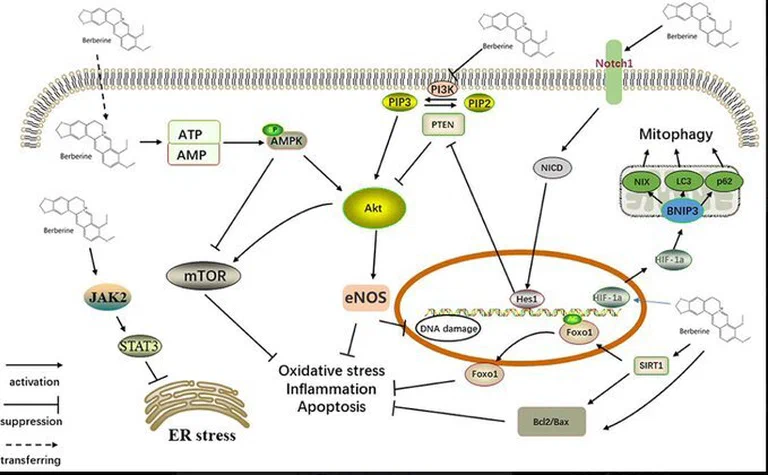
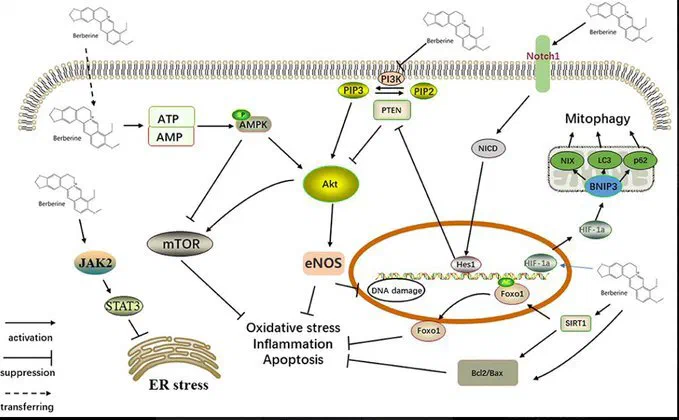
Berberine exerts cardioprotection through interconnected pathways that reduce oxidative stress, inflammation, endoplasmic reticulum (ER) stress, apoptosis, and mitochondrial dysfunction while enhancing autophagy and mitophagy:
AMPK Activation and Autophagy/Mitophagy: BBR boosts AMPK, which inhibits the Akt/mTOR pathway to promote autophagy. It also activates the HIF-1α/BNIP3 pathway for mitophagy, improving mitochondrial membrane potential and respiratory complex activity.
Anti-Inflammatory Effects: Suppresses PI3K/Akt signaling to lower proinflammatory cytokines (IL-6, IL-1β, TNF-α). Involves SIRT1/FOXO activation for broader anti-inflammatory and antioxidant benefits.
Anti-Apoptotic Pathways: Inhibits caspases (caspase-3, -9) and Apaf-1; activates Notch1 to upregulate NICD and Hes1; engages PTEN/Akt, eNOS phosphorylation, and SIRT1/FOXO to prevent cell death.
ER Stress and Oxidative Stress Reduction: Modulates JAK2/STAT3 to alleviate ER stress; reduces myeloperoxidase (MPO) activity, induces gp91phox and superoxide dismutase (SOD), and enhances catalase/MnSOD via SIRT1/FOXO.
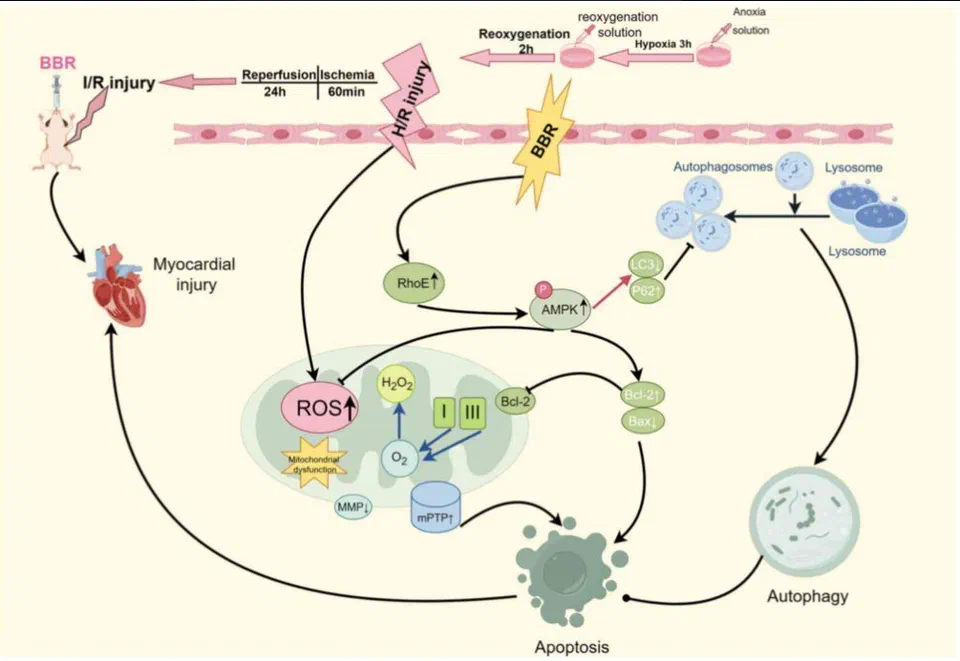
These mechanisms position berberine as a calorie-restriction mimetic, overlapping with metformin's roles in reducing inflammation and boosting autophagy for cardioprotection.
Study Limitations
While the preclinical evidence is compelling, important limitations exist:
- Geographic bias (all studies from China)
- Potential positive publication bias
- Lack of large animal models
- No comorbidity inclusion (e.g., diabetes, common in human I/R)
- Methodological flaws (poor blinding, randomization issues)
As the review notes: "However, this conclusion should be further investigated in clinical studies." (Wang et al., 2021)
Berberine vs. Metformin: A Calorie-Restriction Mimetic Comparison
Evidence Level: [CM/AN] – Mechanistic comparison studies CONFIDENCE: MODERATE for mechanistic parallels
Both berberine and metformin are well-known calorie-restriction mimetics that activate AMPK to confer metabolic benefits. Remarkably, berberine operates through strikingly similar mechanisms to metformin, making it a compelling natural alternative for potential cardioprotection and metabolic health.
Shared Mechanisms of Action
| Pathway | Berberine Effect | Metformin Effect | Therapeutic Implication |
|---|---|---|---|
| AMPK Activation | Direct activation via AMP/ATP ratio increase | Complex I inhibition → AMPK activation | Energy sensing, metabolic regulation |
| mTOR Inhibition | AMPK-dependent mTORC1 inhibition | AMPK-dependent mTORC1 inhibition | Autophagy induction, reduced protein synthesis |
| Autophagy Promotion | ↑ ATG proteins, Beclin-1 via AMPK | ↑ ATG proteins, Beclin-1 via AMPK | Cellular cleanup, mitochondrial quality |
| Inflammation Reduction | ↓ NLRP3, TNF-α, IL-6 via NF-κB | ↓ NLRP3, TNF-α, IL-6 via NF-κB | Anti-inflammatory effects |
| Oxidative Stress | ↓ NOX4, ↑ SOD/catalase | ↓ NOX4, ↑ SOD/catalase | Reduced ROS damage |
| Mitochondrial Protection | ↑ mitophagy via HIF-1α/BNIP3 | ↑ mitophagy via PINK1/Parkin | Removal of damaged mitochondria |
Key Differences and Advantages
Berberine Advantages:
- Natural sourcing: Plant-derived alkaloid from Berberis species
- Gut microbiome modulation: Exhibits prebiotic-like effects on beneficial gut bacteria
- Multi-target profile: Broader range of molecular targets beyond AMPK
- Lipid benefits: More pronounced effects on LDL and triglyceride reduction
Metformin Advantages:
- Extensive clinical data: Decades of human trials and safety data
- Standard of care: First-line treatment for type 2 diabetes
- Dosing: Well-established dosing protocols
- Cost: Generally less expensive as generic medication
Clinical Implications
The mechanistic parallels between berberine and metformin suggest that berberine could serve as:
- An alternative for patients intolerant to metformin
- An adjunct therapy to enhance metformin's effects
- A preventive supplement for at-risk individuals
- A cardioprotective agent in ischemic conditions
Both compounds activate the fundamental AMPK-mTOR-autophagy axis that underlies the beneficial effects of calorie restriction, supporting metabolic function, cardiovascular health, and healthy aging.
Enhancing Berberine Bioavailability: Fats and Piperine
Evidence Level: [AN] – Pharmacokinetic studies in animal models CONFIDENCE: HIGH for bioavailability enhancement, MODERATE for human translation
Berberine suffers from notoriously poor oral bioavailability typically less than 1% due to poor intestinal absorption, active efflux by P-glycoprotein (P-gp) transporters, and rapid first-pass metabolism in the liver and gut Chaudhri & Jain, 2023. Multiple physicochemical and formulation strategies have been investigated to overcome these limitations, including nanoparticle delivery, phospholipid complexes, and bioenhancer co-administration Imenshahidi & Hosseinzadeh, 2020. Strategies combining berberine with fats and piperine from black pepper can significantly improve uptake, drawing parallels to how these enhancers boost curcumin from turmeric.
Piperine as a Bioenhancer
Piperine, the active alkaloid in black pepper, acts as a potent bioavailability enhancer through multiple mechanisms:
P-gp Efflux Inhibition: Berberine is a known P-gp substrate. Piperine inhibits these efflux pumps, preventing berberine from being pumped back out of intestinal cells Bhardwaj et al., 2002.
CYP3A4 Enzyme Inhibition: Piperine inhibits cytochrome P450 3A4, the primary enzyme responsible for berberine metabolism, thereby reducing first-pass breakdown.
Enhanced Gut Permeability: Piperine alters intestinal membrane dynamics, improving paracellular and transcellular absorption Chaudhri & Jain, 2023.
Evidence for Berberine
Pharmacokinetic studies in rabbits demonstrate piperine's dramatic effect on berberine absorption:
| Bioenhancer | Cmax Increase | Study |
|---|---|---|
| Piperine | 626.53% | Narade & Pore, 2023 |
| Quercetin | 401.86% | Narade & Pore, 2023 |
| Curcumin | 168.60% | Narade & Pore, 2023 |
Piperine exhibited the strongest bioenhancing effect among tested compounds, with significant reduction in time to peak (Tmax) and extended overall exposure (AUC) (Narade & Pore, 2023).
Implementation: Pair berberine with 5-20 mg piperine per dose (from standardized black pepper extract like BioPerine, or approximately 1/4 teaspoon freshly ground black pepper). Many commercial supplements combine 500 mg berberine with 5-10 mg piperine.
Fats for Improved Absorption
While berberine is not as fat-soluble as curcumin, co-administration with dietary fats enhances absorption through:
Delayed Gastric Emptying: Fats slow stomach emptying, prolonging berberine's exposure time in the small intestine for uptake.
Micelle Formation: Dietary fats promote micelle formation. This aids in solubilizing berberine and transporting it across the intestinal epithelium.
Implementation: Take berberine with meals containing 5-10 g of healthy fats such as avocados, olive oil, nuts, seeds, or fatty fish. This approach also minimizes gastrointestinal discomfort, a common side effect when berberine is taken on an empty stomach.
Combined Strategy and Cautions
For optimal results, take berberine with a fatty meal seasoned with black pepper mirroring turmeric's "golden paste" approach. This dual strategy leverages synergistic effects: reduced efflux, slowed metabolism, and prolonged intestinal exposure.
Standard dosing: 500 mg berberine 2-3 times daily with meals. Bioenhancers may allow dose reduction while maintaining efficacy.
Cautions: Piperine inhibits drug-metabolizing enzymes and may increase blood levels of co-administered medications, including:
- Phenytoin (antiepileptic)
- Theophylline (asthma medication)
- Certain cardiovascular drugs
Consult a healthcare provider before combining berberine with prescription medications, especially those with narrow therapeutic windows (Pattanaik et al., 2006; Bedada et al., 2017).
Counter-Evidence & Limitations
Clinical Evidence Gaps:
- Cardiovascular meta-analysis based entirely on animal studies (270 rodents, all from China)
- No large-scale human trials for berberine in cardiovascular protection
- Cancer evidence primarily from cell and animal studies, limited human data
- Geographic bias in existing research (overrepresentation of Chinese studies)
- Potential publication bias favoring positive results
Safety and Contraindications:
- May interact with cytochrome P450 medications (piperine enhancement effect)
- Gastrointestinal side effects common when taken without food
- Not recommended during pregnancy or breastfeeding
- May lower blood glucose too much when combined with diabetes medications
- Limited long-term safety data beyond 6-12 months
Evidence Quality Issues:
- Many studies have small sample sizes (<50 participants)
- Heterogeneous dosing regimens across trials
- Limited standardization of berberine extracts
- Industry funding bias in some supplement industry studies
Evidence Summary Table
| Claim | Evidence Type | Confidence | Key Limitations |
|---|---|---|---|
| AMPK activation | [PR] Human trials | HIGH | Well-established mechanism |
| mTOR inhibition | [AN] Cell/animal | HIGH | Mechanistic consensus |
| Diabetes glucose control | [PR/PP] Meta-analyses | MODERATE | Variable HbA1c reduction |
| Cancer apoptosis | [AN] Preclinical | MODERATE (mechanism) | Limited human data |
| Cancer outcomes | [PP] Early trials | LOW | Insufficient evidence |
| Cardiovascular protection | [AN] Animal studies | MODERATE | No human RCTs |
| Bioavailability enhancement | [AN] PK studies | HIGH | Animal data only |
| Metformin comparison | [CM] Mechanistic | MODERATE | Indirect comparison |
Conclusion
Berberine's ability to modulate cellular pathways like AMPK, mTOR, and apoptotic signaling highlights its comprehensive therapeutic potential. By addressing the root causes of metabolic dysfunction in diabetes, disrupting tumor metabolism in cancer, and providing robust cardioprotection against ischemia/reperfusion injury, berberine serves as a powerful natural remedy deserving of further exploration.
As a calorie-restriction mimetic with mechanistic parallels to metformin, berberine offers unique advantages including its natural sourcing, gut microbiome modulation, and multi-target profile. While clinical trials are needed to fully translate the preclinical findings particularly in cardiovascular protection, the existing evidence positions berberine as a promising adjunct therapy for managing chronic diseases and promoting metabolic health.
The convergence of berberine's effects on inflammation, oxidative stress, autophagy, and mitochondrial function across multiple disease states underscores its potential as a versatile therapeutic compound in the emerging paradigm of metabolic and integrative medicine.