Table of Contents
Key Takeaways
- The EMA BWP position paper (EMA/CHMP/BWP/61303/2023, adopted 31 October 2023) committed in writing to two investigations with a planned completion of 1 December 2023: analytical characterisation of residual DNA covering fragment sizes, intact circular plasmid and SV40 sequences, and testing of bacterial transformation capability.
- One deliverable is now public: the sponsor's residual DNA characterisation report (INX100594280, data current to 29 February 2024), released by EMA. The transformation-capability testing, a batch-level dataset, any integration or insertional-mutagenicity assessment, and any reassessment following Achs et al. (2025) remain publicly unaccounted.
- The question set below is written to be filed, not to be read: each block names the authority, the record and the document class sought, and presumes no outcome.
TL;DR (1-minute read)
On 31 October 2023 the EMA's Biologics Working Party adopted a position paper on residual DNA in Comirnaty. It named two investigations with a planned completion date of 1 December 2023: analytical characterisation of residual DNA, including fragment-size distribution, intact circular plasmid and SV40 sequences; and testing of the residual DNA plasmid's replication capability in bacteria. The commitments are in writing, quoted verbatim below.
What has happened to them is only partly accounted for. The sponsor's residual DNA characterisation report (data current to 29 February 2024) has been released by EMA. The bacterial transformation testing, a batch-level dataset, the regulatory assessment of what was submitted, and any reassessment after the publication of Achs et al. (2025) are not in the public record.
This page is the action layer of the DNA contamination cluster: a set of questions, written to be filed with eight authorities, that converts the commitments into a documented public record. It presumes no outcome. Answers that support, qualify or contradict the independent observations are all scientifically informative.
The anchor: two investigations due 1 December 2023#
The BWP position on residual DNA in Comirnaty (EMA/CHMP/BWP/61303/2023, adopted 31 October 2023, released under access-to-documents request ASK-289849) states, verbatim:
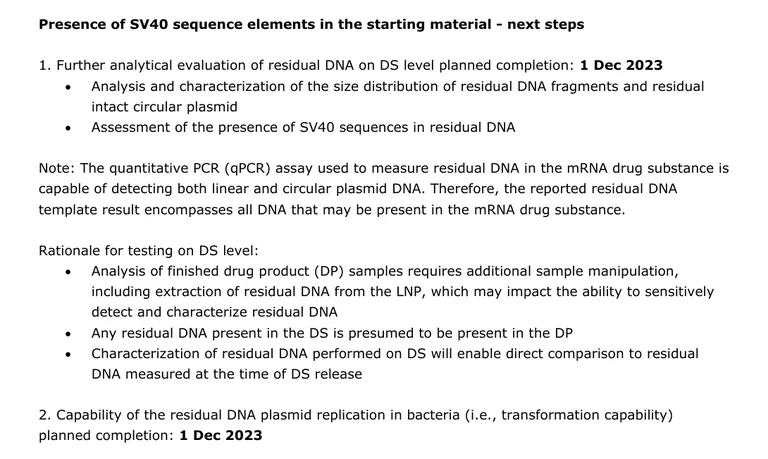
"1. Further analytical evaluation of residual DNA on DS level - planned completion: 1 Dec 2023. Analysis and characterization of the size distribution of residual DNA fragments and residual intact circular plasmid. Assessment of the presence of SV40 sequences in residual DNA."
"2. Capability of the residual DNA plasmid replication in bacteria (i.e., transformation capability) - planned completion: 1 Dec 2023."
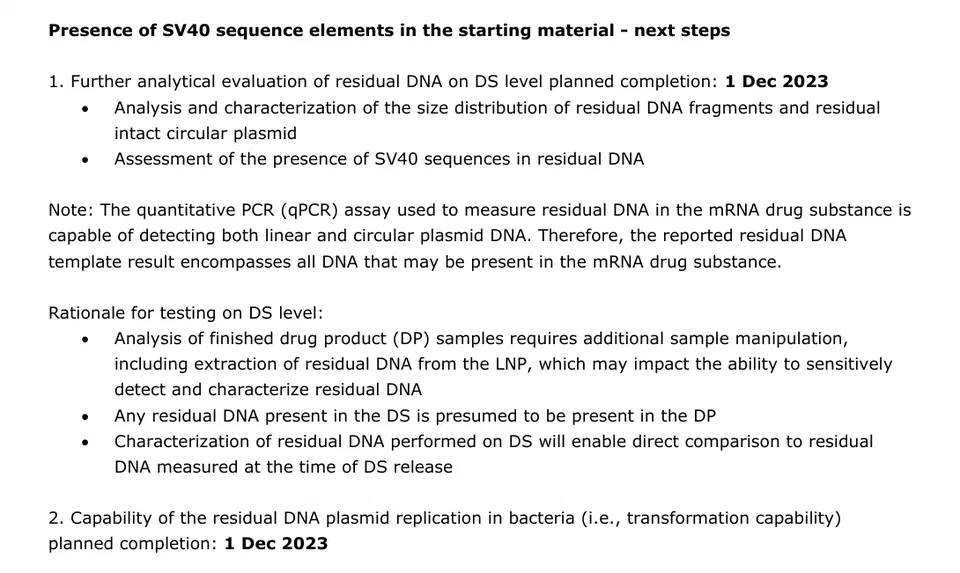
One citation detail before filing: the cover reference is EMA/CHMP/BWP/61303/2023, and footers on later pages of the same document carry the cross-reference EMA/CHMP/BWP/482571/2023. The crops on this page show the footer form.
The full document, its concessions and its page-cited quotations are documented on the plasmid map article. Two features matter for filing. First, the commitments are dated and specific, which makes "was this done, and where is the record" a legitimate access question rather than an opinion. Second, the two investigations are separate: characterisation (what DNA is there, in what form) and transformation capability (what the DNA can do). Conflating them is the most common way these questions get answered with something else.
How to use these questions#
- File for documents, not opinions. Several of the routes below (TGA, Health Canada, FDA) are freedom-of-information regimes: they release records, they do not answer scientific questions. The questions below are written as document specifications. Ask for "all records concerning X, including reports, protocols, assessments and correspondence", not for a position.
- One authority, one filing. The universal question adapts to any authority that oversees an equivalent programme. The numbered blocks are tuned per body, using the record that body already holds.
- Keep the identifiers. Document references (EMA/CHMP/BWP/61303/2023, INX100594280, EMA/555075/2023, Q-2670, FOI 5286) narrow the search and shorten the response. Delete them and the request widens, and widens again the estimated search time.
- Expect three kinds of answer. Records that support, qualify or contradict the independent observations are all informative. A regulator that holds nothing is also an answer, and in two of the blocks below it is precisely the answer being tested for.
The run-around, illustrated#
The questions below will not meet silence. They will meet patterns, and the patterns are already on the record in the documents the questions cite. Every image in this section is a crop from a source document named in Sources, altered only by cropping. Each subsection ends with the question numbers that defeat the pattern. Read it as a preview of the likely reply, not as an argument.
A deadline in writing, provisional in the minutes#

The position paper of 31 October 2023 committed both investigations to "planned completion: 1 Dec 2023". The BWP minutes of 4 to 6 December 2023 record what that came to mean: the MAH was to "provide provisional characterisation data and an interim risk assessment", that "Results from additional characterisation studies and the final risk assessment will be provided in January", on a timetable ending "RSI/Opinion by 25 Jan 2024".
None of this is concealed; the minutes state it plainly. The pattern is what follows: a dated commitment becomes a provisional December and a final January, and the January deliverables themselves were never published. The final risk assessment and the additional characterisation studies are what E10(a)-(c) and H8 request, and 25 January 2024 is the date window to cite in the search.
A conclusion that repeats its own missing data#
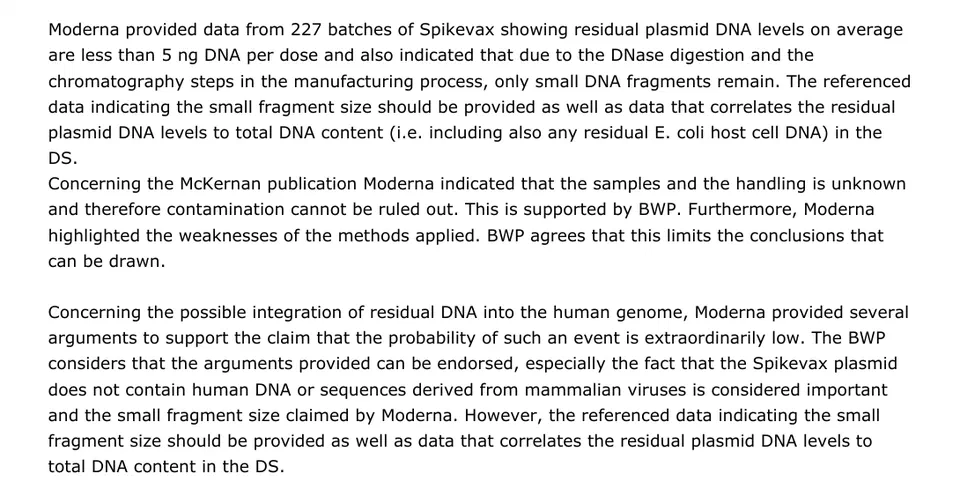

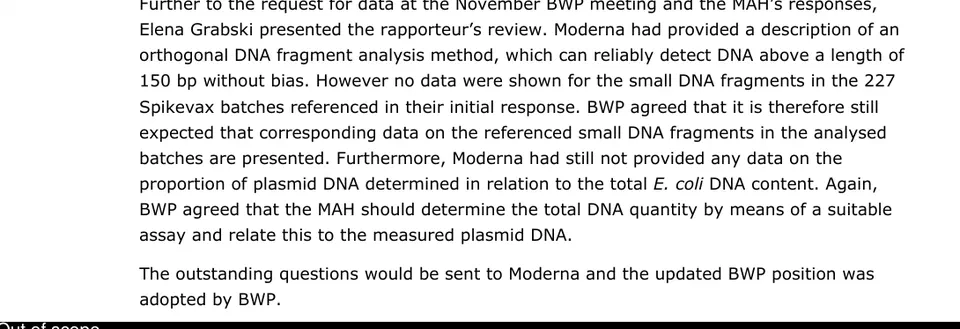
The Spikevax position paper concludes: "Moderna provided conclusive responses to the questions concerning the risk of residual DNA in Spikevax, which are considered acceptable. However, the referenced data indicating the small fragment size should be provided as well as data that correlates the residual plasmid DNA levels to total DNA content in the DS."
That request appears three times in the four-page document: twice on page 3, once in the conclusion on page 4. Twice it opens with "However". The December minutes confirm it was not drafting repetition: "no data were shown for the small DNA fragments in the 227 Spikevax batches", and "Moderna had still not provided any data on the proportion of plasmid DNA determined in relation to the total E. coli DNA content". A conclusion that calls responses acceptable while the data they rest on "should be provided" is a request still open in the document's own words. Filed as: U9, item 4, with any authority holding the Spikevax file (FDA, TGA, Health Canada).
Supplied, but never labelled#
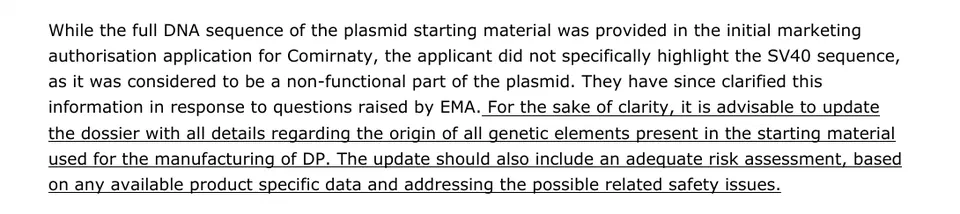
EMA's position paper records that "the applicant did not specifically highlight the SV40 sequence, as it was considered to be a non-functional part of the plasmid" in the original marketing authorisation application. The TGA's FOI 27-3438, released two years later, reaches the same finding in its answer 6: "Pfizer provided the sequence of the plasmid used. They did not specifically label the SV40 promoter sequence in the plasmid. The TGA identified the promoter through sequence alignment."
The reply this produces is "it was always in the dossier". That is true, and it is also the gap: the sequence was supplied, and no one reading the dossier was told it was there. The questions that move this are about who was told what, and when: E10(c) for the EMA assessment record, H9 for the parliamentary record of the recommendation to remove the elements, T5 for the TGA's alignment records.
Testing that "could also be considered"#

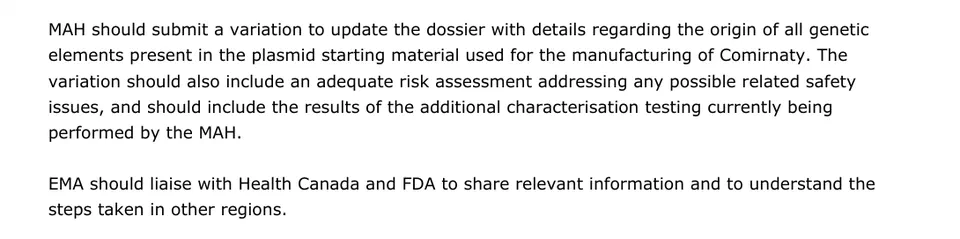
Both crops come from the closing pages of the same position paper. Confirmatory testing at finished product level, "carried out by OMCL to confirm the levels of residual DNA in commercial batches of Comirnaty", is something that "could also be considered". And "EMA should liaise with Health Canada and FDA to share relevant information and to understand the steps taken in other regions." No actor for the testing, no date for the liaison, no record of what the sharing produced. A filer who asks whether independent testing was done will be answered with this paragraph, which does not say. I5 puts the OMCL question where it can be answered, F4 and H8 ask each liaison party what it received, and U9 item 3 asks for the protocols.
"Not contaminated", qualified in another answer#
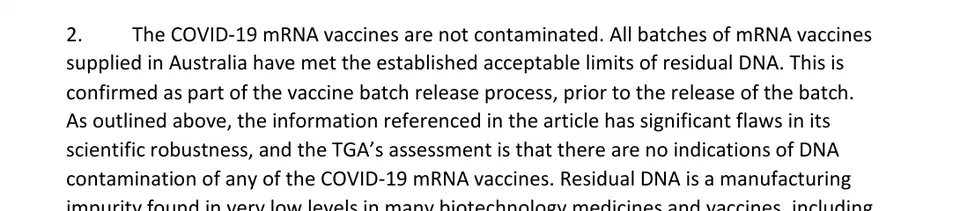
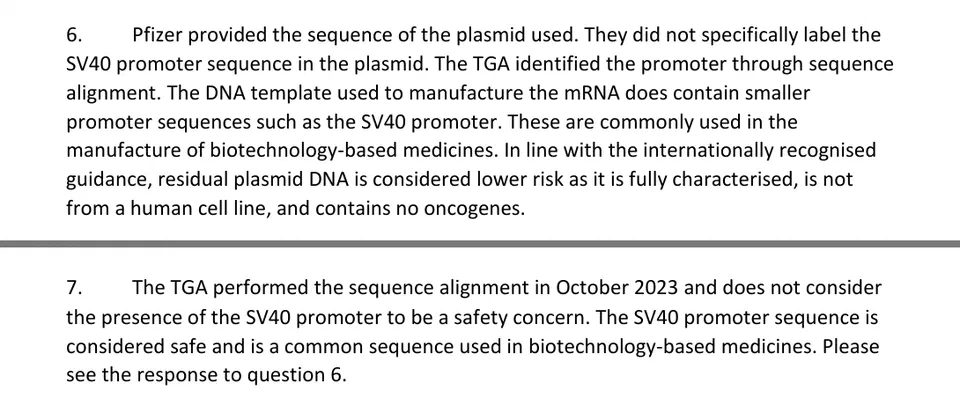
FOI 27-3438 answers a set of written questions put to the TGA. Answer 2 carries the headline: "The COVID-19 mRNA vaccines are not contaminated." Answers 6 and 7 of the same document carry the method: Pfizer supplied the plasmid sequence without labelling the SV40 promoter, the TGA identified it "through sequence alignment" performed "in October 2023", and the reassurance rests on residual plasmid DNA being "fully characterised", "not from a human cell line", and containing "no oncogenes".
The headline answer and the qualifying answers sit in different paragraphs of one release. A request that quotes only answer 2 will be answered with answer 2. The mass statement comes from batch-release qPCR; the sequence finding comes from the TGA's own alignment; neither is a fragment-size or transformation result. T5 asks for the laboratory records underneath both.
The report that answers half the programme#

What the deadline produced is partly public. EMA released the sponsor's characterisation report, INX100594280 for PF-07302048 (Comirnaty), covering batches manufactured from 2020 to 2023. Every page carries the stamp "Data up to date as of 29 February 2024", and the report carries an approval stamp of 25 January 2024, the date the minutes gave for the "RSI/Opinion".
Two features matter for filing. The report answers the first investigation, characterisation; the public record still contains no transformation-capability testing, the second investigation. And the data cut-off, 29 February 2024, precedes Achs et al. (2025), so the question of whether the conclusions survived that publication is open on the face of the record. E10(d) and E11 exist for exactly these two gaps.
One request's paper trail#
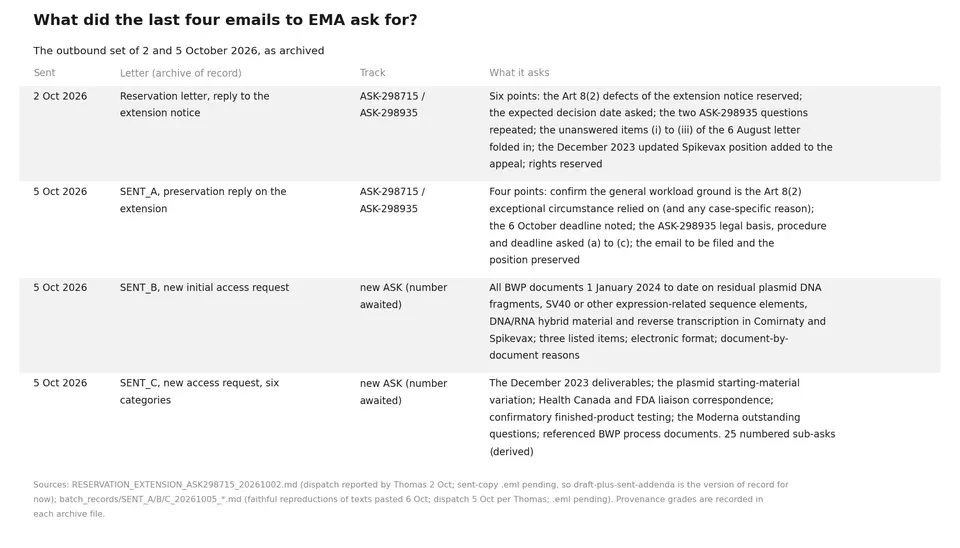
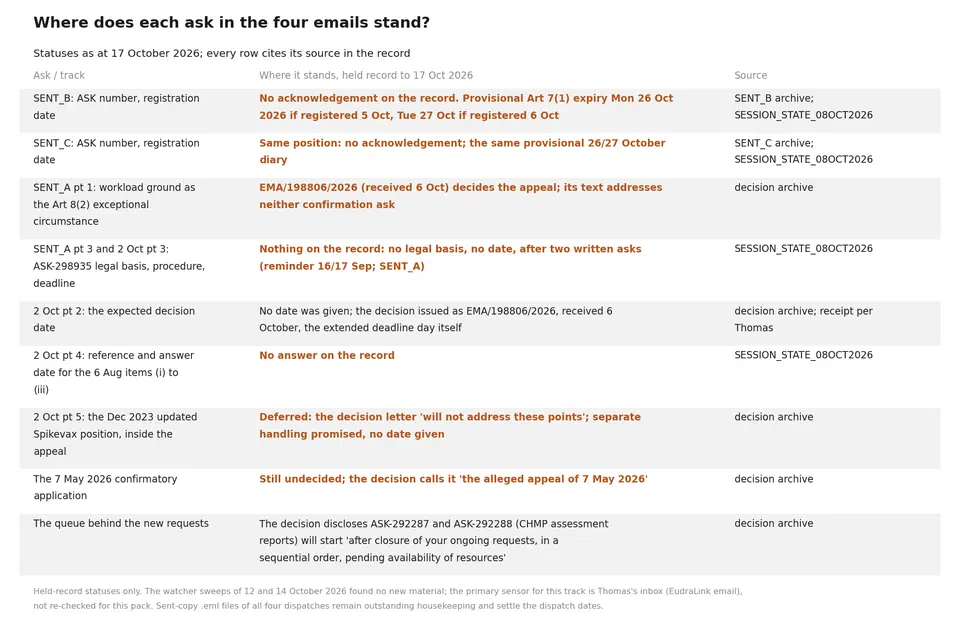
The last two figures are from the author's own proceeding. ASK-289849, one Regulation (EC) No 1049/2001 request, produced the position paper and the December 2023 minutes quoted on this page, through months of correspondence before a part-release, documented in the published reanalysis. The question set on this page is built so the next filer's ledger starts shorter: cite the released documents, ask for what they reference but do not contain. When the ledger stays open anyway, that is what C3 and G3 are for.
The universal question (U9)#
File this with any authority overseeing an equivalent programme.
The EMA Biologics Working Party's position paper on residual DNA in Comirnaty (EMA/CHMP/BWP/61303/2023, adopted 31 October 2023) identified two investigations with planned completion dates of 1 December 2023: analytical characterisation of residual DNA, including fragment sizes, intact circular plasmid and SV40 sequences; and assessment of bacterial transformation capability.
For any equivalent programme overseen by your authority, please identify:
- Whether each investigation was completed, postponed, modified or cancelled.
- Actual completion dates, and the samples and batches tested, distinguishing drug substance from finished product.
- The laboratory, analytical protocols and validation records.
- Raw measurements, controls, detection limits and final conclusions.
- Whether the conclusions were subsequently revisited following publication of Achs et al. (2025) or other sequencing evidence.
Please cite document references, registration numbers and dates for each item, and distinguish between the presence of plasmid-derived sequences, physical evidence of intact circular plasmids, experimentally demonstrated bacterial transformation capability, and any genomic-integration assessment.
EMA (E10, E11)#
Part of the December 2023 programme is now public. EMA has released the sponsor's residual DNA characterisation report for Comirnaty (INX100594280, PF-07302048, data current to 29 February 2024), and the December 2023 BWP minutes (EMA/555075/2023, item 3.2.1) were released under ASK-289849. What the public record still does not contain is a batch-level dataset, the transformation-capability testing, any integration or insertional-mutagenicity assessment, the study reports underlying the 2024 CHMP variation assessment, and any reconciliation with sequencing evidence published after the report's data cut-off.
E10. Completion of the October 2023 BWP investigation, and the assessment record
In relation to the two investigations planned for completion on 1 December 2023 under EMA/CHMP/BWP/61303/2023:
Please provide the final reports, submission dates, regulatory assessment records, batch identifiers and findings concerning:
(a) Residual DNA fragment-length distributions.
(b) The presence and quantity of intact circular plasmid DNA.
(c) Detection and characterisation of SV40-derived sequences.
(d) Experimental bacterial transformation and plasmid replication capability.
(e) Any assessment of genomic integration or insertional mutagenicity of the residual plasmid DNA, including any application of the integration assay published as a standard method for plasmid DNA vaccines (Ledwith et al., 2000), or the reasons no such assessment was performed.
For the released characterisation report (INX100594280, data current to 29 February 2024), please provide the assessment records, including the December 2023 BWP minutes (EMA/555075/2023, item 3.2.1), the 2024 CHMP variation assessment record and the study reports underlying it.
If any element of the planned work was not completed, provide the subsequent regulatory decisions and reasons.
E11. Reconciliation with published sequencing evidence
Has EMA assessed the independent reanalysis of Achs et al. (PRJNA1303864), including evidence of non-uniform plasmid-region coverage and the reported E. coli K-12 host-genome signal?
Did the 2023 analytical programme include a method capable of detecting bacterial host-genome DNA independently of plasmid-specific qPCR?
Please provide any relevant assessment and explain whether the 2023 results were considered representative of later manufacturing processes and variants.
The timing is the point of E11: the released report's data cut-off (29 February 2024) precedes Achs et al. (2025), so the question of whether the conclusions survived that publication is open on the face of the record.
Health Canada (H8, H9)#
H8. Unresolved questions from Parliamentary Question Q-2670
Parliamentary Question Q-2670 (44th Parliament, 1st Session), placed on the Order Paper by Dean Allison (Niagara West) on 2 May 2024 and answered on 19 June 2024, expressly requested information about Pfizer's December 2023 commitments concerning residual DNA fragment size, circular plasmid characterisation and bacterial replication capability, including whether Pfizer provided the requested characterisation of residual circular DNA plasmid.
The published government response did not separately disclose the requested analytical results.
For each investigation, did Health Canada receive a final report, on what date, and what conclusions were reached?
Please identify the precise documents relied upon in the response to Q-2670 and provide the releasable analytical findings.
H9. Subsequent independent evidence
Health Canada's position on removing the sequence elements is itself on the parliamentary record: Q-2665 quotes a 29 August 2023 email from a Health Canada official on working with international partners toward "harmonisation regarding removal of these sequence elements from the plasmid for future strain changes".
Has Health Canada reassessed the 2023 sponsor submissions against Achs et al. (2025), including the published raw sequencing data and subsequent independent analyses?
Were the size-distribution and bacterial transformation investigations repeated, supplemented or otherwise reviewed for later Comirnaty variants?
Please identify any corresponding assessment records and the disposition of Health Canada's recommendation to remove unnecessary plasmid elements.
FDA (F4)#
F4. The December 2023 investigations in the FDA record
Did FDA receive the results of the December 2023 investigations concerning DNA fragment size, intact circular plasmids and bacterial transformation capability?
If received, provide the submission dates, study reports and FDA review conclusions.
Were these investigations performed on drug substance, finished product, or both?
Has FDA evaluated whether existing plasmid-targeted residual-DNA assays adequately characterise bacterial host-genome DNA and heterogeneous plasmid fragments, including in light of the Achs et al. sequencing data?
TGA (T5)#
The TGA has published finished-product residual-DNA measurements for 28 batches (15 Comirnaty, 0.05-5.91 ng/dose; 13 Spikevax, 0.04-0.89 ng/dose), all reported below the 10 ng/dose benchmark, from single-target plasmid qPCR. The released Spikevax method (FOI 5286) names kanamycin resistance as its only target; no released document names the Comirnaty assay's target.
A second release, FOI 27-3438 (19 August 2026), contains the TGA's answers to a set of written questions about DNA contamination. Answers 6 and 7 record that Pfizer supplied the plasmid sequence without labelling the SV40 promoter, that the TGA identified it through its own sequence alignment in October 2023, and that residual plasmid DNA "is fully characterised, is not from a human cell line, and contains no oncogenes". The release contains no sequencing coverage data.
T5. Beyond mass measurement
Did this laboratory programme also investigate the physical integrity, fragment-size distribution or bacterial transformation capability of the residual DNA?
Were the results compared with the investigations planned by the EMA BWP for December 2023?
Please disclose any available analytical records, including whether the reported mass measurements distinguish fragmented plasmid DNA, intact circular plasmids and bacterial host-genome DNA.
Note for filing: the TGA's FOI process requires requests for documents rather than information; frame T5 as a request for all laboratory records, protocols and correspondence concerning the items above, not as questions the TGA is asked to answer in prose.
HPRA (I5)#
I5. The Irish record
Has HPRA received, requested or reviewed the results of the EMA BWP's December 2023 planned residual-DNA investigations?
Has HPRA, directly or through European regulatory or Official Medicines Control Laboratory arrangements, requested independent verification of intact circular plasmid DNA, fragment-size distributions, SV40-derived sequences or bacterial host-genome DNA in batches supplied to Ireland?
If no such investigation has occurred, please identify the regulatory assessment relied upon and whether the Achs et al. sequencing evidence has been referred for further evaluation.
WHO (W3)#
W3. The guidance basis
Does WHO's residual-DNA guidance distinguish between total residual DNA mass, the physical integrity of residual plasmid DNA, bacterial transformation capability and DNA associated with lipid nanoparticles?
What evidence supports applying the existing mass-based benchmark to products containing DNA populations with different fragment lengths and molecular forms?
Has WHO reviewed whether the 2023 regulatory requests for circular plasmid characterisation and transformation testing reveal a need for additional analytical guidance?
There is no external access-to-documents route to WHO comparable to the national regimes above; W3 is written correspondence to the Secretariat and the responsible expert committee.
The overseers (C3, G3)#
These two blocks do not ask a regulator about science. They ask an oversight body whether the record was searched and handled properly.
C3. Office of the Information Commissioner of Canada
In relation to access requests concerning the December 2023 sponsor commitments, were completed analytical reports, fragment-size datasets and bacterial transformation records individually identified and considered for disclosure?
Were any responsive records withheld as confidential commercial information, or were they absent from the records searched?
Please distinguish records not held, records withheld and records released with redactions. This question concerns the completeness and treatment of records, not the scientific merits of the underlying studies.
G3. European Ombudsman
In the handling of EMA access-to-documents requests concerning the October 2023 BWP position paper, did the Agency adequately identify and account for records arising from the two investigations scheduled for 1 December 2023?
Where the position paper identifies a planned deliverable but subsequent disclosures do not include its outcome, what steps are required to establish whether a responsive record was created, held, withheld or transferred?
This question concerns administrative transparency and the adequacy of the document search, not a request for the Ombudsman to determine scientific safety.
The author's own ASK-289849 proceeding, through which the BWP position paper and the December 2023 minutes were released, is documented on the plasmid map article and in the published reanalysis. It is the working example of G3's premise.
Where to send them#
| Authority | Route | File through |
|---|---|---|
| EMA | Regulation (EC) No 1049/2001 | Access-to-documents policy (EMA/613457/2010 Rev.1); send a request to EMA |
| Health Canada | Access to Information Act (5 dollar application fee) | Access to information and privacy, Health Canada |
| FDA | FOIA (5 U.S.C. 552), 20 working-day statutory response | Freedom of information; FOIA request form |
| TGA | Freedom of Information Act 1982 (Cth); documents, not questions | Freedom of information (FOI); FOI request form |
| HPRA | Freedom of Information Act 2014; publication scheme under s.8 | FOI section of the HPRA website, hpra.ie |
| WHO | Written correspondence | No external access-to-documents route; address the Secretariat or the responsible expert committee |
| Office of the Information Commissioner of Canada | ATIA complaint (60-day window; complainant must be the original requester) | Submit your complaint |
| European Ombudsman | Complaint under Article 228 TFEU | Complaint form |
Check the disclosure logs first (TGA and EMA both maintain them): part of what E10 asks for was released to one requester and published, and a narrower request citing the released documents is cheaper and faster than a broad one.
Scope and evidentiary limitation#
These questions do not presume that the investigations were never completed, that residual-DNA limits were exceeded, or that clinical harm occurred.
On genomic integration the record is not an absence of evidence. Integration of SV40 sequences into host-cell DNA has been documented in the cell-transformation literature since 1976, an integration assay for plasmid DNA vaccines was published as a standard method in 2000 (Ledwith et al., PMID 11713822), and today's residual-DNA limits were set on oncogenicity and infectivity grounds in 2009 (Sheng-Fowler et al., PMID 19285882). What the public record lacks is not evidence that integration occurs; it is any application of that assay framework to these products. E10(e) asks for that record. The full evidence chain is set out in the insertional-mutagenesis analysis.
The Achs sequencing evidence raises questions about sequence composition, coverage and fragment representation. It does not independently establish the transformation capability of recovered plasmid DNA.
The requested regulatory records may support, qualify or contradict the independent observations. All three outcomes would be scientifically informative.
What this page does not claim#
This page does not assert that any authority listed above failed, withheld, or erred. It asserts that a dated, written commitment exists; that part of its outcome is public and part is not; and that the balance can be converted into public record through ordinary access procedures. The distinction between those two claims is the difference between a question that gets answered and a question that gets dismissed.
Sources#
Exhibits on this page are cropped from these documents, altered only by cropping; the crop provenance (source file, page, anchor text) is logged in the author's working files.
- EMA/CHMP/BWP/61303/2023. BWP position on residual DNA in Comirnaty, adopted 31 October 2023. Released under access-to-documents request ASK-289849. Quotations, page cites and the concessions documented on the plasmid map article.
- Pfizer/BioNTech. Comirnaty: residual DNA characterization report, INX100594280 (PF-07302048), every page stamped "Data up to date as of 29 February 2024". Released by EMA: report PDF.
- EMA/555075/2023. December 2023 BWP minutes, item 3.2.1. Released under ASK-289849; available from EMA under Regulation (EC) No 1049/2001.
- EMA/481623/2023. BWP position on residual DNA in Spikevax. Released under access-to-documents request ASK-289849; crops on this page are from pages 3 and 4.
- Therapeutic Goods Administration. FOI 27-3438, released 19 August 2026, document 2: release PDF.
- EMA/CHMP/21199/2024. CHMP Type II variation assessment; a public copy is mirrored at ghr.agency.
- Therapeutic Goods Administration. Summary report of residual DNA and endotoxin on COVID-19 mRNA vaccines conducted by TGA Laboratories: public report.
- Ledwith BJ, Manam S, Troilo PJ, et al. Plasmid DNA vaccines: assay for integration into host genomic DNA. Dev Biol (Basel). 2000;104:33-43. PMID 11713822.
- Sheng-Fowler L, Lewis AM Jr, Peden K. Issues associated with residual cell-substrate DNA in viral vaccines. Biologicals. 2009 Jun;37(3):190-5. PMID 19285882.
- House of Commons of Canada. Written Question Q-2670 and Q-2665, 44th Parliament, 1st Session.
- Achs et al. Short-read sequencing of COVID-19 mRNA vaccines for DNA residual characterization. npj Vaccines 2025. DOI 10.1038/s41541-025-01304-9; public deposit PRJNA1303864.
- McKernan K, Speicher DJ, Rose J. Systematic methodological flaws in DNA contamination assessment of mRNA vaccines: a critical analysis of Achs et al. (2025). Oncotarget 2026;17:368-376. DOI 10.18632/oncotarget.28913.
- Emmett T. Residual DNA in Comirnaty and Spikevax: regulatory disclosure, measurement comparability and independent reanalysis. Preprint v2, 30 October 2026. Zenodo record 23815537; companion article on this site.
Further reading in the cluster: the investigation, the open-questions agenda, the policy case, and the cluster reading map.